Co-delivery of timolol and hyaluronic acid from semi-circular ring-implanted contact lenses for the treatment of glaucoma: in vitro and in vivo evaluation
Biomaterials ScienceBIOMATER SCI-UK Pub Date: 2018-04-16 DOI: 10.1039/C8BM00212F
Abstract
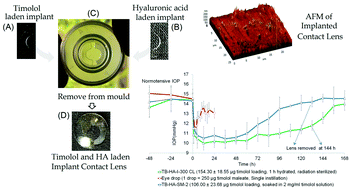
Glaucoma is a chronic disease, which is currently treated using frequent high dose applications of an eye drop solution; this method is tedious, and most of patients are non-compliant to it. Contact lenses are emerging as a convenient option to sustain the release of ophthalmic drugs. However, the incorporation of a drug/formulation changes the optical and physical properties of contact lenses. Contact lens users have also reported pink eye syndrome; this makes contact lenses unsuitable to be accepted as a medical device. The objective of the present study was to design novel timolol and hyaluronic acid (comfort agent)-loaded semi-circular ring-implanted contact lenses that could uphold the release at therapeutic rates without compromising the critical lens properties. The drug-loaded rings were individually implanted within the periphery of the contact lenses using modified cast-moulding technology. Atomic force microscopy showed an average roughness of 12.38 nm for the implanted lens that was significantly lower as compared to that of the Freshlook contact lenses (116.27 nm). A major amount of timolol was leached (from 46.47 to 58.79%) during the monomer extraction and moist sterilization (autoclave) steps; therefore, the lenses were sterilized by radiation and packaged under dry conditions (dehydrated). The in vitro release data showed sustained release of timolol and hyaluronic acid up to 96 h. The in vivo drug release study on rabbit eyes showed the presence of timolol in tear fluid up to 72 h. The in vivo pharmacodynamics studies showed a reduction in IOP till 144 h with a low drug loading (154 μg) as compared to the case of a single instillation eye drop solution (250 μg). This study has demonstrated the successful application of implantation technology to co-deliver timolol and hyaluronic acid from contact lenses for an extended period of time to treat glaucoma.
Recommended Literature
- [1] Emulsifier-free, organotellurium-mediated living radical emulsion polymerization (emulsion TERP) of styrene: poly(dimethylaminoethyl methacrylate) macro-TERP agent? Yukiya KitayamaPolym. Chem., 2014,5, 2784-2792 10.1039/C3PY01539D
- [2] Evolution of cellulose into flexible conductive green electronics: a smart strategy to fabricate sustainable electrodes for supercapacitors Tengfei Yu,Yuehan Wu,Wei Li,Bin LiRSC Adv., 2014,4, 34134-34143 10.1039/C4RA07017H
- [3] Essential effect of the electrolyte on the mechanical and chemical degradation of LiNi0.8Co0.15Al0.05O2 cathodes upon long-term cycling?? Xiaoming Liu,Zachary D. Hood,Wangda Li,Donovan N. Leonard,Arumugam Manthiram,Miaofang ChiJ. Mater. Chem. A, 2021,9, 2111-2119 10.1039/D0TA07814J
- [4] Evolution in surface coverage of CH3NH3PbI3?XClXvia heat assisted solvent vapour treatment and their effects on photovoltaic performance of devices Dhirendra K. Chaudhary,Pramendra Kumar,Lokendra KumarRSC Adv., 2016,6, 94731-94738 10.1039/C6RA18729C
- [5] Fast-Track to Research Data Management in Experimental Material Science-Setting the Ground for Research Group Level Materials Digitalization. LarsBanko,AlfredLudwig 10.1021/acscombsci.0c00057
- [6] Evidence of rutile-to-anatase photo-induced electron transfer in mixed-phase TiO2 by solid-state NMR spectroscopy? Weili Dai,Guangjun Wu,Michael HungerChem. Commun., 2015,51, 13779-13782 10.1039/C5CC04971G
- [7] Examination of ammonia–poly(pyrrole) interactions by piezoelectric and conductivity measurements Analyst, 1991,116, 1125-1130 10.1039/AN9911601125
- [8] Dissociative dynamics of O2 on Ag(110)? Ivor Lon?ari?Phys. Chem. Chem. Phys., 2015,17, 9436-9445 10.1039/C4CP05900J
- [9] Fate of single walled carbon nanotubes in wetland ecosystems? Joseph H. Bisesi,Tara Sabo-AttwoodEnviron. Sci.: Nano, 2014,1, 574-583 10.1039/C4EN00063C
- [10] Exciplex emission from the mixed dimer of naphthalene and 2-cyanonaphthalene in a supersonic jet Aloke Das,K. K. Mahato,Chayan K. Nandi,Tapas Chakraborty,Shridhar R. Gadre,Nikhil A. GokhalePhys. Chem. Chem. Phys., 2002,4, 2162-2168 10.1039/B200124C

Journal Name:Biomaterials ScienceBIOMATER SCI-UK
research_products
-

CAS no.: 89640-58-4

![1,2,3,4,5,6-Hexahydro-[2,3]bipyridinyl-6-ol](https://ossimg.kuujia.com/scimg/1271000/1270529-38-8x500.png)


![N-(3-cyanothiolan-3-yl)-2-[(2,2,2-trifluoroethyl)sulfanyl]pyridine-4-carboxamide](https://ossimg.kuujia.com/scimg/1444500/1444113-98-7x500.png)

![2,2-Difluoro-3-[methyl(2-methylbutyl)amino]propanoic acid](https://ossimg.kuujia.com/scimg/2138500/2138166-62-6x500.png)

![2-(1H-indol-3-yl)-N-{[6-(thiophen-2-yl)-[1,2,4]triazolo[4,3-b]pyridazin-3-yl]methyl}acetamide](https://ossimg.kuujia.com/scimg/2034500/2034271-14-0x500.png)