Chemistry and biological activities of hetisine-type diterpenoid alkaloids?
RSC Advances Pub Date: 2021-11-08 DOI: 10.1039/D1RA07173D
Abstract
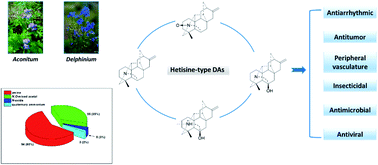
Hetisine-type C20-diterpenoid alkaloids (DAs) are one of the most important DA subtypes. During the past decades, a total of 157 hetisine-type DAs were obtained from plants from seven genera in three families, most of which were isolated from the genera Aconitum and Delphinium in the Ranunculaceae family. Structurally, hetisine-type DAs are characterized by a heptacyclic hetisane skeleton formed by the linkage of C(14)–C(20) and N–C(6) bonds in an atisine-type DA, and their structural diversity is created by the states of the N atom and various substituents. Pharmacological studies have revealed a wide range of pharmacological actions for hetisine-type DAs, including antiarrhythmic, antitumor, antimicrobial and insecticidal activities, as well as effects on peripheral vasculature, which are closely related to their chemical structures. In particular, the prominent antiarrhythmic effects and low toxicity of hetisine-type DAs highlight their potential in antiarrhythmic drug discovery. Hetisine-type DAs with diverse bioactivities are promising lead structures for further development as commercial agents in medicine.
Recommended Literature
- [1] An insight into the hybridization mechanism of hairpin DNA physically immobilized on chemically modified graphenes Adeline Huiling Loo,Alessandra Bonanni,Martin PumeraAnalyst, 2013,138, 467-471 10.1039/C2AN36199J
- [2] An amide probe as a selective Al3+ and Fe3+ sensor inside the HeLa and a549 cell lines: Pictet–Spengler reaction for the rapid detection of tryptophan amino acid? Bidyut Kumar Kundu,Rinky Singh,Ritudhwaj Tiwari,Debasis NayakNew J. Chem., 2019,43, 4867-4877 10.1039/C9NJ00138G
- [3] An intermolecular C–H oxidizing strategy to access highly fused carbazole skeletons from simple naphthylamines? Christian K. Rank,Alexander W. Jones,Tatjana Wall,Patrick Di Martino-Fumo,Sarah Schr?ck,Markus Gerhards,Frederic W. PatureauChem. Commun., 2019,55, 13749-13752 10.1039/C9CC05240B
- [4] Aggregation of biologically important peptides and proteins: inhibition or acceleration depending on protein and metal ion concentrations Benjamin Gabriel Poulson,Kacper Szczepski,Joanna Izabela Lachowicz,Lukasz Jaremko,Abdul-Hamid Emwas,Mariusz JaremkoRSC Adv., 2020,10, 215-227 10.1039/C9RA09350H
- [5] An analysis of the WTC fires using CIB correlations and simple modeling JGQuintiere 10.1177/0734904121989670
- [6] Aggregation-induced emission leading to two distinct emissive species in the solid-state structure of high-dipole organic chromophores? Felix Witte,Philipp Rietsch,Nithiya Nirmalananthan-Budau,Florian Weigert,Jan P. G?tze,Ute Resch-Genger,Siegfried Eigler,Beate PaulusPhys. Chem. Chem. Phys., 2021,23, 17521-17529 10.1039/D1CP02534A
- [7] An apparatus for determining small amounts of alchohol in sour milk and urine Analyst, 1964,89, 272-275 10.1039/AN9648900272
- [8] An approach to the structure and vibrational analysis of cis- and trans-3-chlorostyrene through IR/Raman and INS spectroscopies and theoretical ab initio/DFT calculations? J. M. Granadino-Roldán,M. Fernández-Gómez,A. Navarro,T. Pe?a Ruiz,U. A. JayasooriyaPhys. Chem. Chem. Phys., 2004,6, 1133-1143 10.1039/B314243D
- [9] An ion-exchange method for determining paraquat residues in food crops Analyst, 1965,90, 99-106 10.1039/AN9659000099
- [10] An approach towards the synthesis of novel fused nitrogen tricyclic heterocyclic scaffolds via GBB reaction? Sandip Gangadhar Balwe,Yeon Tae JeongOrg. Biomol. Chem., 2018,16, 1287-1296 10.1039/C7OB02933K

Journal Name:RSC Advances
research_products
-

CAS no.: 89640-58-4


![N-(3-cyanothiolan-3-yl)-2-[(2,2,2-trifluoroethyl)sulfanyl]pyridine-4-carboxamide](https://ossimg.kuujia.com/scimg/1444500/1444113-98-7x500.png)

![1,2,3,4,5,6-Hexahydro-[2,3]bipyridinyl-6-ol](https://ossimg.kuujia.com/scimg/1271000/1270529-38-8x500.png)

![2,2-Difluoro-3-[methyl(2-methylbutyl)amino]propanoic acid](https://ossimg.kuujia.com/scimg/2138500/2138166-62-6x500.png)

![2-(1H-indol-3-yl)-N-{[6-(thiophen-2-yl)-[1,2,4]triazolo[4,3-b]pyridazin-3-yl]methyl}acetamide](https://ossimg.kuujia.com/scimg/2034500/2034271-14-0x500.png)