A comparative study of redox-active, ambipolar electrochromic triphenylamine-based polyimides prepared by electrochemical polymerization and conventional polycondensation methods?
Polymer Chemistry Pub Date: 2017-12-05 DOI: 10.1039/C7PY01897E
Abstract
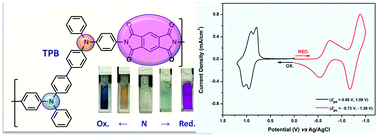
N,N′-Bis(4-diphenylaminophenyl)pyromellitimide (TPA-PMDI) was synthesized from the condensation reaction of 4-aminotriphenylamine with pyromellitic dianhydride (PMDA). The triphenylamine-diimide TPA-PMDI could be electrochemically polymerized into ambipolar, redox-active polyimide films on the electrode surface in an electrolyte solution via the coupling reactions between triphenylamine radical cations. The electro-generated polyimide films (coded as PI-E) exhibit reversible redox processes and stable color changes upon electro-oxidation, changing from a colorless neutral form to orange-yellowish and blue oxidized states. The film could also display pale green and pink cathodic coloring upon electro-reduction. Electrochromic devices using the electropolymerized film as an active layer were also fabricated as preliminary investigations for electrochromic applications. For a comparative study, a structurally similar polyimide (PI-C) was prepared by a conventional two-step condensation from N,N′-bis(4-aminophenyl)-N,N′-diphenyl-4,4′-biphenyldiamine with PMDA, and its spectroscopic, electrochemical and electrochromic properties were compared with those of the electro-synthesized PI-E.
Recommended Literature
- [1] An integrated chip for immunofluorescence and its application to analyze lysosomal storage disorders Jie Shen,Ying Zhou,Tu Lu,Junya Peng,Zhixiang Lin,Yuhong Pang,Li YuLab Chip, 2012,12, 317-324 10.1039/C1LC20845D
- [2] An air-stable organometallic polymer containing titanafluorene moieties obtained by the Sonogashira–Hagihara cross-coupling polycondensation? Alvin Tanudjaja,Shinsuke Inagi,Fusao Kitamura,Toshikazu Takata,Ikuyoshi TomitaDalton Trans., 2021,50, 3037-3043 10.1039/D0DT03663C
- [3] An alumina stabilized graphene oxide wrapped SnO2 hollow sphere LIB anode with improved lithium storage? Xiang Liu,Qian Sun,A. B. Djuri?i?,Maohai Xie,Baohu Dai,Jinyao Tang,Charles Surya,Changzhong Liao,Kaimin ShihRSC Adv., 2015,5, 100783-100789 10.1039/C5RA22482A
- [4] An amino group functionalized metal–organic framework as a luminescent probe for highly selective sensing of Fe3+ ions? Zhonghua Xiang,Chuanqi Fang,Sanhua Leng,Dapeng CaoJ. Mater. Chem. A, 2014,2, 7662-7665 10.1039/C4TA00313F
- [5] An atlas of endohedral Sc2S cluster fullerenes? Li-Hua Gan,Rui Wu,Jian-Lei Tian,Patrick W. FowlerPhys. Chem. Chem. Phys., 2017,19, 419-425 10.1039/C6CP07370K
- [6] An antioxidant self-healing hydrogel for 3D cell cultures? Lei Yang,Yuan Zeng,Haibo Wu,Chunwu Zhou,Lei TaoJ. Mater. Chem. B, 2020,8, 1383-1388 10.1039/C9TB02792K
- [7] An asymmetric supercapacitor based on controllable WO3 nanorod bundle and alfalfa-derived porous carbon? Kanjun Sun,Fengting Hua,Shuzhen Cui,Yanrong Zhu,Hui Peng,Guofu MaRSC Adv., 2021,11, 37631-37642 10.1039/D1RA04788D
- [8] An insight into the hybridization mechanism of hairpin DNA physically immobilized on chemically modified graphenes Adeline Huiling Loo,Alessandra Bonanni,Martin PumeraAnalyst, 2013,138, 467-471 10.1039/C2AN36199J
- [9] An intensified π-hole in beryllium-doped boron nitride meshes: its determinant role in CO2 conversion into hydrocarbon fuels? Luis Miguel Azofra,Douglas R. MacFarlane,Chenghua SunChem. Commun., 2016,52, 3548-3551 10.1039/C5CC07942J
- [10] Acetyl group orientation modulates the electronic ground-state asymmetry of the special pair in purple bacterial reaction centers P. K. Wawrzyniak,M. T. P. Beerepoot,H. J. M. de Groot,F. BudaPhys. Chem. Chem. Phys., 2011,13, 10270-10279 10.1039/C1CP20213H

Journal Name:Polymer Chemistry
research_products
-

CAS no.: 89640-58-4


![N-(3-cyanothiolan-3-yl)-2-[(2,2,2-trifluoroethyl)sulfanyl]pyridine-4-carboxamide](https://ossimg.kuujia.com/scimg/1444500/1444113-98-7x500.png)

![1,2,3,4,5,6-Hexahydro-[2,3]bipyridinyl-6-ol](https://ossimg.kuujia.com/scimg/1271000/1270529-38-8x500.png)

![2,2-Difluoro-3-[methyl(2-methylbutyl)amino]propanoic acid](https://ossimg.kuujia.com/scimg/2138500/2138166-62-6x500.png)

![2-(1H-indol-3-yl)-N-{[6-(thiophen-2-yl)-[1,2,4]triazolo[4,3-b]pyridazin-3-yl]methyl}acetamide](https://ossimg.kuujia.com/scimg/2034500/2034271-14-0x500.png)