Biodegradable phenylboronic acid-modified ε-polylysine for glucose-responsive insulin delivery via transdermal microneedles?
Journal of Materials Chemistry B Pub Date: 2021-07-13 DOI: 10.1039/D1TB00880C
Abstract
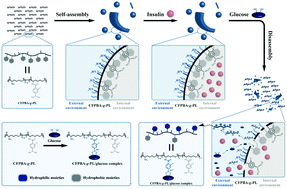
Microneedles with insulin-loaded glucose-responsive particles are promising to control the blood glucose levels of diabetic patients. In particular, the long-term usage of these microneedles calls for biodegradable and cost-effective particles, which are still large challenges. In this paper, glucose-responsive 4-carboxy-3-fluorophenylboronic acid-grafted ε-polylysine (CFPBA-g-PL) was synthesized to meet these requirements. CFPBA-g-PL had low cytotoxicity, good hemocompatibility and no tissue reaction. The pharmacokinetics of CFPBA-g-PL were also studied. The self-assembled particles of CFPBA-g-PL were prepared via simple ultrasonic treatment. The insulin-loaded particles of CFPBA-g-PL (named INS/GRP-12.8) presented a glucose-responsive insulin delivery performance based on the disassembly-related mechanism in vitro. The INS/GRP-12.8-encapsulated microneedle patch with a uniform morphology and moderate skin penetration performance was prepared via a molding strategy. INS/GRP-12.8 lasted for more than 8 hours of normoglycemia on STZ-induced diabetic SD rats via subcutaneous injection and the INS/GRP-12.8-encapsulated microneedle patch also showed a blood-glucose-level-lowering performance in vivo via transdermal administration.
Recommended Literature
- [1] Exciting clusters, what does off-resonance actually mean?? Goonay Yousefalizadeh,Shideh Ahmadi,Nicholas J. Mosey,Kevin G. StamplecoskieNanoscale, 2021,13, 242-252 10.1039/D0NR06493A
- [2] Evolution of shape, size, and areal density of a single plane of Si nanocrystals embedded in SiO2 matrix studied by atom probe tomography Bin Han,Yasuo Shimizu,Gabriele Seguini,Celia Castro,Gérard Ben Assayag,Koji Inoue,Yasuyoshi Nagai,Sylvie Schamm-Chardon,Michele PeregoRSC Adv., 2016,6, 3617-3622 10.1039/C5RA26710B
- [3] Excellent peroxidase mimicking property of CuO/Pt nanocomposites and their application as an ascorbic acid sensor? Xinhuan Wang,Shuangfei Cai,Cui QiAnalyst, 2017,142, 2500-2506 10.1039/C7AN00589J
- [4] Establishing plasmon contribution to chemical reactions: alkoxyamines as a thermal probe? Olga Guselnikova,Gérard Audran,Jean-Patrick Joly,Andrii Trelin,Evgeny V. Tretyakov,Vaclav Svorcik,Oleksiy Lyutakov,Sylvain R. A. MarqueChem. Sci., 2021,12, 4154-4161 10.1039/D0SC06470J
- [5] Excellent mechanical performance and enhanced dielectric properties of OBC/SiO2 elastomeric nanocomposites: effect of dispersion of the SiO2 nanoparticles? Xing Zhao,Lu Bai,Rui-Ying Bao,Zheng-Ying Liu,Ming-Bo Yang,Wei YangRSC Adv., 2017,7, 46297-46305 10.1039/C7RA08074C
- [6] Enantiomeric two-fold interpenetrated 3D zinc(ii) coordination networks as a catalytic platform: significant difference between water within the cage and trace water in transesterification? Eunkyung Choi,Minjoo Ryu,Haeri Lee,Ok-Sang JungDalton Trans., 2017,46, 4595-4601 10.1039/C7DT00217C
- [7] Emerging investigator series: kinetics of diopside reactivity for carbon mineralization in mafic–ultramafic rocks BrianaAguila,LandonHardee,H.ToddSchaef,SiavashZare,MohammadJavadAbdolhosseiniQomi,JarrodV.Crum,JadeE.HollimanJr.,ElenaTajueloRodriguez,LawrenceM.Anovitz,KevinM.Rosso,QuinR.S.Miller 10.1039/d3en00087g
- [8] Dissociation of large gaseous serine clusters produces abundant protonated serine octamer Jacob S. Jordan,Evan R. WilliamsAnalyst, 2021,146, 2617-2625 10.1039/D1AN00273B
- [9] EWOD-driven droplet microfluidic device integrated with optoelectronic tweezers as an automated platform for cellular isolation and analysis? Gaurav J. Shah,Eric P.-Y. Chiou,Ming C. Wu,Chang-Jin “CJ” KimLab Chip, 2009,9, 1732-1739 10.1039/B821508A
- [10] Fatty acid eutectic mixtures and derivatives from non-edible animal fat as phase change materials? Pau Gallart-Sirvent,Marc Martín,Gemma Villorbina,Mercè Balcells,Aran Solé,Luisa F. Cabeza,Ramon Canela-GarayoaRSC Adv., 2017,7, 24133-24139 10.1039/C7RA03845C
Journal Name:Journal of Materials Chemistry B
research_products
-

CAS no.: 89640-58-4

![1,2,3,4,5,6-Hexahydro-[2,3]bipyridinyl-6-ol](https://ossimg.kuujia.com/scimg/1271000/1270529-38-8x500.png)


![N-(3-cyanothiolan-3-yl)-2-[(2,2,2-trifluoroethyl)sulfanyl]pyridine-4-carboxamide](https://ossimg.kuujia.com/scimg/1444500/1444113-98-7x500.png)

![2,2-Difluoro-3-[methyl(2-methylbutyl)amino]propanoic acid](https://ossimg.kuujia.com/scimg/2138500/2138166-62-6x500.png)

![2-(1H-indol-3-yl)-N-{[6-(thiophen-2-yl)-[1,2,4]triazolo[4,3-b]pyridazin-3-yl]methyl}acetamide](https://ossimg.kuujia.com/scimg/2034500/2034271-14-0x500.png)