A cobalt phosphide catalyst for the hydrogenation of nitriles?
Chemical Science Pub Date: 2020-06-09 DOI: 10.1039/D0SC00247J
Abstract
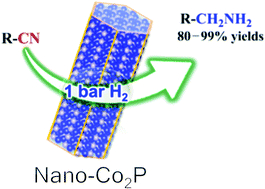
The study of metal phosphide catalysts for organic synthesis is rare. We present, for the first time, a well-defined nano-cobalt phosphide (nano-Co2P) that can serve as a new class of catalysts for the hydrogenation of nitriles to primary amines. While earth-abundant metal catalysts for nitrile hydrogenation generally suffer from air-instability (pyrophoricity), low activity and the need for harsh reaction conditions, nano-Co2P shows both air-stability and remarkably high activity for the hydrogenation of valeronitrile with an excellent turnover number exceeding 58000, which is over 20- to 500-fold greater than that of those previously reported. Moreover, nano-Co2P efficiently promotes the hydrogenation of a wide range of nitriles, which include di- and tetra-nitriles, to the corresponding primary amines even under just 1 bar of H2 pressure, far milder than the conventional reaction conditions. Detailed spectroscopic studies reveal that the high performance of nano-Co2P is attributed to its air-stable metallic nature and the increase of the d-electron density of Co near the Fermi level by the phosphidation of Co, which thus leads to the accelerated activation of both nitrile and H2. Such a phosphidation provides a promising method for the design of an advanced catalyst with high activity and stability in highly efficient and environmentally benign hydrogenations.
Recommended Literature
- [1] Aggregation dynamics, structure, and mechanical properties of bigels L. Di Michele,D. Fiocco,F. Varrato,E. Eiser,G. FoffiSoft Matter, 2014,10, 3633-3648 10.1039/C3SM52558A
- [2] An artificial photosynthesis system comprising a covalent triazine framework as an electron relay facilitator for photochemical carbon dioxide reduction? Siquan Zhang,Shengyao Wang,Liping Guo,Hao Chen,Bien Tan,Shangbin JinJ. Mater. Chem. C, 2020,8, 192-200 10.1039/C9TC05297F
- [3] Acetyl protected thiol methacrylic polymers as effective ligands to keep quantum dots in luminescent standby mode? Marta Liras,Isabel Quijada-Garrido,Marta Palacios-Cuesta,Sonia Mu?oz-Durieux,Olga GarcíaPolym. Chem., 2014,5, 433-442 10.1039/C3PY00987D
- [4] An insight into the role of side chains in the microstructure and carrier mobility of high-performance conjugated polymers? Jianyao Huang,Dong Gao,Zhihui Chen,Weifeng ZhangPolym. Chem., 2021,12, 2471-2480 10.1039/D1PY00105A
- [5] An analysis of the WTC fires using CIB correlations and simple modeling JGQuintiere 10.1177/0734904121989670
- [6] An anti-leakage liquid metal thermal interface material Kaiyuan Huang,Wangkang Qiu,Meilian Ou,Xiaorui Liu,Zenan Liao,Sheng ChuRSC Adv., 2020,10, 18824-18829 10.1039/D0RA02351E
- [7] An arsenic trioxide nanoparticle prodrug (ATONP) potentiates a therapeutic effect on an aggressive hepatocellular carcinoma model via enhancement of intratumoral arsenic accumulation and disturbance of the tumor microenvironment? Xin Fu,Qing-rong Liang,Rong-guang Luo,Yan-shu Li,Xiao-ping Xiao,Lu-lu Yu,Wen-zhe Shan,Guang-qin FanJ. Mater. Chem. B, 2019,7, 3088-3099 10.1039/C9TB00349E
- [8] An aptasensor for the detection of ampicillin in milk using a personal glucose meter Xixi Li,Nanwei Zhu,Ruohan Li,Qinpu ZhangAnal. Methods, 2020,12, 3376-3381 10.1039/D0AY00256A
- [9] An artificial CO-releasing metalloprotein built by histidine-selective metallation? Inês S. Albuquerque,Hélia F. Jeremias,Miguel Chaves-Ferreira,Dijana Matak-Vinkovic,Omar Boutureira,Carlos C. Rom?oChem. Commun., 2015,51, 3993-3996 10.1039/C4CC10204E
- [10] An investigation on the second-order nonlinear optical response of cationic bipyridine or phenanthroline iridium(iii) complexes bearing cyclometallated 2-phenylpyridines with a triphenylamine substituent? David B. Cordes,Alexandra M. Z. Slawin,Stefania Righetto,Denis Jacquemin,Eli Zysman-Colman,Véronique GuerchaisDalton Trans., 2018,47, 8292-8300 10.1039/C8DT00754C

Journal Name:Chemical Science
research_products
-

CAS no.: 89640-58-4

![1,2,3,4,5,6-Hexahydro-[2,3]bipyridinyl-6-ol](https://ossimg.kuujia.com/scimg/1271000/1270529-38-8x500.png)


![N-(3-cyanothiolan-3-yl)-2-[(2,2,2-trifluoroethyl)sulfanyl]pyridine-4-carboxamide](https://ossimg.kuujia.com/scimg/1444500/1444113-98-7x500.png)

![2,2-Difluoro-3-[methyl(2-methylbutyl)amino]propanoic acid](https://ossimg.kuujia.com/scimg/2138500/2138166-62-6x500.png)

![2-(1H-indol-3-yl)-N-{[6-(thiophen-2-yl)-[1,2,4]triazolo[4,3-b]pyridazin-3-yl]methyl}acetamide](https://ossimg.kuujia.com/scimg/2034500/2034271-14-0x500.png)