Live-cell fluorescence imaging: assessment of thioflavin T uptake in human epidermal carcinoma cells
MedChemComm Pub Date: 2018-04-20 DOI: 10.1039/C8MD00101D
Abstract
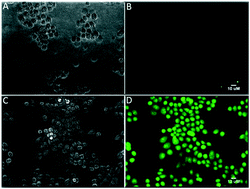
Thioflavin T (ThT), a positively charged heterocyclic small molecule, is a widely used fluorescent marker of amyloid pathophysiology to confirm the cause of death in post mortem brain tissue of Alzheimer's disease (AD) patients. Literature precedents indicate that current positron emission tomography (PET) agents, such as 11C-PIB and 18F-flutemetamol, share significant structural similarity with ThT, a lipophilic dye which does not traverse the blood–brain barrier (BBB) to enable the detection of Aβ plaques in vivo. While vital for maintaining normal physiology and healthy brain function, the BBB comprises brain endothelial cells sealed via paracellular protein complexes, bound by an extracellular matrix forming tight junctions thus controlling the delivery of molecules into the brain. The human P-glycoprotein (Pgp/ABCB1, 170 kD plasma membrane protein), belonging to the ABC family of efflux transporter proteins, also lines the luminal surface of brain endothelial cells thus poised to secrete its recognized substrates into the blood. Herein, we postulate that thioflavin T (ThT), due to its physico-chemical attributes, such as moderate lipophilicity and protonated nitrogen, could very well be recognized as a transport substrate of Pgp (P-glycoprotein, ABCB1) thus restricting its permeation into the brain. To evaluate whether or not ThT is indeed recognized by Pgp as its transport substrate thus limiting its BBB permeability, herein, we evaluate cellular accumulation profiles of ThT and PiB (a similar structural uncharged mimetic) in human epidermal carcinoma KB-3-1 (Pgp?) and MDR KB-8-5 (Pgp+) cells, using live-cell fluorescence imaging. While ThT penetrates KB-3-1 cells, it gets excluded from KB-8-5 cells, and also indicates LY335979-induced uptake in Pgp-expressing cells. Furthermore, the cellular uptake profiles of PiB are not impacted by the expression of Pgp under identical conditions. These data show that uptake profiles of ThT have been modified by the expression of Pgp in these cells, and are inversely proportional to the expression of the transporter protein located on the plasma membrane of these cells. Combined data demonstrate that ThT is efficiently recognized by Pgp as its transport substrate.
Recommended Literature
- [1] An intensified π-hole in beryllium-doped boron nitride meshes: its determinant role in CO2 conversion into hydrocarbon fuels? Luis Miguel Azofra,Douglas R. MacFarlane,Chenghua SunChem. Commun., 2016,52, 3548-3551 10.1039/C5CC07942J
- [2] An alumina stabilized graphene oxide wrapped SnO2 hollow sphere LIB anode with improved lithium storage? Xiang Liu,Qian Sun,A. B. Djuri?i?,Maohai Xie,Baohu Dai,Jinyao Tang,Charles Surya,Changzhong Liao,Kaimin ShihRSC Adv., 2015,5, 100783-100789 10.1039/C5RA22482A
- [3] An aptasensor for the detection of ampicillin in milk using a personal glucose meter Xixi Li,Nanwei Zhu,Ruohan Li,Qinpu ZhangAnal. Methods, 2020,12, 3376-3381 10.1039/D0AY00256A
- [4] An alternative biorefinery approach to address microalgal seasonality: blending with spent coffee grounds Andre Prates Pereira,Tao Dong,Eric P. Knoshaug,Nick Nagle,Ryan Spiller,Bonnie Panczak,Christopher J. Chuck,Philip T. PienkosSustainable Energy Fuels, 2020,4, 3400-3408 10.1039/D0SE00164C
- [5] An artificial photosynthesis system comprising a covalent triazine framework as an electron relay facilitator for photochemical carbon dioxide reduction? Siquan Zhang,Shengyao Wang,Liping Guo,Hao Chen,Bien Tan,Shangbin JinJ. Mater. Chem. C, 2020,8, 192-200 10.1039/C9TC05297F
- [6] An Aptamer Bio-barCode (ABC) assay using SPR, RNase H, and probes with RNA and gold-nanorods for anti-cancer drug screening Chengbin Yang,Hing Lun Tsang,Pui Man Lau,Ken-Tye Yong,Ho Pui Ho,Siu Kai KongAnalyst, 2017,142, 3579-3587 10.1039/C7AN01026E
- [7] An integrated cathode and solid electrolyte via in situ polymerization with significantly reduced interface resistance? Jialiang Yuan,Ran Dong,Yuan Li,Yang Liu,Zhuo Zheng,Yuxia Liu,Yan Sun,Benhe Zhong,Zhenguo Wu,Xiaodong GuoChem. Commun., 2021,57, 13004-13007 10.1039/D1CC04485K
- [8] An algal process treatment combined with the Fenton reaction for high concentrations of amoxicillin and cefradine Haitao Li,Yu Pan,Zhizhi Wang,Shan Chen,Ruixin Guo,Jianqiu ChenRSC Adv., 2015,5, 100775-100782 10.1039/C5RA21508K
- [9] An insight into the role of side chains in the microstructure and carrier mobility of high-performance conjugated polymers? Jianyao Huang,Dong Gao,Zhihui Chen,Weifeng ZhangPolym. Chem., 2021,12, 2471-2480 10.1039/D1PY00105A
- [10] An amino group functionalized metal–organic framework as a luminescent probe for highly selective sensing of Fe3+ ions? Zhonghua Xiang,Chuanqi Fang,Sanhua Leng,Dapeng CaoJ. Mater. Chem. A, 2014,2, 7662-7665 10.1039/C4TA00313F

Journal Name:MedChemComm
research_products
-

CAS no.: 89640-58-4


![N-(3-cyanothiolan-3-yl)-2-[(2,2,2-trifluoroethyl)sulfanyl]pyridine-4-carboxamide](https://ossimg.kuujia.com/scimg/1444500/1444113-98-7x500.png)

![1,2,3,4,5,6-Hexahydro-[2,3]bipyridinyl-6-ol](https://ossimg.kuujia.com/scimg/1271000/1270529-38-8x500.png)

![2,2-Difluoro-3-[methyl(2-methylbutyl)amino]propanoic acid](https://ossimg.kuujia.com/scimg/2138500/2138166-62-6x500.png)

![2-(1H-indol-3-yl)-N-{[6-(thiophen-2-yl)-[1,2,4]triazolo[4,3-b]pyridazin-3-yl]methyl}acetamide](https://ossimg.kuujia.com/scimg/2034500/2034271-14-0x500.png)