Paracetamol metabolism, hepatotoxicity, biomarkers and therapeutic interventions: a perspective??
Toxicology Research Pub Date: 2018-03-06 DOI: 10.1039/C7TX00340D
Abstract
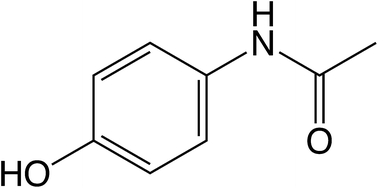
After over 60 years of therapeutic use in the UK, paracetamol (acetaminophen, N-acetyl-p-aminophenol, APAP) remains the subject of considerable research into both its mode of action and toxicity. The pharmacological properties of APAP are the focus of some activity, with the role of the metabolite N-arachidonoylaminophenol (AM404) still a topic of debate. However, that the hepatotoxicity of APAP results from the production of the reactive metabolite N-acetyl-p-benzoquinoneimine (NAPQI/NABQI) that can deplete glutathione, react with cellular macromolecules, and initiate cell death, is now beyond dispute. The disruption of cellular pathways that results from the production of NAPQI provides a source of potential biomarkers of the severity of the damage. Research in this area has provided new diagnostic markers such as the microRNA miR-122 as well as mechanistic biomarkers associated with apoptosis, mitochondrial dysfunction, inflammation and tissue regeneration. Additionally, biomarkers of, and systems biology models for, glutathione depletion have been developed. Furthermore, there have been significant advances in determining the role of both the innate immune system and genetic factors that might predispose individuals to APAP-mediated toxicity. This perspective highlights some of the progress in current APAP-related research.
Recommended Literature
- [1] An ionic liquid-mesoporous silica blend as a novel adsorbent for the adsorption and recovery of palladium ions, and its applications in continuous flow study and as an industrial catalyst? Shivani Sharma,Chia-Ming Wu,Ranjit T. Koodali,N. RajeshRSC Adv., 2016,6, 26668-26678 10.1039/C5RA26673D
- [2] An anti-leakage liquid metal thermal interface material Kaiyuan Huang,Wangkang Qiu,Meilian Ou,Xiaorui Liu,Zenan Liao,Sheng ChuRSC Adv., 2020,10, 18824-18829 10.1039/D0RA02351E
- [3] An ATP-selective, lanthanide complex luminescent probe? Xiao Liu,Jun Xu,Yinyun Lv,Wenyu Wu,Weisheng Liu,Yu TangDalton Trans., 2013,42, 9840-9846 10.1039/C3DT50986A
- [4] An artificial photosynthetic system for photoaccumulation of two electrons on a fused dipyridophenazine (dppz)–pyridoquinolinone ligand? Philipp Traber,Stephan Kupfer,Stefanie Gr?fe,Isabelle Baussanne,Martine Demeunynck,Jean-Marie Mouesca,Serge Gambarelli,Vincent Artero,Murielle Chavarot-KerlidouChem. Sci., 2018,9, 4152-4159 10.1039/C7SC04348A
- [5] An integrated droplet-digital microfluidic system for on-demand droplet creation, mixing, incubation, and sorting? Lab Chip, 2019,19, 524-535 10.1039/C8LC01170B
- [6] Aggregation dynamics, structure, and mechanical properties of bigels L. Di Michele,D. Fiocco,F. Varrato,E. Eiser,G. FoffiSoft Matter, 2014,10, 3633-3648 10.1039/C3SM52558A
- [7] Aggregation-induced emission enhancement of carbon quantum dots and applications in light emitting devices Rongyan Guo,Tao Li,Shuie ShiJ. Mater. Chem. C, 2019,7, 5148-5154 10.1039/C9TC01138B
- [8] An atom efficient route to N-aryl and N-alkyl pyrrolines by transition metal catalysis? Supaporn Sawadjoon,Joseph S. M. SamecOrg. Biomol. Chem., 2011,9, 2548-2554 10.1039/C0OB00383B
- [9] An aptamer-based keypad lock system? Yaqing Liu,Jiangtao Ren,Jing Li,Jiyang Liu,Erkang WangChem. Commun., 2012,48, 802-804 10.1039/C1CC15979H
- [10] An arsenic trioxide nanoparticle prodrug (ATONP) potentiates a therapeutic effect on an aggressive hepatocellular carcinoma model via enhancement of intratumoral arsenic accumulation and disturbance of the tumor microenvironment? Xin Fu,Qing-rong Liang,Rong-guang Luo,Yan-shu Li,Xiao-ping Xiao,Lu-lu Yu,Wen-zhe Shan,Guang-qin FanJ. Mater. Chem. B, 2019,7, 3088-3099 10.1039/C9TB00349E

Journal Name:Toxicology Research
research_products
-

CAS no.: 89640-58-4

![1,2,3,4,5,6-Hexahydro-[2,3]bipyridinyl-6-ol](https://ossimg.kuujia.com/scimg/1271000/1270529-38-8x500.png)


![N-(3-cyanothiolan-3-yl)-2-[(2,2,2-trifluoroethyl)sulfanyl]pyridine-4-carboxamide](https://ossimg.kuujia.com/scimg/1444500/1444113-98-7x500.png)

![2,2-Difluoro-3-[methyl(2-methylbutyl)amino]propanoic acid](https://ossimg.kuujia.com/scimg/2138500/2138166-62-6x500.png)

![2-(1H-indol-3-yl)-N-{[6-(thiophen-2-yl)-[1,2,4]triazolo[4,3-b]pyridazin-3-yl]methyl}acetamide](https://ossimg.kuujia.com/scimg/2034500/2034271-14-0x500.png)