Thalidomide-type teratogenicity: structure–activity relationships for congeners
Toxicology Research Pub Date: 2018-09-26 DOI: 10.1039/C8TX00187A
Abstract
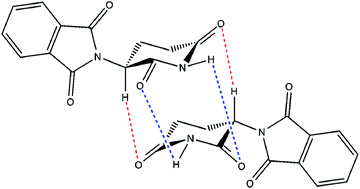
Unravelling the molecular basis of thalidomide embryotoxicity, which is remarkably species–specific, is challenging in view of its low toxicity in the mature animal. Employing data derived solely from proven sensitive primate species or susceptible strains of rabbit, the structure–activity relationship of over 50 compounds which are, arguably, congeners of thalidomide has been reviewed. The molecular requirement for ‘thalidomide-type’ teratogenicity was highly structure dependent. Both the phthalimide and glutarimide groups were essential for embryopathic activity, although minor substitutions in either or both rings could be tolerated without a loss of toxicity. An α-linkage between the two cyclic structures was essential; a β-link resulted in a complete loss of embryopathic activity. Crucially, this α-configuration provided a centre of asymmetry enabling the existence of stereoisomers. The thalidomide molecule is not a static entity and under physiological conditions it undergoes a number of intra- and inter-molecular reactions. Besides irreversible hydrolysis, its keto–enol tautomerism, base-assisted proton transfer and glutarimide ring rotation lead to rapid interconversion of the thalidomide enantiomers. These enantiomers form equilibria between themselves and also between both homochiral and heterochiral dimers. It is proposed that the more energetically favourable and stable heterochiral dimer of thalidomide is an active agent that possesses the structural features of the paired nucleotides of the double-stranded DNA. Its capacity to enter into hydrogen bonding interactions affects DNA expression in a chaotic manner without causing permanent mutations. This disruption may well be concentrated at nucleotide sites known to be involved in specific promoter regions of the genome.
Recommended Literature
- [1] An artificial photosynthetic system for photoaccumulation of two electrons on a fused dipyridophenazine (dppz)–pyridoquinolinone ligand? Philipp Traber,Stephan Kupfer,Stefanie Gr?fe,Isabelle Baussanne,Martine Demeunynck,Jean-Marie Mouesca,Serge Gambarelli,Vincent Artero,Murielle Chavarot-KerlidouChem. Sci., 2018,9, 4152-4159 10.1039/C7SC04348A
- [2] An integrated digital microfluidic chip for multiplexed proteomic sample preparation and analysis by MALDI-MS? Hyejin Moon,Aaron R. Wheeler,Robin L. Garrell,Chang-Jin “CJ” KimLab Chip, 2006,6, 1213-1219 10.1039/B601954D
- [3] Alt-proteins: A promising future 10.1002/fsat.3701_10.x
- [4] An integrated cathode and solid electrolyte via in situ polymerization with significantly reduced interface resistance? Jialiang Yuan,Ran Dong,Yuan Li,Yang Liu,Zhuo Zheng,Yuxia Liu,Yan Sun,Benhe Zhong,Zhenguo Wu,Xiaodong GuoChem. Commun., 2021,57, 13004-13007 10.1039/D1CC04485K
- [5] An integrated system for field analysis of Cd(ii) and Pb(ii) via preconcentration using nano-TiO2/cellulose paper composite and subsequent detection with a portable X-ray fluorescence spectrometer? Xiaofeng LinRSC Adv., 2016,6, 9002-9006 10.1039/C5RA25693C
- [6] An amorphous carbon nitride/NiO/CoN-based composite: a highly efficient nonprecious electrode for supercapacitors and the oxygen evolution reaction? Huifang Yang,Haoran Guo,Peidong Fan,Xinpan Li,Wenlu Ren,Rui SongNanoscale, 2020,12, 7024-7034 10.1039/D0NR00001A
- [7] Acetyl protected thiol methacrylic polymers as effective ligands to keep quantum dots in luminescent standby mode? Marta Liras,Isabel Quijada-Garrido,Marta Palacios-Cuesta,Sonia Mu?oz-Durieux,Olga GarcíaPolym. Chem., 2014,5, 433-442 10.1039/C3PY00987D
- [8] Acentric and chiral heterometallic inorganic–organic hybrid frameworks mediated by alkali or alkaline earth ions: synthesis and NLO properties Huabin Zhang,Shaowu DuCrystEngComm, 2014,16, 4059-4068 10.1039/C3CE42419G
- [9] An analysis of the WTC fires using CIB correlations and simple modeling JGQuintiere 10.1177/0734904121989670
- [10] An apparatus for testing water by measurement of its electrical conductivity Analyst, 1912,37, 538-543 10.1039/AN9123700538

Journal Name:Toxicology Research
research_products
-

CAS no.: 89640-58-4


![N-(3-cyanothiolan-3-yl)-2-[(2,2,2-trifluoroethyl)sulfanyl]pyridine-4-carboxamide](https://ossimg.kuujia.com/scimg/1444500/1444113-98-7x500.png)

![1,2,3,4,5,6-Hexahydro-[2,3]bipyridinyl-6-ol](https://ossimg.kuujia.com/scimg/1271000/1270529-38-8x500.png)

![2,2-Difluoro-3-[methyl(2-methylbutyl)amino]propanoic acid](https://ossimg.kuujia.com/scimg/2138500/2138166-62-6x500.png)

![2-(1H-indol-3-yl)-N-{[6-(thiophen-2-yl)-[1,2,4]triazolo[4,3-b]pyridazin-3-yl]methyl}acetamide](https://ossimg.kuujia.com/scimg/2034500/2034271-14-0x500.png)