Photochemical reactions of halogenated aromatic 1,3-diketones in solution studied by steady state, one- and two-color laser flash photolyses?
Photochemical & Photobiological Sciences Pub Date: 2015-06-18 DOI: 10.1039/C5PP00211G
Abstract
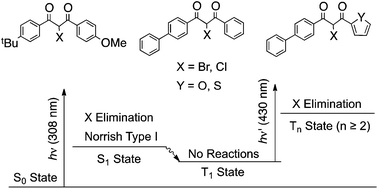
Photochemical processes of 4-tert-butyl-4′-methoxydibenzoylmethane (Avobenzone, AB), 4-phenylbenzoylbenzoyl-, 4-phenylbenzoyl-2′-furanyl- and 4-phenylbenzoyl-2′-thenoylmethanes (PB@Ph, PB@F and PB@T, respectively) substituted with Br and Cl at the C2 position were studied by stationary and laser flash photolyses in solution. The absorption spectral features showed that the molecular structures of the halogenated diketones are in the keto forms while those of halogen-free diketones are in the enol forms. The excited singlet and triplet state energies were determined from the absorption and emission spectra. From the absorption spectral changes upon steady state photolysis of brominated diketones in ethanol, the corresponding halogen-free diketones were formed due to Br elimination being the major photochemical process. The determined quantum yields for the formation of the halogen-free diketones were independent of the amount of dissolved oxygen, indicating that the elimination process is an event in the excited singlet (S1) states. In contrast, from the observed absorption spectra obtained upon photolysis of chlorinated AB and PB@Ph, it was inferred that Norrish type I is the major photochemical reaction in the S1 states in acetonitrile. Chlorinated PB@F and PB@T were found to undergo Cl elimination in the S1 states in cyclohexane to form the corresponding halogen-free diketones. Laser photolysis studies of brominated AB in acetonitrile and ethanol provided a transient absorption spectrum ascribable to the Avobenzone radical (ABR) produced by debromination as the initial intermediate, followed by the AB formation in ethanol. The quenching rate constant of ABR by ethanol and the quantum yield of the AB formation via ABR were determined. These observations provided evidence that H-atom abstraction of ABR from ethanol is responsible for the AB formation. Conversely, laser flash photolysis of brominated and chlorinated PB@Ph, PB@F and PB@T demonstrated the formation of the triplet–triplet absorption spectra. No chemical reactions were found to occur in the triplet (T1) states. Two-color two-laser photolysis studies were carried out on the T1 state of chlorinated PB@Ph, PB@F and PB@T, resulting in the formation of the corresponding halogen-free diketones. These observations confirmed the occurrence of Cl elimination in the highly excited triplet (Tn, n ≥ 2) states. Based on the computed bond dissociation energies for the C–halogen and C–C bonds, switching mechanisms of dehalogenation and α-cleavage were discussed.
Recommended Literature
- [1] Fate of Sb(v) and Sb(iii) species along a gradient of pH and oxygen concentration in the Carnoulès mine waters (Southern France) Eléonore Resongles,Corinne Casiot,Fran?oise Elbaz-Poulichet,Rémi Freydier,Odile Bruneel,Christine Piot,Sophie Delpoux,Aurélie Volant,Angélique DesoeuvreEnviron. Sci.: Processes Impacts, 2013,15, 1536-1544 10.1039/C3EM00215B
- [2] Enantiocontrolled construction of sistodiolynne, an unusual polyketide from the wood-decay fungus Sistrema raduloides Chem. Commun., 1997, 767-768 10.1039/A700186J
- [3] Evolution and characterization of a benzylguanine-binding RNA aptamer? J. Xu,T. J. Carrocci,A. A. HoskinsChem. Commun., 2016,52, 549-552 10.1039/C5CC07605F
- [4] Distinguishing between polymorphic forms of linezolid by solid-phase electronic and vibrational circular dichroism? Jadwiga Frelek,Marcin Górecki,Marta ?aszcz,Agata Suszczyńska,Elemér Vass,Wojciech J. SzczepekChem. Commun., 2012,48, 5295-5297 10.1039/C2CC31207G
- [5] Distribution pattern and allocation of defects in hydrogenated ZnO thin films? Vitaly Gurylev,Chung-Yi Su,Tsong-Pyng PerngPhys. Chem. Chem. Phys., 2016,18, 16033-16038 10.1039/C6CP01768A
- [6] Fe3O4 nanosphere@microporous organic networks: enhanced anode performances in lithium ion batteries through carbonization? Byungho Lim,Jaewon Jin,Jin Yoo,Seung Yong Han,Kyeongyeol Kim,Sungah Kang,Nojin Park,Sang Moon Lee,Hae Jin Kim,Seung Uk SonChem. Commun., 2014,50, 7723-7726 10.1039/C4CC02068E
- [7] Fe3O4/PEG-SO3H as a heterogeneous and magnetically-recyclable nanocatalyst for the oxidation of sulfides to sulfones or sulfoxides Saeideh Mirfakhraei,Malak Hekmati,Fereshteh Hosseini Eshbala,Hojat VeisiNew J. Chem., 2018,42, 1757-1761 10.1039/C7NJ02513K
- [8] Exchanged ligands on the surface of a giant cluster: [(MoO3)176(H2O)63(CH3OH)17Hn](32 – n)– Chem. Commun., 1998, 1501-1502 10.1039/A801804I
- [9] Enabling shape memory and healable effects in a conjugated polymer by incorporating siloxane via dynamic imine bond? Yaling Zhang,Chunhui Dai,Shiwei Zhou,Bin LiuChem. Commun., 2018,54, 10092-10095 10.1039/C8CC05410J
- [10] Fe/Fe3C@C nanoparticles encapsulated in N-doped graphene–CNTs framework as an efficient bifunctional oxygen electrocatalyst for robust rechargeable Zn–air batteries? Zhiyan Chen,Nan Wu,Yaobing Wang,Bing Wang,Yingde WangJ. Mater. Chem. A, 2018,6, 516-526 10.1039/C7TA08423D
Journal Name:Photochemical & Photobiological Sciences
research_products
-

CAS no.: 89640-58-4

![1,2,3,4,5,6-Hexahydro-[2,3]bipyridinyl-6-ol](https://ossimg.kuujia.com/scimg/1271000/1270529-38-8x500.png)


![N-(3-cyanothiolan-3-yl)-2-[(2,2,2-trifluoroethyl)sulfanyl]pyridine-4-carboxamide](https://ossimg.kuujia.com/scimg/1444500/1444113-98-7x500.png)

![2,2-Difluoro-3-[methyl(2-methylbutyl)amino]propanoic acid](https://ossimg.kuujia.com/scimg/2138500/2138166-62-6x500.png)

![2-(1H-indol-3-yl)-N-{[6-(thiophen-2-yl)-[1,2,4]triazolo[4,3-b]pyridazin-3-yl]methyl}acetamide](https://ossimg.kuujia.com/scimg/2034500/2034271-14-0x500.png)