Synthesis and protein kinase C (PKC)-C1 domain binding properties of diacyltetrol based anionic lipids?
Molecular BioSystems Pub Date: 2014-08-28 DOI: 10.1039/C4MB00382A
Abstract
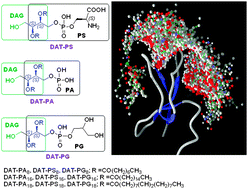
The protein kinase C (PKC) family of lipid-activated kinases plays a significant role in the regulation of diverse cellular functions including tumor promotion, apoptosis, differentiation, and others. The lipophilic second messenger diacylglycerols (DAGs) act as endogenous ligands for the PKCs in the presence of anionic phospholipids. To develop effective PKC regulators and understand the importance of anionic phospholipids in DAG binding of PKC isoforms, we conveniently synthesized octanoic acid containing diacyltetrol (DAT) based hybrid lipids with both DAG and anionic phospholipid headgroups within the same molecule. We also used palmitic and oleic acid containing hybrid lipids for additional understanding of the PKC-C1 domain binding mechanism. Biophysical studies showed that hydrophobic side chains, DAG and anionic phospholipids headgroups are necessary for their interaction with the C1-domain of PKC isoforms. The hybrid lipids DAT-PS and DAT-PA specifically interact with the PKCδ-C1b and PKCθ-C1b subdomains and showed 5- and 2.5-fold stronger binding affinity compared with DAG, respectively. Whereas, the PKCα-C1a subdomain interacts with the hybrid lipids, without any significant specificity. The present results show that hybrid lipids bind to the PKC C1b/a subdomains and can be further studied to decipher their binding mechanism and biological activities. This study proposes a new concept of developing PKC activators by using tetrol-based anionic hybrid lipids having both phospholipids and diacylglycerol headgroups within the same molecule. This study also supplies useful information for the binding potencies of hybrid lipids with PKC-C1 domains.
Recommended Literature
- [1] An aptasensor for the detection of ampicillin in milk using a personal glucose meter Xixi Li,Nanwei Zhu,Ruohan Li,Qinpu ZhangAnal. Methods, 2020,12, 3376-3381 10.1039/D0AY00256A
- [2] Alternative mixtures to R-600a. Theoretical assessment and experimental energy evaluation of binary mixtures in a commercial cooler: Mélanges alternatifs au R-600a. évaluation théorique et évaluation énergétique expérimentale de mélanges binaires dans un refroidisseur commercial. DanielCalleja-Anta,DanielSánchez,LauraNebot-Andres,RamónCabello,RodrigoLlopis 10.1016/j.ijrefrig.2023.05.009
- [3] An approach to biodegradable star polymeric architectures using disulfide coupling? Jingquan Liu,Huiyun Liu,Zhongfan Jia,Volga Bulmus,Thomas P. DavisChem. Commun., 2008, 6582-6584 10.1039/B817037A
- [4] Alt-proteins: A promising future 10.1002/fsat.3701_10.x
- [5] An aqueous ammonia sensor based on an inkjet-printed polyaniline nanoparticle-modified electrode Karl Crowley,Eimer O'Malley,Aoife Morrin,Malcolm R. Smyth,Anthony J. KillardAnalyst, 2008,133, 391-399 10.1039/B716154A
- [6] An arsenic trioxide nanoparticle prodrug (ATONP) potentiates a therapeutic effect on an aggressive hepatocellular carcinoma model via enhancement of intratumoral arsenic accumulation and disturbance of the tumor microenvironment? Xin Fu,Qing-rong Liang,Rong-guang Luo,Yan-shu Li,Xiao-ping Xiao,Lu-lu Yu,Wen-zhe Shan,Guang-qin FanJ. Mater. Chem. B, 2019,7, 3088-3099 10.1039/C9TB00349E
- [7] An amphipathic trans-acting phosphorothioate RNA element delivers an uncharged phosphorodiamidate morpholino sequence in mdx mouse myotubes? H. V. Jain,D. Verthelyi,S. L. BeaucageRSC Adv., 2017,7, 42519-42528 10.1039/C7RA04247G
- [8] An integrated chip for immunofluorescence and its application to analyze lysosomal storage disorders Jie Shen,Ying Zhou,Tu Lu,Junya Peng,Zhixiang Lin,Yuhong Pang,Li YuLab Chip, 2012,12, 317-324 10.1039/C1LC20845D
- [9] An insight into the origin of room-temperature ferromagnetism in SnO2 and Mn-doped SnO2 quantum dots: an experimental and DFT approach? Dhamodaran Manikandan,S. Amirthapandian,I. S. Zhidkov,A. I. Kukharenko,S. O. Cholakh,Ramaswamy MuruganPhys. Chem. Chem. Phys., 2018,20, 6500-6514 10.1039/C7CP07182E
- [10] An autonomous self-optimizing flow machine for the synthesis of pyridine–oxazoline (PyOX) ligands? Eric Wimmer,Daniel Cortés-Borda,Solène Brochard,Elvina Barré,Charlotte Truchet,Fran?ois-Xavier FelpinReact. Chem. Eng., 2019,4, 1608-1615 10.1039/C9RE00096H
Journal Name:Molecular BioSystems
research_products
-

CAS no.: 89640-58-4


![N-(3-cyanothiolan-3-yl)-2-[(2,2,2-trifluoroethyl)sulfanyl]pyridine-4-carboxamide](https://ossimg.kuujia.com/scimg/1444500/1444113-98-7x500.png)

![1,2,3,4,5,6-Hexahydro-[2,3]bipyridinyl-6-ol](https://ossimg.kuujia.com/scimg/1271000/1270529-38-8x500.png)

![2,2-Difluoro-3-[methyl(2-methylbutyl)amino]propanoic acid](https://ossimg.kuujia.com/scimg/2138500/2138166-62-6x500.png)

![2-(1H-indol-3-yl)-N-{[6-(thiophen-2-yl)-[1,2,4]triazolo[4,3-b]pyridazin-3-yl]methyl}acetamide](https://ossimg.kuujia.com/scimg/2034500/2034271-14-0x500.png)