A lipidomics investigation into the intervention of celastrol in experimental colitis?
Molecular BioSystems Pub Date: 2016-03-11 DOI: 10.1039/C5MB00864F
Abstract
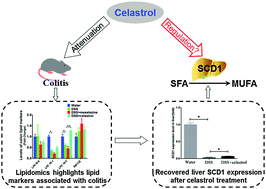
Celastrol is well known for its anti-inflammatory and anti-cancer effects. In this study, the efficacy of celastrol against dextran sulfate sodium (DSS)-induced inflammatory bowel disease (IBD) in mice was established and the mechanism was investigated using lipidomics. Celastrol treatment significantly alleviated DSS-induced colitis in mice, as revealed by the body weight, colon length, scores of rectal bleeding and diarrhea, serum TNF-α level, and histological analysis results. Lipidomics analysis based on UPLC/MS revealed characteristic changes in the metabolic profiles of the colitis mice, with altered levels of lipid markers associated with IBD, including LPC18?:?0, LPC18?:?1, LPC18?:?2, sphingomyelin (SM), and increased LPC18?:?0/LPC18?:?1 and LPC18?:?0/LPC18?:?2 ratios. For the celastrol-treated colitis mice, however, levels of the above lipid markers were restored, together with recovered saturated LPC/unsaturated LPC ratios. Accordingly, using GC–MS analysis, increased stearic acid (C18?:?0)/oleic acid (C18?:?1) and stearic acid (C18?:?0)/linoleic acid (C18?:?2) ratios were observed in colitis mice, which were later recovered after celastrol treatment. Quantitative real-time PCR analysis revealed that the liver expression of stearoyl-coenzyme A desaturase 1 (SCD1), the key enzyme controlling the desaturation of saturated fatty acid, was dramatically inhibited in IBD mice, and was obviously recovered after celastrol treatment. These results suggest that the increased saturated LPC/unsaturated LPC (and saturated fatty acid/unsaturated fatty acid) ratios associated with SCD1 down-regulation could be regarded as biomarkers of colitis, and celastrol alleviates DSS-induced colitis partially via up-regulation of SCD1, restoring the altered balance between stearic acid- and oleic acid-derived lipid species, which plays an important role in alleviating colitis. In all, this study provided the scientific basis for further development of celastrol in treating IBD.
Recommended Literature
- [1] Evolution in surface coverage of CH3NH3PbI3?XClXvia heat assisted solvent vapour treatment and their effects on photovoltaic performance of devices Dhirendra K. Chaudhary,Pramendra Kumar,Lokendra KumarRSC Adv., 2016,6, 94731-94738 10.1039/C6RA18729C
- [2] Excitable dynamics in the bromate–sulfite–ferrocyanide reaction J. Zagora,M. Vosla?,L. Schreiberová,I. SchreiberPhys. Chem. Chem. Phys., 2002,4, 1284-1291 10.1039/B110048C
- [3] Enantiocontrolled construction of sistodiolynne, an unusual polyketide from the wood-decay fungus Sistrema raduloides Chem. Commun., 1997, 767-768 10.1039/A700186J
- [4] Excellent kinetics of single-phase Gd-doped ceria fuel electrodes in solid oxide cells? Andreas Nenning,Manuel Holzmann,Jürgen Fleig,Alexander K. OpitzMater. Adv., 2021,2, 5422-5431 10.1039/D1MA00202C
- [5] Excellent peroxidase mimicking property of CuO/Pt nanocomposites and their application as an ascorbic acid sensor? Xinhuan Wang,Shuangfei Cai,Cui QiAnalyst, 2017,142, 2500-2506 10.1039/C7AN00589J
- [6] Evolution study of photo-synthesized gold nanoparticles by spectral deconvolution model: a quantitative approach Chung-Sung Yang,Mong-Shian Shih,Fang-Yi ChangNew J. Chem., 2006,30, 729-735 10.1039/B516465F
- [7] Embedding heteroatoms: an effective approach to create porphyrin-based functional materials Norihito Fukui,Keisuke Fujimoto,Hideki Yorimitsu,Atsuhiro OsukaDalton Trans., 2017,46, 13322-13341 10.1039/C7DT02815F
- [8] Estimation of activation energy for electroporation and pore growth rate in liquid crystalline and gel phases of lipid bilayers using molecular dynamics simulations? Amit Kumar Majhi,Subbarao Kanchi,V. Venkataraman,K. G. Ayappa,Prabal K. MaitiSoft Matter, 2015,11, 8632-8640 10.1039/C5SM02029H
- [9] Examination of the hydrogen-bonding networks in small water clusters (n = 2–5, 13, 17) using absolutely localized molecular orbital energy decomposition analysis? Erika A. Cobar,Paul R. Horn,Robert G. Bergman,Martin Head-GordonPhys. Chem. Chem. Phys., 2012,14, 15328-15339 10.1039/C2CP42522J
- [10] Emergence of cationic polyamine dendrimersomes: design, stimuli sensitivity and potential biomedical applications Partha Laskar,Christine DufèsNanoscale Adv., 2021,3, 6007-6026 10.1039/D1NA00536G
Journal Name:Molecular BioSystems
research_products
-

CAS no.: 89640-58-4


![N-(3-cyanothiolan-3-yl)-2-[(2,2,2-trifluoroethyl)sulfanyl]pyridine-4-carboxamide](https://ossimg.kuujia.com/scimg/1444500/1444113-98-7x500.png)

![1,2,3,4,5,6-Hexahydro-[2,3]bipyridinyl-6-ol](https://ossimg.kuujia.com/scimg/1271000/1270529-38-8x500.png)

![2,2-Difluoro-3-[methyl(2-methylbutyl)amino]propanoic acid](https://ossimg.kuujia.com/scimg/2138500/2138166-62-6x500.png)

![2-(1H-indol-3-yl)-N-{[6-(thiophen-2-yl)-[1,2,4]triazolo[4,3-b]pyridazin-3-yl]methyl}acetamide](https://ossimg.kuujia.com/scimg/2034500/2034271-14-0x500.png)