Open cell foam materials as Pd reservoirs for Suzuki–Miyaura coupling catalysis at ppb level?
Reaction Chemistry & Engineering Pub Date: 2023-04-06 DOI: 10.1039/D3RE00111C
Abstract
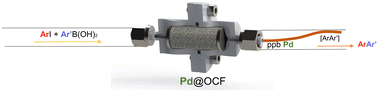
For the Suzuki–Miyaura C–C coupling, it is well accepted that the active catalytic species in the liquid phase are leached from the solid palladium precursor. This was demonstrated for shaped solid Pd precursors which allows fixed-bed applications in flow chemistry. Yet, many interesting solid Pd precursors, including supported nanoparticles (NPs), are available as finely divided powders that cannot be used in fixed-bed reactors because of the too high pressure drop generated. In this work, open cell foam materials (OCF) are used as supports for Pd/C, Siliacat-Pd(0) and Pd(II)-DPP catalysts powders and Pd(0) NPs. The coupling of 4-iodoacetophenone with phenylboronic acid is used as a model reaction to evaluate the activity of leached species. Some experiments with other aryl halides are also reported. It is shown that all the catalytic foams are able to leach active species and that trace amounts in the range 30–300 ppb of Pd in solution are sufficient to carry out the reaction while maintaining a low pressure drop.
Recommended Literature
- [1] Establishing new scaling relations on two-dimensional MXenes for CO2 electroreduction? Albertus D. Handoko,Khoong Hong Khoo,Teck Leong Tan,Hongmei Jin,Zhi Wei SehJ. Mater. Chem. A, 2018,6, 21885-21890 10.1039/C8TA06567E
- [2] Exchanged ligands on the surface of a giant cluster: [(MoO3)176(H2O)63(CH3OH)17Hn](32 – n)– Chem. Commun., 1998, 1501-1502 10.1039/A801804I
- [3] Distinct impact of glycation towards the aggregation and toxicity of murine and human amyloid-β? Eunju Nam,Jiyeon Han,Sunhee Choi,Mi Hee LimChem. Commun., 2021,57, 7637-7640 10.1039/D1CC02695J
- [4] Fe3O4 nanoparticle chains with N-doped carbon coating: magnetotactic bacteria assisted synthesis and high-rate lithium storage? Dan Yang,Yanping Zhou,Xianhong Rui,Jixin Zhu,Ziyang Lu,Eileen Fong,Qingyu YanRSC Adv., 2013,3, 14960-14962 10.1039/C3RA42116C
- [5] Fast-pulsing NMR techniques for the detection of weak interactions: successful natural abundance probe of hydrogen bonds in peptides? Amandine Altmayer-Henzien,Valérie Declerck,David J. Aitken,Ewen Lescop,Denis Merlet,Jonathan FarjonOrg. Biomol. Chem., 2013,11, 7611-7615 10.1039/C3OB41876F
- [6] Evolution of hierarchical porous structures in supramolecular guest–host hydrogels? Christopher B. Rodell,Christopher B. Highley,Minna H. Chen,Neville N. Dusaj,Chao Wang,Lin Han,Jason A. BurdickSoft Matter, 2016,12, 7839-7847 10.1039/C6SM01395C
- [7] Excimer emission and magnetoluminescence of radical-based zinc(ii) complexes doped in host crystals? Shojiro Kimura,Tetsuro KusamotoChem. Commun., 2020,56, 11195-11198 10.1039/D0CC04830E
- [8] Excited state potential energy surfaces and their interactions in FeIVO active sites Shaun D. Wong,Edward I. SolomonDalton Trans., 2014,43, 17567-17577 10.1039/C4DT01366B
- [9] Esterase-responsive polymeric prodrug-based tumor targeting nanoparticles for improved anti-tumor performance against colon cancer? Gang Pan,Yi-jie Bao,Jie Xu,Tao Liu,Cheng Liu,Yan-yan Qiu,Xiao-jing Shi,Hui Yu,Ting-ting Jia,Xia Yuan,Ze-ting Yuan,Yi-jun CaoRSC Adv., 2016,6, 42109-42119 10.1039/C6RA05236C
- [10] Establishment and implications of a characterization method for magnetic nanoparticle using cell tracking velocimetry and magnetic susceptibility modified solutions Huading Zhang,Lee R. Moore,Maciej Zborowski,P. Stephen Williams,Shlomo Margel,Jeffrey J. ChalmersAnalyst, 2005,130, 514-527 10.1039/B412723D

Journal Name:Reaction Chemistry & Engineering
research_products
-

CAS no.: 89640-58-4

![1,2,3,4,5,6-Hexahydro-[2,3]bipyridinyl-6-ol](https://ossimg.kuujia.com/scimg/1271000/1270529-38-8x500.png)


![N-(3-cyanothiolan-3-yl)-2-[(2,2,2-trifluoroethyl)sulfanyl]pyridine-4-carboxamide](https://ossimg.kuujia.com/scimg/1444500/1444113-98-7x500.png)

![2,2-Difluoro-3-[methyl(2-methylbutyl)amino]propanoic acid](https://ossimg.kuujia.com/scimg/2138500/2138166-62-6x500.png)

![2-(1H-indol-3-yl)-N-{[6-(thiophen-2-yl)-[1,2,4]triazolo[4,3-b]pyridazin-3-yl]methyl}acetamide](https://ossimg.kuujia.com/scimg/2034500/2034271-14-0x500.png)