Review on fungal enzyme inhibitors – potential drug targets to manage human fungal infections
RSC Advances Pub Date: 2016-04-11 DOI: 10.1039/C6RA01577H
Abstract
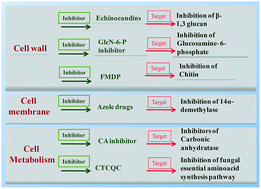
Invasive fungal infections caused by opportunistic fungal pathogens have been emerging as a global problem of great concern as they are associated with increased morbidity and mortality. Despite this, there are very limited drugs of choice to treat fungal infections. The continuous usage of these drugs is associated with resistance development and thus this is another area of concern. Fungal enzymes represent one of the most important and potential targets for drug development, as they are essential for their growth and establishment in the host. In this review, we have discussed the well established and currently available enzyme inhibitors as therapeutic choices to treat fungal infections as well as those enzyme inhibitors that have been identified as suitable drug candidates to manage fungal infections. Thus, the study of fungal biosynthetic enzymes and their inhibitors could potentially show a promising way of drug development for emerging and re-emerging fungal infections of humans.
Recommended Literature
- [1] Emergence of microfluidic wearable technologies Joo Chuan Yeo,KenryLab Chip, 2016,16, 4082-4090 10.1039/C6LC00926C
- [2] Evolution in surface coverage of CH3NH3PbI3?XClXvia heat assisted solvent vapour treatment and their effects on photovoltaic performance of devices Dhirendra K. Chaudhary,Pramendra Kumar,Lokendra KumarRSC Adv., 2016,6, 94731-94738 10.1039/C6RA18729C
- [3] Emerging investigator series: bacteriophages as nano engineering tools for quality monitoring and pathogen detection in water and wastewater Fereshteh BayatEnviron. Sci.: Nano, 2021,8, 367-389 10.1039/D0EN00962H
- [4] Fast-Track to Research Data Management in Experimental Material Science-Setting the Ground for Research Group Level Materials Digitalization. LarsBanko,AlfredLudwig 10.1021/acscombsci.0c00057
- [5] Dissociative electron attachment to HGaF4 Lewis–Br?nsted superacid Marcin Czapla,Jack SimonsPhys. Chem. Chem. Phys., 2018,20, 21739-21745 10.1039/C8CP04007A
- [6] Evolution of shape, size, and areal density of a single plane of Si nanocrystals embedded in SiO2 matrix studied by atom probe tomography Bin Han,Yasuo Shimizu,Gabriele Seguini,Celia Castro,Gérard Ben Assayag,Koji Inoue,Yasuyoshi Nagai,Sylvie Schamm-Chardon,Michele PeregoRSC Adv., 2016,6, 3617-3622 10.1039/C5RA26710B
- [7] Evolving better nanoparticles: Genetic algorithms for optimising cluster geometries Dalton Trans., 2003, 4193-4207 10.1039/B305686D
- [8] Fate of Sb(v) and Sb(iii) species along a gradient of pH and oxygen concentration in the Carnoulès mine waters (Southern France) Eléonore Resongles,Corinne Casiot,Fran?oise Elbaz-Poulichet,Rémi Freydier,Odile Bruneel,Christine Piot,Sophie Delpoux,Aurélie Volant,Angélique DesoeuvreEnviron. Sci.: Processes Impacts, 2013,15, 1536-1544 10.1039/C3EM00215B
- [9] EWOD-driven droplet microfluidic device integrated with optoelectronic tweezers as an automated platform for cellular isolation and analysis? Gaurav J. Shah,Eric P.-Y. Chiou,Ming C. Wu,Chang-Jin “CJ” KimLab Chip, 2009,9, 1732-1739 10.1039/B821508A
- [10] Ester-directed orthogonal dual C–H activation and ortho aryl C–H alkenylation via distal weak coordination? Manickam Bakthadoss,Tadiparthi Thirupathi Reddy,Vishal Agarwal,Duddu S. SharadaChem. Commun., 2022,58, 1406-1409 10.1039/D1CC06097J

Journal Name:RSC Advances
research_products
-

CAS no.: 89640-58-4


![N-(3-cyanothiolan-3-yl)-2-[(2,2,2-trifluoroethyl)sulfanyl]pyridine-4-carboxamide](https://ossimg.kuujia.com/scimg/1444500/1444113-98-7x500.png)

![1,2,3,4,5,6-Hexahydro-[2,3]bipyridinyl-6-ol](https://ossimg.kuujia.com/scimg/1271000/1270529-38-8x500.png)

![2,2-Difluoro-3-[methyl(2-methylbutyl)amino]propanoic acid](https://ossimg.kuujia.com/scimg/2138500/2138166-62-6x500.png)

![2-(1H-indol-3-yl)-N-{[6-(thiophen-2-yl)-[1,2,4]triazolo[4,3-b]pyridazin-3-yl]methyl}acetamide](https://ossimg.kuujia.com/scimg/2034500/2034271-14-0x500.png)