Asymmetric Michael addition in an aqueous environment with the assistance of optically active hyperbranched polymers?
Polymer Chemistry Pub Date: 2017-01-25 DOI: 10.1039/C7PY00036G
Abstract
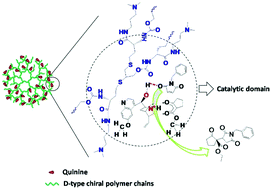
Herein, we report a novel category of optically active hyperbranched polymers (HBPs) that can serve as a recyclable chiral host platform to promote the asymmetric Michael addition reactions in aqueous environments. The chiral hydrophobic cavities within the HBPs provide a chiral microenvironment for the asymmetric Michael addition with a high product yield of up to 89% and satisfactory enantioselectivity. HBPs-6 (prepared with pure D-type chiral monomer) and quinine can work together in a synergistic way, which leads to an enhancement in catalytic stereoselectivity. However, for HBPs-1 (prepared with pure L-type chiral monomer), the catalytic stereoselectivity of quinine within the L-type chiral hydrophobic cavities is slightly suppressed since the quinine units are very likely to be shielded by the polymer chains. The present study not only provides a catalyst scaffold to achieve high yield and enantioselectivity for the asymmetric Michael addition in aqueous environments, but also is of great fundamental value for the rational design of artificial synthetic materials in approximating enzymes.
Recommended Literature
- [1] Embedding cyclic nitrone in mesoporous silica particles for EPR spin trapping of superoxide and other radicals? Eric Besson,Stéphane Gastaldi,Emily Bloch,Selma Aslan,Hakim Karoui,Olivier Ouari,Micael HardyAnalyst, 2019,144, 4194-4203 10.1039/C9AN00468H
- [2] Enantio- & chemo-selective preparation of enantiomerically enriched aliphatic nitro alcohols using Candida parapsilosis ATCC 7330 Sowmyalakshmi VenkataramanRSC Adv., 2015,5, 73807-73813 10.1039/C5RA13593A
- [3] Distribution and ecological risk assessment of typical antibiotics in the surface waters of seven major rivers, China? Environ. Sci.: Processes Impacts, 2021,23, 1088-1100 10.1039/D1EM00079A
- [4] Excitable dynamics in the bromate–sulfite–ferrocyanide reaction J. Zagora,M. Vosla?,L. Schreiberová,I. SchreiberPhys. Chem. Chem. Phys., 2002,4, 1284-1291 10.1039/B110048C
- [5] Enantiopure 2,6-disubstituted piperidines bearing one alkene- or alkyne-containing substituent: preparation and application to total syntheses of indolizidine-alkaloids? Hui Liu,Deyong Su,Guolin Cheng,Jimin Xu,Xinyan Wang,Yuefei HuOrg. Biomol. Chem., 2010,8, 1899-1904 10.1039/B927007H
- [6] Evolution of shape, size, and areal density of a single plane of Si nanocrystals embedded in SiO2 matrix studied by atom probe tomography Bin Han,Yasuo Shimizu,Gabriele Seguini,Celia Castro,Gérard Ben Assayag,Koji Inoue,Yasuyoshi Nagai,Sylvie Schamm-Chardon,Michele PeregoRSC Adv., 2016,6, 3617-3622 10.1039/C5RA26710B
- [7] Excimer and exciplex formation in a pair of bright phosphorescent isomers constructed from Cu3(pyrazolate)3 and Cu3I3 coordination luminophores? Shun-Ze Zhan,Mian Li,Xiao-Ping Zhou,Dan Li,Seik Weng NgRSC Adv., 2011,1, 1457-1459 10.1039/C1RA00566A
- [8] Fatty acid eutectic mixtures and derivatives from non-edible animal fat as phase change materials? Pau Gallart-Sirvent,Marc Martín,Gemma Villorbina,Mercè Balcells,Aran Solé,Luisa F. Cabeza,Ramon Canela-GarayoaRSC Adv., 2017,7, 24133-24139 10.1039/C7RA03845C
- [9] Exceptional activity of sub-nm Pt clusters on CdS for photocatalytic hydrogen production: a combined experimental and first-principles study? Qiyuan Wu,Shangmin Xiong,Peichuan Shen,Shen Zhao,Alexander OrlovCatal. Sci. Technol., 2015,5, 2059-2064 10.1039/C4CY01563K
- [10] Excellent mechanical performance and enhanced dielectric properties of OBC/SiO2 elastomeric nanocomposites: effect of dispersion of the SiO2 nanoparticles? Xing Zhao,Lu Bai,Rui-Ying Bao,Zheng-Ying Liu,Ming-Bo Yang,Wei YangRSC Adv., 2017,7, 46297-46305 10.1039/C7RA08074C

Journal Name:Polymer Chemistry
research_products
-

CAS no.: 89640-58-4


![N-(3-cyanothiolan-3-yl)-2-[(2,2,2-trifluoroethyl)sulfanyl]pyridine-4-carboxamide](https://ossimg.kuujia.com/scimg/1444500/1444113-98-7x500.png)

![1,2,3,4,5,6-Hexahydro-[2,3]bipyridinyl-6-ol](https://ossimg.kuujia.com/scimg/1271000/1270529-38-8x500.png)

![2,2-Difluoro-3-[methyl(2-methylbutyl)amino]propanoic acid](https://ossimg.kuujia.com/scimg/2138500/2138166-62-6x500.png)

![2-(1H-indol-3-yl)-N-{[6-(thiophen-2-yl)-[1,2,4]triazolo[4,3-b]pyridazin-3-yl]methyl}acetamide](https://ossimg.kuujia.com/scimg/2034500/2034271-14-0x500.png)