Magneto-structural diversity of Co(ii) compounds with 1-benzylimidazole induced by linear pseudohalide coligands?
Inorganic Chemistry Frontiers Pub Date: 2020-09-28 DOI: 10.1039/D0QI00752H
Abstract
We report the preparation, spectroscopic characterisation, crystal structure determination and cryomagnetic investigation of three cobalt(II) complexes of formula trans-[Co(bim)4(NCS)2] (1), [Co(bim)2(NCO)2] (2) and [Co(bim)2(N3)2]n (3) (bim = 1-benzylimidazole). The structure of 1 is made up of neutral [Co(bim)4(NCS)2] mononuclear units, where the cobalt(II) ion is six-coordinate with four monodentate bim ligands in equatorial positions and two N-thiocyanato groups in the axial sites building a slightly compressed octahedron. In contrast to 1, each cobalt(II) ion in 2 is four-coordinate with two imidazole-nitrogen atoms from two bim molecules and two N-cyanato ligands describing a slightly distorted tetrahedral geometry, the value of Okuniewski's structural parameter being 0.925. The structure of 3 consists of uniform chains of cobalt(II) ions connected by double end-to-end azido bridges in equatorial positions with two trans-coordinated bim molecules occupying the axial sites. The Co–Nbim bond lengths in 3 are ca. 0.06 ? shorter than the Co–Nazido distances, the value of the tetragonality parameter being 1.03. The intrachain cobalt–cobalt separation is 5.361(1) ?, a value which is much shorter than the shortest interchain one (ca. 12.4 ?). Detailed solid state ac and dc magnetic studies show that 1 and 2 are field-induced single-ion magnets with D = +88.6 (1) and ?6.8 cm?1 (2). Q-band EPR spectrometry measurements for polycrystalline samples of 1 and 2 confirm the signs of D and reveal the occurrence of a strong (1)/low (2) low asymmetry in the g-tensors. Theoretical calculations by CASSCF/NEVPT2 support the results from magnetometry and EPR for 1 and 2. The values of the spin reversal barrier which were obtained from the corresponding Arrhenius plots cover the ranges 48.0–50.2 cm?1 (1) and 25.9–27.2 and 11.5–13.1 cm?1 for the high- and low-temperature relaxation processes (2). Compound 3 exhibits an overall antiferromagnetic behaviour with a maximum of the magnetic susceptibility at ca. 70 K, the intrachain antiferromagnetic coupling being J = ?26.5 cm?1 (the spin Hamiltonian being defined as 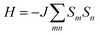 ). This value is of the same nature and its size compares well with those reported for the scarce examples of this type of cobalt(II) chain.

Recommended Literature
- [1] Fe(iii)-mediated isomerization of α,α-diarylallylic alcohols to ketones via radical 1,2-aryl migration? Ziyang Deng,Changwei Chen,Sunliang CuiRSC Adv., 2016,6, 93753-93755 10.1039/C6RA20007A
- [2] Evolution of calcium phosphate precipitation in hanging drop vapor diffusion by in situRaman microspectroscopy Gloria Belén Ramírez-Rodríguez,José Manuel Delgado-López,Jaime Gómez-MoralesCrystEngComm, 2013,15, 2206-2212 10.1039/C2CE26556G
- [3] Excimer–monomer switch: a reaction-based approach for selective detection of fluoride? Qiao Song,Angela Bamesberger,Lingyun Yang,Haley Houtwed,Haishi CaoAnalyst, 2014,139, 3588-3592 10.1039/C4AN00522H
- [4] Establishing plasmon contribution to chemical reactions: alkoxyamines as a thermal probe? Olga Guselnikova,Gérard Audran,Jean-Patrick Joly,Andrii Trelin,Evgeny V. Tretyakov,Vaclav Svorcik,Oleksiy Lyutakov,Sylvain R. A. MarqueChem. Sci., 2021,12, 4154-4161 10.1039/D0SC06470J
- [5] Establishment and implications of a characterization method for magnetic nanoparticle using cell tracking velocimetry and magnetic susceptibility modified solutions Huading Zhang,Lee R. Moore,Maciej Zborowski,P. Stephen Williams,Shlomo Margel,Jeffrey J. ChalmersAnalyst, 2005,130, 514-527 10.1039/B412723D
- [6] Esterase-responsive polymeric prodrug-based tumor targeting nanoparticles for improved anti-tumor performance against colon cancer? Gang Pan,Yi-jie Bao,Jie Xu,Tao Liu,Cheng Liu,Yan-yan Qiu,Xiao-jing Shi,Hui Yu,Ting-ting Jia,Xia Yuan,Ze-ting Yuan,Yi-jun CaoRSC Adv., 2016,6, 42109-42119 10.1039/C6RA05236C
- [7] Excellent kinetics of single-phase Gd-doped ceria fuel electrodes in solid oxide cells? Andreas Nenning,Manuel Holzmann,Jürgen Fleig,Alexander K. OpitzMater. Adv., 2021,2, 5422-5431 10.1039/D1MA00202C
- [8] Emulsifier-free, organotellurium-mediated living radical emulsion polymerization (emulsion TERP) of styrene: poly(dimethylaminoethyl methacrylate) macro-TERP agent? Yukiya KitayamaPolym. Chem., 2014,5, 2784-2792 10.1039/C3PY01539D
- [9] Fe(ii)-Assisted one-pot synthesis of ultra-small core–shell Au–Pt nanoparticles as superior catalysts towards the HER and ORR? Yi Cao,Yujiao Xiahou,Lixiang Xing,Xiang Zhang,Hong Li,ChenShou Wu,Haibing XiaNanoscale, 2020,12, 20456-20466 10.1039/D0NR04995F
- [10] Evolution of important glucosinolates in three common Brassica vegetables during their processing into vegetable powder and in vitro gastric digestion Nan Fu,Naphaporn Chiewchan,Xiao Dong ChenFood Funct., 2020,11, 211-220 10.1039/C9FO00811J

Journal Name:Inorganic Chemistry Frontiers
research_products
-

CAS no.: 89640-58-4

![1,2,3,4,5,6-Hexahydro-[2,3]bipyridinyl-6-ol](https://ossimg.kuujia.com/scimg/1271000/1270529-38-8x500.png)


![N-(3-cyanothiolan-3-yl)-2-[(2,2,2-trifluoroethyl)sulfanyl]pyridine-4-carboxamide](https://ossimg.kuujia.com/scimg/1444500/1444113-98-7x500.png)

![2,2-Difluoro-3-[methyl(2-methylbutyl)amino]propanoic acid](https://ossimg.kuujia.com/scimg/2138500/2138166-62-6x500.png)

![2-(1H-indol-3-yl)-N-{[6-(thiophen-2-yl)-[1,2,4]triazolo[4,3-b]pyridazin-3-yl]methyl}acetamide](https://ossimg.kuujia.com/scimg/2034500/2034271-14-0x500.png)