Simultaneous production of hydrogen with the degradation of organic pollutants using TiO2 photocatalyst modified with dual surface components?
Energy & Environmental Science Pub Date: 2012-03-16 DOI: 10.1039/C2EE21310A
Abstract
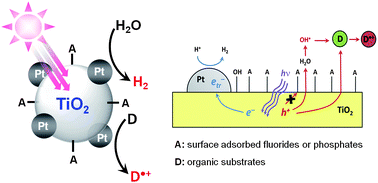
The simultaneous production of hydrogen and degradation of organic pollutants (4-chlorophenol, urea, and urine) was successfully achieved using titania photocatalysts which were modified with both anion adsorbates (fluoride or phosphate) and (noble) metals (Pt, Pd, Au, Ag, Cu, or Ni). The dual-function photocatalysis worked only when both components coexisted on the surface of TiO2, whereas TiO2 modified with a single surface component (F–TiO2, P–TiO2, or Pt/TiO2) was inactive under the same experimental condition. Two main surface-modified photocatalysts, F–TiO2/Pt (surface fluorinated and platinized) and P–TiO2/Pt (surface phosphated and platinized), were similarly active for dual-function photocatalysis in the anoxic suspension under UV irradiation. With these catalysts employed, the degradation of 4-chlorophenol (or urea) was accompanied by the concurrent production of H2. The synergistic effect greatly depended on the kind of metal and pH. The activity of F–TiO2/Pt gradually decreased with increasing pH, which makes the application of F–TiO2/Pt limited to the acidic pH region. On the other hand, P–TiO2/Pt exhibited a consistent activity over a wide range of pH, which makes P–TiO2/Pt a more practical dual-function photocatalyst. The synergistic effect of anions and metal deposits on the surface of TiO2 enhanced the interfacial electron transfer and reduced the charge recombination which resulted in a maximum of 20-fold increase of H2 production compared to metal deposited TiO2 in the presence of 4-chlorophenol.
Recommended Literature
- [1] Exceptional activity of sub-nm Pt clusters on CdS for photocatalytic hydrogen production: a combined experimental and first-principles study? Qiyuan Wu,Shangmin Xiong,Peichuan Shen,Shen Zhao,Alexander OrlovCatal. Sci. Technol., 2015,5, 2059-2064 10.1039/C4CY01563K
- [2] Enantiocontrolled construction of sistodiolynne, an unusual polyketide from the wood-decay fungus Sistrema raduloides Chem. Commun., 1997, 767-768 10.1039/A700186J
- [3] Evolution of important glucosinolates in three common Brassica vegetables during their processing into vegetable powder and in vitro gastric digestion Nan Fu,Naphaporn Chiewchan,Xiao Dong ChenFood Funct., 2020,11, 211-220 10.1039/C9FO00811J
- [4] Emerging enantiomeric resolution materials with homochiral nano-fabrications Ji-Ping WeiNanoscale, 2015,7, 11815-11832 10.1039/C5NR03048J
- [5] Dissociative electron attachment to HGaF4 Lewis–Br?nsted superacid Marcin Czapla,Jack SimonsPhys. Chem. Chem. Phys., 2018,20, 21739-21745 10.1039/C8CP04007A
- [6] Fatty acid eutectic mixtures and derivatives from non-edible animal fat as phase change materials? Pau Gallart-Sirvent,Marc Martín,Gemma Villorbina,Mercè Balcells,Aran Solé,Luisa F. Cabeza,Ramon Canela-GarayoaRSC Adv., 2017,7, 24133-24139 10.1039/C7RA03845C
- [7] Evolution of dealloying induced strain in nanoporous gold crystals? Ross Harder,David C. Dunand,Ian McNultyNanoscale, 2017,9, 5686-5693 10.1039/C6NR09635B
- [8] Dissociation of large gaseous serine clusters produces abundant protonated serine octamer Jacob S. Jordan,Evan R. WilliamsAnalyst, 2021,146, 2617-2625 10.1039/D1AN00273B
- [9] Excellent mechanical performance and enhanced dielectric properties of OBC/SiO2 elastomeric nanocomposites: effect of dispersion of the SiO2 nanoparticles? Xing Zhao,Lu Bai,Rui-Ying Bao,Zheng-Ying Liu,Ming-Bo Yang,Wei YangRSC Adv., 2017,7, 46297-46305 10.1039/C7RA08074C
- [10] Enabling shape memory and healable effects in a conjugated polymer by incorporating siloxane via dynamic imine bond? Yaling Zhang,Chunhui Dai,Shiwei Zhou,Bin LiuChem. Commun., 2018,54, 10092-10095 10.1039/C8CC05410J

Journal Name:Energy & Environmental Science
research_products
-

CAS no.: 89640-58-4


![N-(3-cyanothiolan-3-yl)-2-[(2,2,2-trifluoroethyl)sulfanyl]pyridine-4-carboxamide](https://ossimg.kuujia.com/scimg/1444500/1444113-98-7x500.png)

![1,2,3,4,5,6-Hexahydro-[2,3]bipyridinyl-6-ol](https://ossimg.kuujia.com/scimg/1271000/1270529-38-8x500.png)

![2,2-Difluoro-3-[methyl(2-methylbutyl)amino]propanoic acid](https://ossimg.kuujia.com/scimg/2138500/2138166-62-6x500.png)

![2-(1H-indol-3-yl)-N-{[6-(thiophen-2-yl)-[1,2,4]triazolo[4,3-b]pyridazin-3-yl]methyl}acetamide](https://ossimg.kuujia.com/scimg/2034500/2034271-14-0x500.png)