Insect olfactory system inspired biosensors for odorant detection
Sensors & Diagnostics Pub Date: 2022-10-08 DOI: 10.1039/D2SD00112H
Abstract
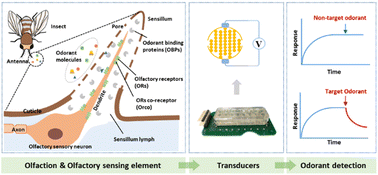
With their accurate olfactory system, insects can detect and discriminate thousands of odorants at very low concentrations in a complicated chemical environment. Inspired by this remarkable olfactory ability, physicochemical transducers integrated with different olfactory derived materials or biomimetic elements were studied and developed, which are collectively called olfactory biosensors. Widely used biological materials include insect antennae, odorant-binding proteins, chemosensory proteins, olfactory receptors, and even sensitive peptides. Based on the physiological properties of these biological materials, they can be incorporated with different analytical techniques, including electrochemical impedance spectroscopy, localized surface plasmon resonance, field-effect transistors, quartz crystal microbalance, surface acoustic waves, and fluorescence imaging, for odorant detection. This paper reviews the development of olfactory biosensors along with typical biochemical detecting cases. The roles of the olfactory system are highlighted to show the design, construction, and detection of olfactory biosensors. Meanwhile, the performance and advantages of insect olfactory system inspired biosensors are introduced with their applications in food evaluation, environmental monitoring, and healthcare diagnosis. With advances in olfactory sensing mechanisms, sensing technologies, and miniaturized electronics, olfactory biosensors, especially those biosensors based on olfactory sensing systems, will eventually become effective detection and analytical tools in the future.
Recommended Literature
- [1] EWOD-driven droplet microfluidic device integrated with optoelectronic tweezers as an automated platform for cellular isolation and analysis? Gaurav J. Shah,Eric P.-Y. Chiou,Ming C. Wu,Chang-Jin “CJ” KimLab Chip, 2009,9, 1732-1739 10.1039/B821508A
- [2] Fc microparticles can modulate the physical extent and magnitude of complement activity? David White,Sean R. StowellBiomater. Sci., 2017,5, 463-474 10.1039/C6BM00608F
- [3] Enantio- & chemo-selective preparation of enantiomerically enriched aliphatic nitro alcohols using Candida parapsilosis ATCC 7330 Sowmyalakshmi VenkataramanRSC Adv., 2015,5, 73807-73813 10.1039/C5RA13593A
- [4] Estimates of hydride ion stability in condensed systems: energy of formation and solvation in aqueous and polar-organic solvents Craig A. Kelly,David R. RosseinskyPhys. Chem. Chem. Phys., 2001,3, 2086-2090 10.1039/B010092G
- [5] Excimer emission and magnetoluminescence of radical-based zinc(ii) complexes doped in host crystals? Shojiro Kimura,Tetsuro KusamotoChem. Commun., 2020,56, 11195-11198 10.1039/D0CC04830E
- [6] Distinct correlation between (CN2)x units and pores: a low-cost method for predesigned wide range control of micropore size of porous carbon? Xiaotong Feng,Lei Bian,Jie Ma,Lei Zhou,Xiayan Wang,Guangsheng Guo,Qiaosheng PuChem. Commun., 2019,55, 3963-3966 10.1039/C9CC01213C
- [7] Emergence of cationic polyamine dendrimersomes: design, stimuli sensitivity and potential biomedical applications Partha Laskar,Christine DufèsNanoscale Adv., 2021,3, 6007-6026 10.1039/D1NA00536G
- [8] Evolution of dealloying induced strain in nanoporous gold crystals? Ross Harder,David C. Dunand,Ian McNultyNanoscale, 2017,9, 5686-5693 10.1039/C6NR09635B
- [9] Fast synthesis of red Li3BaSrLn3(WO4)8:Eu3+ phosphors for white LEDs under near-UV excitation by a microwave-assisted solid state reaction method and photoluminescence studies Bo Wei,Zhenyu Liu,Chen Xie,Shu Yang,Wentao Tang,Aiwei Gu,Wing-Tak Wong,Ka-Leung WongJ. Mater. Chem. C, 2015,3, 12322-12327 10.1039/C5TC03165F
- [10] Dissociation of large gaseous serine clusters produces abundant protonated serine octamer Jacob S. Jordan,Evan R. WilliamsAnalyst, 2021,146, 2617-2625 10.1039/D1AN00273B

Journal Name:Sensors & Diagnostics
research_products
-

CAS no.: 89640-58-4


![N-(3-cyanothiolan-3-yl)-2-[(2,2,2-trifluoroethyl)sulfanyl]pyridine-4-carboxamide](https://ossimg.kuujia.com/scimg/1444500/1444113-98-7x500.png)

![1,2,3,4,5,6-Hexahydro-[2,3]bipyridinyl-6-ol](https://ossimg.kuujia.com/scimg/1271000/1270529-38-8x500.png)

![2,2-Difluoro-3-[methyl(2-methylbutyl)amino]propanoic acid](https://ossimg.kuujia.com/scimg/2138500/2138166-62-6x500.png)

![2-(1H-indol-3-yl)-N-{[6-(thiophen-2-yl)-[1,2,4]triazolo[4,3-b]pyridazin-3-yl]methyl}acetamide](https://ossimg.kuujia.com/scimg/2034500/2034271-14-0x500.png)