Controllable fabrication of a hybrid containing dodecyl dihydrogen phosphate modified magnesium borate whisker/hydrated alumina for enhancing the fire safety and mechanical properties of epoxy resin?
RSC Advances Pub Date: 2022-03-08 DOI: 10.1039/D1RA08289B
Abstract
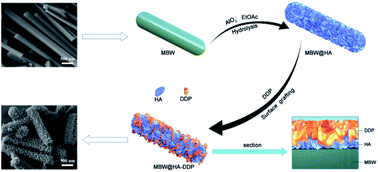
A composite particle with hydrated alumina deposited on the surface of magnesium borate whisker (MBW@HA) was prepared following a chemical liquid deposition method. Subsequently, dodecyl dihydrogen phosphate (DDP) was grafted onto the surface of the composite particles to synthesize an inorganic–organic hybrid (MBW@HA–DDP). The structure, morphology, and composition of MBW@HA–DDP were well characterized. The results revealed the hybrid of MBW@HA–DDP was successfully synthesized characterized by a hydrophobic surface. Subsequently, the obtained MBW@HA–DDP was incorporated into epoxy resin (EP) to fabricate flame retardant composites. The results revealed that the incorporation of MBW@HA–DDP significantly improved the fire safety of EP, for instance, the total heat release (THR) and peak heat release rate (PHRR) of the EP composite with 10-phr MBW@HA–DDP added were reduced by 28.1% and 32.0%, respectively, accompanied with lower total smoke production (TSP) and smoke production rate (SPR). The improved fire safety was due to the barrier function of MBW and HA, and the dilution effect of water vapor generated from HA. Meanwhile, the phosphorus oxoacids generated from DDP could function as catalysts and increase the degree of graphitization of the char residues, thus protecting the matrix effectively. In relation to mechanical properties, the incorporation of MBW@HA–DDP did not deteriorate the mechanical properties of EP but improved them to some extent. The results presented herein help develop a novel strategy for developing flame retardants characterized by good flame-retardant behavior and improved mechanical properties.
Recommended Literature
- [1] Enantiocontrolled construction of sistodiolynne, an unusual polyketide from the wood-decay fungus Sistrema raduloides Chem. Commun., 1997, 767-768 10.1039/A700186J
- [2] Exfoliation of transition-metal dichalcogenides using ATP in aqueous solution? Xinyi Liu,Huan Chen,Jing Lin,Yi Li,Liangqia GuoChem. Commun., 2019,55, 2972-2975 10.1039/C8CC10259G
- [3] Evolution and characterization of a benzylguanine-binding RNA aptamer? J. Xu,T. J. Carrocci,A. A. HoskinsChem. Commun., 2016,52, 549-552 10.1039/C5CC07605F
- [4] Ester-directed orthogonal dual C–H activation and ortho aryl C–H alkenylation via distal weak coordination? Manickam Bakthadoss,Tadiparthi Thirupathi Reddy,Vishal Agarwal,Duddu S. SharadaChem. Commun., 2022,58, 1406-1409 10.1039/D1CC06097J
- [5] Fe3O4 nanosphere@microporous organic networks: enhanced anode performances in lithium ion batteries through carbonization? Byungho Lim,Jaewon Jin,Jin Yoo,Seung Yong Han,Kyeongyeol Kim,Sungah Kang,Nojin Park,Sang Moon Lee,Hae Jin Kim,Seung Uk SonChem. Commun., 2014,50, 7723-7726 10.1039/C4CC02068E
- [6] Fe3O4/PEG-SO3H as a heterogeneous and magnetically-recyclable nanocatalyst for the oxidation of sulfides to sulfones or sulfoxides Saeideh Mirfakhraei,Malak Hekmati,Fereshteh Hosseini Eshbala,Hojat VeisiNew J. Chem., 2018,42, 1757-1761 10.1039/C7NJ02513K
- [7] Distinct correlation between (CN2)x units and pores: a low-cost method for predesigned wide range control of micropore size of porous carbon? Xiaotong Feng,Lei Bian,Jie Ma,Lei Zhou,Xiayan Wang,Guangsheng Guo,Qiaosheng PuChem. Commun., 2019,55, 3963-3966 10.1039/C9CC01213C
- [8] Fe(iii)-mediated isomerization of α,α-diarylallylic alcohols to ketones via radical 1,2-aryl migration? Ziyang Deng,Changwei Chen,Sunliang CuiRSC Adv., 2016,6, 93753-93755 10.1039/C6RA20007A
- [9] Establishing empirical design rules of nucleic acid templates for the synthesis of silver nanoclusters with tunable photoluminescence and functionalities towards targeted bioimaging applications? Jason Y. C. Lim,Yong Yu,Guorui Jin,Kai Li,Yi Lu,Jianping XieNanoscale Adv., 2020,2, 3921-3932 10.1039/D0NA00381F
- [10] Distribution pattern and allocation of defects in hydrogenated ZnO thin films? Vitaly Gurylev,Chung-Yi Su,Tsong-Pyng PerngPhys. Chem. Chem. Phys., 2016,18, 16033-16038 10.1039/C6CP01768A

Journal Name:RSC Advances
research_products
-

CAS no.: 89640-58-4

![1,2,3,4,5,6-Hexahydro-[2,3]bipyridinyl-6-ol](https://ossimg.kuujia.com/scimg/1271000/1270529-38-8x500.png)


![N-(3-cyanothiolan-3-yl)-2-[(2,2,2-trifluoroethyl)sulfanyl]pyridine-4-carboxamide](https://ossimg.kuujia.com/scimg/1444500/1444113-98-7x500.png)

![2,2-Difluoro-3-[methyl(2-methylbutyl)amino]propanoic acid](https://ossimg.kuujia.com/scimg/2138500/2138166-62-6x500.png)

![2-(1H-indol-3-yl)-N-{[6-(thiophen-2-yl)-[1,2,4]triazolo[4,3-b]pyridazin-3-yl]methyl}acetamide](https://ossimg.kuujia.com/scimg/2034500/2034271-14-0x500.png)