How the substrate affects amination reaction kinetics of nitrochlorobenzene?
Reaction Chemistry & Engineering Pub Date: 2022-02-14 DOI: 10.1039/D1RE00534K
Abstract
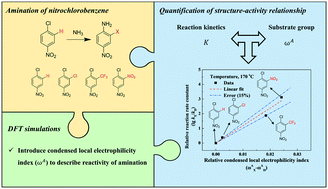
The reaction rate of the amination is affected by its electron-withdrawing group, however, there is currently a lack of quantitative research on the reaction rate of different substrates in experiments and simulations. In this work, taking the amination of nitrochlorobenzene as an example, the effects of various substrates, namely 4-nitrchlorobenzene, 4-chloro-3-(trifluoromethyl)nitrobenzene, 2,4-dinitrochloroben-zene, and 3,4-dichloronitrobenzene, on the reaction rate were systematically examined in a microflow system. Through the homogeneous continuous amination reaction strategy, the reaction kinetic characteristics of different substrates were obtained. The stronger the electron-withdrawing ability of the side chain group, the milder the reaction conditions and the shorter the reaction time. Furthermore, a density functional theory (DFT) simulation method was established to calculate the condensed local electrophilicity index (ωA). There is a good fitting on the relationship between the relative reaction rate  of different substrates and the relative condensed local electrophilic index (ωAX ? ωAH). It not only allows the prediction of the reaction rate of different substrates and the design of industrial production systems but also inspires us to enable more quick organic synthesis process development with the assistance of theoretic calculation.
Recommended Literature
- [1] Fate of Sb(v) and Sb(iii) species along a gradient of pH and oxygen concentration in the Carnoulès mine waters (Southern France) Eléonore Resongles,Corinne Casiot,Fran?oise Elbaz-Poulichet,Rémi Freydier,Odile Bruneel,Christine Piot,Sophie Delpoux,Aurélie Volant,Angélique DesoeuvreEnviron. Sci.: Processes Impacts, 2013,15, 1536-1544 10.1039/C3EM00215B
- [2] Excimer formation effects and trap-assisted charge recombination loss channels in organic solar cells of perylene diimide dimer acceptors? Min Kim,Jae-Joon Lee,Tengling Ye,Panagiotis E. Keivanidis,Kilwon ChoJ. Mater. Chem. C, 2020,8, 1686-1696 10.1039/C9TC04955J
- [3] Evolution in surface coverage of CH3NH3PbI3?XClXvia heat assisted solvent vapour treatment and their effects on photovoltaic performance of devices Dhirendra K. Chaudhary,Pramendra Kumar,Lokendra KumarRSC Adv., 2016,6, 94731-94738 10.1039/C6RA18729C
- [4] Excimer emission and magnetoluminescence of radical-based zinc(ii) complexes doped in host crystals? Shojiro Kimura,Tetsuro KusamotoChem. Commun., 2020,56, 11195-11198 10.1039/D0CC04830E
- [5] Evidence of CO2 molecule acting as an electron acceptor on a nanoporous metal–organic-framework MIL-53 or Cr3+(OH)(O2C–C6H4–CO2)? Alexandre Vimont,Arnaud Travert,Philippe Bazin,Jean-Claude Lavalley,Marco Daturi,Christian Serre,Gérard Férey,Sandrine Bourrelly,Philip L. LlewellynChem. Commun., 2007, 3291-3293 10.1039/B703468G
- [6] Excellent kinetics of single-phase Gd-doped ceria fuel electrodes in solid oxide cells? Andreas Nenning,Manuel Holzmann,Jürgen Fleig,Alexander K. OpitzMater. Adv., 2021,2, 5422-5431 10.1039/D1MA00202C
- [7] Embedding heteroatoms: an effective approach to create porphyrin-based functional materials Norihito Fukui,Keisuke Fujimoto,Hideki Yorimitsu,Atsuhiro OsukaDalton Trans., 2017,46, 13322-13341 10.1039/C7DT02815F
- [8] Excellent energy storage performance in NaNbO3-based relaxor antiferroeic ceramics under a low electric field XuxinCheng,XiaomingChen,PengyuanFan 10.1007/s10832-022-00283-w
- [9] Excitation dependent bidirectional electron transfer in phthalocyanine-functionalised MoS2 nanosheets? Christopher J. Harrison,Kyle J. Berean,Enrico Della Gaspera,Jian Zhen Ou,Richard B. Kaner,Kourosh Kalantar-zadeh,Torben DaenekeNanoscale, 2016,8, 16276-16283 10.1039/C6NR04326G
- [10] Fe(ii)-Assisted one-pot synthesis of ultra-small core–shell Au–Pt nanoparticles as superior catalysts towards the HER and ORR? Yi Cao,Yujiao Xiahou,Lixiang Xing,Xiang Zhang,Hong Li,ChenShou Wu,Haibing XiaNanoscale, 2020,12, 20456-20466 10.1039/D0NR04995F

Journal Name:Reaction Chemistry & Engineering
research_products
-

CAS no.: 89640-58-4


![N-(3-cyanothiolan-3-yl)-2-[(2,2,2-trifluoroethyl)sulfanyl]pyridine-4-carboxamide](https://ossimg.kuujia.com/scimg/1444500/1444113-98-7x500.png)

![1,2,3,4,5,6-Hexahydro-[2,3]bipyridinyl-6-ol](https://ossimg.kuujia.com/scimg/1271000/1270529-38-8x500.png)

![2,2-Difluoro-3-[methyl(2-methylbutyl)amino]propanoic acid](https://ossimg.kuujia.com/scimg/2138500/2138166-62-6x500.png)

![2-(1H-indol-3-yl)-N-{[6-(thiophen-2-yl)-[1,2,4]triazolo[4,3-b]pyridazin-3-yl]methyl}acetamide](https://ossimg.kuujia.com/scimg/2034500/2034271-14-0x500.png)