Thermo-curable and photo-patternable polysiloxanes and polycarbosiloxanes by a facile Piers–Rubinsztajn polycondensation and post-modification?
Polymer Chemistry Pub Date: 2022-03-22 DOI: 10.1039/D2PY00234E
Abstract
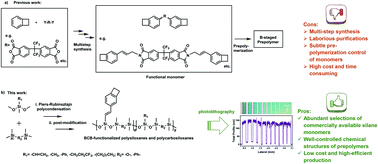
With the rapid development of integrated circuit (IC) chips towards nanometric miniaturization, advanced integration and high performance, interlayer dielectric (ILD) materials play an increasingly important role in meeting the requirements of various advanced packaging technologies. Herein, a series of benzocyclobutene (BCB)-functionalized thermosetting polysiloxane and polycarbosiloxane ILD materials are disclosed. The main-chain structure was achieved and modulated by an efficient Piers–Rubinsztajn (P–R) polycondensation, and the post-modification of thermo-curable BCB groups was realized via a simple Heck reaction. The fully cured resins exhibited excellent dielectric properties with a dielectric constant (Dk) of 2.43 and a dissipation factor (Df) of 1.18 × 10?3, good thermal stability with the 5% weight loss temperature (Td5) above 450 °C, tunable mechanical properties, and low water absorption (0.13% in boiling water for 24 h). In addition, the resultant polysiloxane and polycarbosiloxanes showed the great capability of convenient photolithography with a bis-diazirine cross-linker under UV light. Compared with traditional BCB-functionalized thermosetting ILD resins, our procedure avoids laborious synthesis and subtle pre-polymerization control of BCB monomers. It provides a facile and universal method for modulating the dielectric and mechanical properties of ILD materials, showing great potential in the advanced packaging of ICs, flexible displays and printed circuit boards (PCBs).
Recommended Literature
- [1] Fe3O4 nanoclusters highly dispersed on a porous graphene support as an additive for improving the hydrogen storage properties of LiBH4? Guang Xu,Wei Zhang,Ying Zhang,Xiaoxia Zhao,Ping Wen,Di MaRSC Adv., 2018,8, 19353-19361 10.1039/C8RA02762E
- [2] Excellent energy storage performance in NaNbO3-based relaxor antiferroeic ceramics under a low electric field XuxinCheng,XiaomingChen,PengyuanFan 10.1007/s10832-022-00283-w
- [3] EWOD-driven droplet microfluidic device integrated with optoelectronic tweezers as an automated platform for cellular isolation and analysis? Gaurav J. Shah,Eric P.-Y. Chiou,Ming C. Wu,Chang-Jin “CJ” KimLab Chip, 2009,9, 1732-1739 10.1039/B821508A
- [4] Evolution and characterization of a benzylguanine-binding RNA aptamer? J. Xu,T. J. Carrocci,A. A. HoskinsChem. Commun., 2016,52, 549-552 10.1039/C5CC07605F
- [5] Distinct roles of SNARE-mimicking lipopeptides during initial steps of membrane fusion? Alena Koukalová,?árka Pokorná,Aimee L. Boyle,Nestor Lopez Mora,Alexander Kros,Martin Hof,Radek ?achlNanoscale, 2018,10, 19064-19073 10.1039/C8NR05730C
- [6] Enabling stable MnO2 matrix for aqueous zinc-ion battery cathodes? Yiding Jiao,Liqun Kang,Jasper Berry-Gair,Kit McColl,Jianwei Li,Haobo Dong,Hao Jiang,Ryan Wang,Furio Corà,Dan J. L. Brett,Ivan P. ParkinJ. Mater. Chem. A, 2020,8, 22075-22082 10.1039/D0TA08638J
- [7] Enabling chloride salts for thermal energy storage: implications of salt purity? J. Matthew Kurley,Phillip W. Halstenberg,Abbey McAlister,Stephen Raiman,Richard T. MayesRSC Adv., 2019,9, 25602-25608 10.1039/C9RA03133B
- [8] Fe3O4/Au/Fe3O4 nanoflowers exhibiting tunable saturation magnetization and enhanced bioconjugation Feng Shi,Kunping Yan,Mingli Peng,Xiao Cheng,Yanling Luo,Xuemei Chen,V. A. L. Roy,Zuankai WangNanoscale, 2012,4, 747-751 10.1039/C2NR11489E
- [9] Evolutionary approaches in protein engineering towards biomaterial construction Brindha J.,Balamurali M. M.,Kaushik ChandaRSC Adv., 2019,9, 34720-34734 10.1039/C9RA06807D
- [10] Emerging investigators Polym. Chem., 2015,6, 5501-5502 10.1039/C5PY90111A

Journal Name:Polymer Chemistry
research_products
-

CAS no.: 89640-58-4

![1,2,3,4,5,6-Hexahydro-[2,3]bipyridinyl-6-ol](https://ossimg.kuujia.com/scimg/1271000/1270529-38-8x500.png)


![N-(3-cyanothiolan-3-yl)-2-[(2,2,2-trifluoroethyl)sulfanyl]pyridine-4-carboxamide](https://ossimg.kuujia.com/scimg/1444500/1444113-98-7x500.png)

![2,2-Difluoro-3-[methyl(2-methylbutyl)amino]propanoic acid](https://ossimg.kuujia.com/scimg/2138500/2138166-62-6x500.png)

![2-(1H-indol-3-yl)-N-{[6-(thiophen-2-yl)-[1,2,4]triazolo[4,3-b]pyridazin-3-yl]methyl}acetamide](https://ossimg.kuujia.com/scimg/2034500/2034271-14-0x500.png)