2-Amino-5-chlorobenzophenone passivating perovskite films using multiple functional groups towards high-performance solar cells?
Journal of Materials Chemistry C Pub Date: 2023-02-28 DOI: 10.1039/D3TC00275F
Abstract
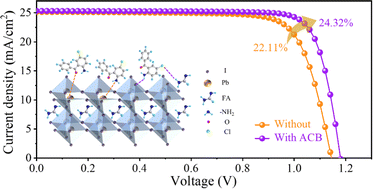
Surface defects of perovskite films are considered to be a source of carrier nonradiative recombination in perovskite solar cells (PSCs) that causes not only the degradation of power conversion efficiency (PCE) but also instability. In this study, an organic small molecule, 2-amino-5-chlorobenzophenone (ACB), is employed to passivate the surface defects of (FAPbI3)0.95(MAPbBr3)0.05 perovskite films. The O of the carbonyl group (–C![[double bond, length as m-dash]](https://www.rsc.org/images/entities/char_e001.gif) O) and the N of the amino group (–NH2) in ACB form a coordinate bond with the uncoordinated Pb2+ of the perovskite to passivate this defect. The –NH2 and –Cl groups in ACB can also form a hydrogen bond with the perovskite, which inhibits the degradation of the perovskite films. PSCs with ACB passivation possess lower defect state density and better photoelectric properties. Therefore, PCE of the PSCs is increased from 22.11% to 24.32% by ACB passivation. Furthermore, the ambient stability of the PSCs is also enhanced. The unencapsulated PSCs with ACB passivation maintain 90% of their initial PCE after being stored for 1440 h under ambient conditions.
O) and the N of the amino group (–NH2) in ACB form a coordinate bond with the uncoordinated Pb2+ of the perovskite to passivate this defect. The –NH2 and –Cl groups in ACB can also form a hydrogen bond with the perovskite, which inhibits the degradation of the perovskite films. PSCs with ACB passivation possess lower defect state density and better photoelectric properties. Therefore, PCE of the PSCs is increased from 22.11% to 24.32% by ACB passivation. Furthermore, the ambient stability of the PSCs is also enhanced. The unencapsulated PSCs with ACB passivation maintain 90% of their initial PCE after being stored for 1440 h under ambient conditions.
Recommended Literature
- [1] Fe/Fe3C@C nanoparticles encapsulated in N-doped graphene–CNTs framework as an efficient bifunctional oxygen electrocatalyst for robust rechargeable Zn–air batteries? Zhiyan Chen,Nan Wu,Yaobing Wang,Bing Wang,Yingde WangJ. Mater. Chem. A, 2018,6, 516-526 10.1039/C7TA08423D
- [2] Fast-Track to Research Data Management in Experimental Material Science-Setting the Ground for Research Group Level Materials Digitalization. LarsBanko,AlfredLudwig 10.1021/acscombsci.0c00057
- [3] Essential effect of the electrolyte on the mechanical and chemical degradation of LiNi0.8Co0.15Al0.05O2 cathodes upon long-term cycling?? Xiaoming Liu,Zachary D. Hood,Wangda Li,Donovan N. Leonard,Arumugam Manthiram,Miaofang ChiJ. Mater. Chem. A, 2021,9, 2111-2119 10.1039/D0TA07814J
- [4] Emulsion technologies for multicellular tumour spheroid radiation assays? Kay S. McMillan,Anthony G. McCluskey,Annette Sorensen,Marie Boyd,Michele ZagnoniAnalyst, 2016,141, 100-110 10.1039/C5AN01382H
- [5] Excess electrons in lithium–ethylamine solutions—density, electrical conductivity and EPR studies Phys. Chem. Chem. Phys., 1999,1, 3561-3565 10.1039/A900683D
- [6] Emerging 2D hybrid nanomaterials: towards enhanced sensitive and selective conductometric gas sensors at room temperature Hanie Hashtroudi,Ian D. R. MackinnonJ. Mater. Chem. C, 2020,8, 13108-13126 10.1039/D0TC01968B
- [7] Evolved polymerases facilitate selection of fully 2′-OMe-modified aptamers? Zhixia Liu,Tingjian Chen,Floyd E. RomesbergChem. Sci., 2017,8, 8179-8182 10.1039/C7SC03747C
- [8] Evidence that the availability of an allylic hydrogen governs the regioselectivity of the Wacker oxidation Matthew J. Gaunt,Jinquan Yu,Jonathan B. SpencerChem. Commun., 2001, 1844-1845 10.1039/B103066N
- [9] Excellent peroxidase mimicking property of CuO/Pt nanocomposites and their application as an ascorbic acid sensor? Xinhuan Wang,Shuangfei Cai,Cui QiAnalyst, 2017,142, 2500-2506 10.1039/C7AN00589J
- [10] Emergence of cationic polyamine dendrimersomes: design, stimuli sensitivity and potential biomedical applications Partha Laskar,Christine DufèsNanoscale Adv., 2021,3, 6007-6026 10.1039/D1NA00536G
Journal Name:Journal of Materials Chemistry C
research_products
-

CAS no.: 89640-58-4


![N-(3-cyanothiolan-3-yl)-2-[(2,2,2-trifluoroethyl)sulfanyl]pyridine-4-carboxamide](https://ossimg.kuujia.com/scimg/1444500/1444113-98-7x500.png)

![1,2,3,4,5,6-Hexahydro-[2,3]bipyridinyl-6-ol](https://ossimg.kuujia.com/scimg/1271000/1270529-38-8x500.png)

![2,2-Difluoro-3-[methyl(2-methylbutyl)amino]propanoic acid](https://ossimg.kuujia.com/scimg/2138500/2138166-62-6x500.png)

![2-(1H-indol-3-yl)-N-{[6-(thiophen-2-yl)-[1,2,4]triazolo[4,3-b]pyridazin-3-yl]methyl}acetamide](https://ossimg.kuujia.com/scimg/2034500/2034271-14-0x500.png)