Effect of liposome surface modification with water-soluble phospholipid polymer chain-conjugated lipids on interaction with human plasma proteins?
Journal of Materials Chemistry B Pub Date: 2021-09-20 DOI: 10.1039/D1TB01485D
Abstract
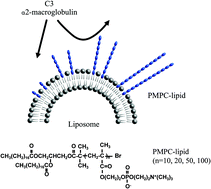
Alternative liposome surface coatings for PEGylation to evade the immune system, particularly the complement system, have garnered significant interest. We previously reported poly(2-methacryloyloxyethyl phosphorylcholine) (MPC)-based lipids (PMPC–lipids) and investigated the surface modification of liposomes. In this study, we synthesize PMPC–lipids with polymerization degrees of 10 (MPC10–lipid), 20 (MPC20–lipid), 50 (MPC50–lipid), and 100 (MPC100–lipid), and coated liposomes with 1, 5, or 10 mol% PMPC–lipids (PMPC–liposomes). Non-modified and PEGylated liposomes are used as controls. We investigate the liposome size, surface charge, polydispersity index, and adsorption of plasma proteins to the liposomes post incubation in human plasma containing N,N,N′,N′-ethylenediamine tetraacetic acid (EDTA) or lepirudin by some methods such as sodium dodecyl sulphate–polyacrylamide gel electrophoresis (SDS–PAGE), western blotting, and automated capillary western blot, with emphasis on the binding of complement protein C3. It is shown that the coating of liposome PMPC–lipids can suppress protein adsorption more effectively with an increase in the molecular weight and molar ratio (1–10 mol%). Apolipoprotein A-I is detected on PMPC–liposomes with a higher molecular weight and higher molar ratio of PMPC–lipids, whereas α2-macroglobulin is detected on non-modified, PEGylated, and PMPC–liposomes with a shorter polymer chain. In addition, a correlation is shown among the PMPC molecular weight, molar ratio, and C3 binding. The MPC10–lipid cannot inhibit C3 binding efficiently, whereas surface modifications with 10 mol% MPC20–lipid and 5 mol% and 10 mol% MPC50–lipid suppress both total protein and C3 binding. Hence, liposome modification with PMPC–lipids can be a possible strategy for avoiding complement activation.
Recommended Literature
- [1] Fe3O4 nanoparticle chains with N-doped carbon coating: magnetotactic bacteria assisted synthesis and high-rate lithium storage? Dan Yang,Yanping Zhou,Xianhong Rui,Jixin Zhu,Ziyang Lu,Eileen Fong,Qingyu YanRSC Adv., 2013,3, 14960-14962 10.1039/C3RA42116C
- [2] Fatty acid eutectic mixtures and derivatives from non-edible animal fat as phase change materials? Pau Gallart-Sirvent,Marc Martín,Gemma Villorbina,Mercè Balcells,Aran Solé,Luisa F. Cabeza,Ramon Canela-GarayoaRSC Adv., 2017,7, 24133-24139 10.1039/C7RA03845C
- [3] Dissociative dynamics of O2 on Ag(110)? Ivor Lon?ari?Phys. Chem. Chem. Phys., 2015,17, 9436-9445 10.1039/C4CP05900J
- [4] Fast-pulsing NMR techniques for the detection of weak interactions: successful natural abundance probe of hydrogen bonds in peptides? Amandine Altmayer-Henzien,Valérie Declerck,David J. Aitken,Ewen Lescop,Denis Merlet,Jonathan FarjonOrg. Biomol. Chem., 2013,11, 7611-7615 10.1039/C3OB41876F
- [5] Emerging enantiomeric resolution materials with homochiral nano-fabrications Ji-Ping WeiNanoscale, 2015,7, 11815-11832 10.1039/C5NR03048J
- [6] Evidence of rutile-to-anatase photo-induced electron transfer in mixed-phase TiO2 by solid-state NMR spectroscopy? Weili Dai,Guangjun Wu,Michael HungerChem. Commun., 2015,51, 13779-13782 10.1039/C5CC04971G
- [7] Fe/S-Catalyzed synthesis of 2-benzoylbenzoxazoles and 2-quinolylbenzoxazoles via redox condensation of o-nitrophenols with acetophenones and methylquinolines? Thi Thu Tram Nguyen,Thanh Binh NguyenOrg. Biomol. Chem., 2021,19, 6015-6020 10.1039/D1OB00976A
- [8] Fast-Track to Research Data Management in Experimental Material Science-Setting the Ground for Research Group Level Materials Digitalization. LarsBanko,AlfredLudwig 10.1021/acscombsci.0c00057
- [9] Excimer and exciplex formation in a pair of bright phosphorescent isomers constructed from Cu3(pyrazolate)3 and Cu3I3 coordination luminophores? Shun-Ze Zhan,Mian Li,Xiao-Ping Zhou,Dan Li,Seik Weng NgRSC Adv., 2011,1, 1457-1459 10.1039/C1RA00566A
- [10] Empowering microfluidics by micro-3D printing and solution-based mineral coating? Hongxia Li,Aikifa Raza,Qiaoyu Ge,Jin-You Lu,TieJun ZhangSoft Matter, 2020,16, 6841-6849 10.1039/D0SM00958J

Journal Name:Journal of Materials Chemistry B
research_products
-

CAS no.: 89640-58-4


![N-(3-cyanothiolan-3-yl)-2-[(2,2,2-trifluoroethyl)sulfanyl]pyridine-4-carboxamide](https://ossimg.kuujia.com/scimg/1444500/1444113-98-7x500.png)

![1,2,3,4,5,6-Hexahydro-[2,3]bipyridinyl-6-ol](https://ossimg.kuujia.com/scimg/1271000/1270529-38-8x500.png)

![2,2-Difluoro-3-[methyl(2-methylbutyl)amino]propanoic acid](https://ossimg.kuujia.com/scimg/2138500/2138166-62-6x500.png)

![2-(1H-indol-3-yl)-N-{[6-(thiophen-2-yl)-[1,2,4]triazolo[4,3-b]pyridazin-3-yl]methyl}acetamide](https://ossimg.kuujia.com/scimg/2034500/2034271-14-0x500.png)