Metal halide perovskites: promising materials toward next-generation circularly polarized luminescence
Journal of Materials Chemistry C Pub Date: 2023-03-23 DOI: 10.1039/D2TC04825F
Abstract
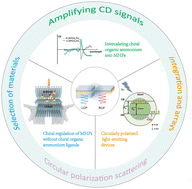
Metal halide perovskites (MHPs) have emerged as highly appealing materials for circularly polarized luminescence (CPL) related applications, owing to their spin-related photoelectric properties and flexible structural adjustment. However, the realization of high circular dichroic (CD) intensity and luminescence dissymmetry factors (glum) remains a challenge faced in the field of CPL material research, which greatly impedes the commercial application of perovskite-based CPL. In this perspective, we discuss the fabrication strategies of intercalating chiral organic ammonium into MHPs and chiral regulation of MHPs without chiral organic ammonium ligands, resulting in CPL emission. We then summarize the progress in circularly polarized light-emitting devices, mainly to realize high-performance CPL emission. These key challenges give rise to several promising research opportunities to facilitate the development of highly stable and high-performance CPL emitting devices, thus inspiring more possibilities for CPL display, cryptology, and anti-counterfeiting applications.
Recommended Literature
- [1] Estimating and correcting interference fringes in infrared spectra in infrared hyperspectral imaging Ghazal Azarfar,Ebrahim Aboualizadeh,Nicholas M. Walter,Simona Ratti,Camilla Olivieri,Alessandra Norici,Michael Nasse,Achim Kohler,Mario GiordanoAnalyst, 2018,143, 4674-4683 10.1039/C8AN00093J
- [2] Evidence that the availability of an allylic hydrogen governs the regioselectivity of the Wacker oxidation Matthew J. Gaunt,Jinquan Yu,Jonathan B. SpencerChem. Commun., 2001, 1844-1845 10.1039/B103066N
- [3] Evolution of dealloying induced strain in nanoporous gold crystals? Ross Harder,David C. Dunand,Ian McNultyNanoscale, 2017,9, 5686-5693 10.1039/C6NR09635B
- [4] Embedding heteroatoms: an effective approach to create porphyrin-based functional materials Norihito Fukui,Keisuke Fujimoto,Hideki Yorimitsu,Atsuhiro OsukaDalton Trans., 2017,46, 13322-13341 10.1039/C7DT02815F
- [5] Exciton manipulation in rippled transition metal dichalcogenides? Chen Long,Ying Dai,Jianwei Li,Hao JinNanoscale, 2020,12, 21124-21130 10.1039/D0NR05602B
- [6] Emerging 2D hybrid nanomaterials: towards enhanced sensitive and selective conductometric gas sensors at room temperature Hanie Hashtroudi,Ian D. R. MackinnonJ. Mater. Chem. C, 2020,8, 13108-13126 10.1039/D0TC01968B
- [7] Exciting clusters, what does off-resonance actually mean?? Goonay Yousefalizadeh,Shideh Ahmadi,Nicholas J. Mosey,Kevin G. StamplecoskieNanoscale, 2021,13, 242-252 10.1039/D0NR06493A
- [8] Evolution of hierarchical porous structures in supramolecular guest–host hydrogels? Christopher B. Rodell,Christopher B. Highley,Minna H. Chen,Neville N. Dusaj,Chao Wang,Lin Han,Jason A. BurdickSoft Matter, 2016,12, 7839-7847 10.1039/C6SM01395C
- [9] Excited-state proton-coupled electron transfer within ion pairs? Gerald J. Meyer,Leif Hammarstr?mChem. Sci., 2020,11, 3460-3473 10.1039/C9SC04941J
- [10] Excitation energies from ground-state density-functionals by means of generator coordinates A. B. F. da Silva,K. CapellePhys. Chem. Chem. Phys., 2009,11, 4564-4569 10.1039/B902529D

Journal Name:Journal of Materials Chemistry C
research_products
-

CAS no.: 89640-58-4


![N-(3-cyanothiolan-3-yl)-2-[(2,2,2-trifluoroethyl)sulfanyl]pyridine-4-carboxamide](https://ossimg.kuujia.com/scimg/1444500/1444113-98-7x500.png)

![1,2,3,4,5,6-Hexahydro-[2,3]bipyridinyl-6-ol](https://ossimg.kuujia.com/scimg/1271000/1270529-38-8x500.png)

![2,2-Difluoro-3-[methyl(2-methylbutyl)amino]propanoic acid](https://ossimg.kuujia.com/scimg/2138500/2138166-62-6x500.png)

![2-(1H-indol-3-yl)-N-{[6-(thiophen-2-yl)-[1,2,4]triazolo[4,3-b]pyridazin-3-yl]methyl}acetamide](https://ossimg.kuujia.com/scimg/2034500/2034271-14-0x500.png)