A vasculatural hydrogel combined with Prussian blue for solar-driven vapor generation?
Journal of Materials Chemistry A Pub Date: 2022-05-16 DOI: 10.1039/D2TA02348B
Abstract
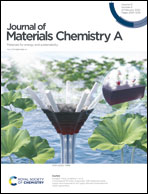
Solar-driven clean water production presents unique merits of sustainability and environmental friendliness. Tremendous efforts have been devoted to the preparation of solar-driven vapor generators (SVGs) with timely water transport and/or excellent light-trapping properties. Herein, an efficient SVG is achieved by the combination of polyvinyl alcohol (PVA) hydrogel and Prussian blue (PB), with a unique vasculature obtained through techniques of a directional freezing and salting-out strategy. Thermodynamic calculations indicate that the water in this SVG system has lower vaporization enthalpy (1126.9 J g?1) than bulk water (2460.0 J g?1), which can be attributed to the high content of weakly hydrogen-bonded water in the PVA fibers. Moreover, both the experimental and theoretical analyses demonstrate that the vertically arranged channels existing in the SVG ensure rapid water transport (1.6 cm min?1) and light-trapping capacities. Benefitting from the above factors, the SVG exhibits a freshwater production rate of 3.44 ± 0.17 kg m?2 h?1 under 1 sun (1 kW m?2) irradiation with a photothermal conversion efficiency of up to 95% in 3.5% NaCl brine, reaching the theoretical ceiling of PVA-based materials. Additionally, it can work in practical environments for a long time without performance degradation, which is usually caused by salt scaling and biological fouling. This new kind of vasculatural hydrogel-based SVG is a competitive candidate for solar-driven clean water production, thus satisfying the growing demand for clean and safe drinking water.

Recommended Literature
- [1] Excellent lithium ion storage property of porous MnCo2O4 nanorods? Peiyuan Zeng,Xiaoxiao Wang,Ming Ye,Qiuyang Ma,Jianwen Li,Wanwan Wang,Baoyou Geng,Zhen FangRSC Adv., 2016,6, 23074-23084 10.1039/C5RA26176G
- [2] Emergence of cationic polyamine dendrimersomes: design, stimuli sensitivity and potential biomedical applications Partha Laskar,Christine DufèsNanoscale Adv., 2021,3, 6007-6026 10.1039/D1NA00536G
- [3] Empowering microfluidics by micro-3D printing and solution-based mineral coating? Hongxia Li,Aikifa Raza,Qiaoyu Ge,Jin-You Lu,TieJun ZhangSoft Matter, 2020,16, 6841-6849 10.1039/D0SM00958J
- [4] Enabling high-throughput single-animal gene-expression studies with molecular and micro-scale technologies Jason WanLab Chip, 2020,20, 4528-4538 10.1039/D0LC00881H
- [5] Dissociative dynamics of O2 on Ag(110)? Ivor Lon?ari?Phys. Chem. Chem. Phys., 2015,17, 9436-9445 10.1039/C4CP05900J
- [6] Essential effect of the electrolyte on the mechanical and chemical degradation of LiNi0.8Co0.15Al0.05O2 cathodes upon long-term cycling?? Xiaoming Liu,Zachary D. Hood,Wangda Li,Donovan N. Leonard,Arumugam Manthiram,Miaofang ChiJ. Mater. Chem. A, 2021,9, 2111-2119 10.1039/D0TA07814J
- [7] Fe/Fe3C@C nanoparticles encapsulated in N-doped graphene–CNTs framework as an efficient bifunctional oxygen electrocatalyst for robust rechargeable Zn–air batteries? Zhiyan Chen,Nan Wu,Yaobing Wang,Bing Wang,Yingde WangJ. Mater. Chem. A, 2018,6, 516-526 10.1039/C7TA08423D
- [8] Fate of single walled carbon nanotubes in wetland ecosystems? Joseph H. Bisesi,Tara Sabo-AttwoodEnviron. Sci.: Nano, 2014,1, 574-583 10.1039/C4EN00063C
- [9] Evolution of important glucosinolates in three common Brassica vegetables during their processing into vegetable powder and in vitro gastric digestion Nan Fu,Naphaporn Chiewchan,Xiao Dong ChenFood Funct., 2020,11, 211-220 10.1039/C9FO00811J
- [10] Excellent kinetics of single-phase Gd-doped ceria fuel electrodes in solid oxide cells? Andreas Nenning,Manuel Holzmann,Jürgen Fleig,Alexander K. OpitzMater. Adv., 2021,2, 5422-5431 10.1039/D1MA00202C
Journal Name:Journal of Materials Chemistry A
research_products
-

CAS no.: 89640-58-4


![N-(3-cyanothiolan-3-yl)-2-[(2,2,2-trifluoroethyl)sulfanyl]pyridine-4-carboxamide](https://ossimg.kuujia.com/scimg/1444500/1444113-98-7x500.png)

![1,2,3,4,5,6-Hexahydro-[2,3]bipyridinyl-6-ol](https://ossimg.kuujia.com/scimg/1271000/1270529-38-8x500.png)

![2,2-Difluoro-3-[methyl(2-methylbutyl)amino]propanoic acid](https://ossimg.kuujia.com/scimg/2138500/2138166-62-6x500.png)

![2-(1H-indol-3-yl)-N-{[6-(thiophen-2-yl)-[1,2,4]triazolo[4,3-b]pyridazin-3-yl]methyl}acetamide](https://ossimg.kuujia.com/scimg/2034500/2034271-14-0x500.png)