Determination of the 144Ce/238U atomic ratio in spent nuclear fuel using double spike isotope dilution mass spectrometry
Journal of Analytical Atomic Spectrometry Pub Date: 2022-04-26 DOI: 10.1039/D2JA00052K
Abstract
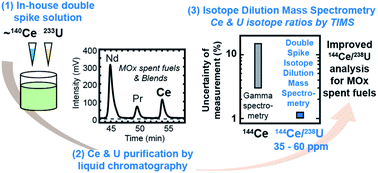
The low abundance cerium-144 radionuclide is one of the significant contributors to the decay heat from spent nuclear fuel for cooling times of less than ten years after nuclear reactor discharge. The accurate quantification of the 144Ce content (or 144Ce/238U) in irradiated nuclear fuel is necessary to validate and extend the neutronic calculation codes as well as to improve the short-term nuclear waste management strategies. In order to quantify the 144Ce/238U atomic ratios at low uncertainty, we developed a new analytical technique based on double spike isotope dilution associated with mass spectrometry. This includes (1) the chemical elimination of the major neodymium-144 isobaric interference by two steps of liquid chromatography prior to isotope analysis by Thermal Ionization Mass Spectrometry (TIMS) using both total evaporation and sequential methods, and (2) the preparation and use of an in-house double spike solution, using a mixture of a natural Ce solution with a 233U-enriched solution. This new approach was applied for the first time on two Mixed Oxide (MOx) spent nuclear fuel samples and allowed the determination of 144Ce/238U atomic ratios ranging from 35 × 10?6 to 59 × 10?6 with a relative expanded uncertainty of measurement of around 1% at a 95% confidence level.
Recommended Literature
- [1] An amino group functionalized metal–organic framework as a luminescent probe for highly selective sensing of Fe3+ ions? Zhonghua Xiang,Chuanqi Fang,Sanhua Leng,Dapeng CaoJ. Mater. Chem. A, 2014,2, 7662-7665 10.1039/C4TA00313F
- [2] Aggregated-fluorescent detection of PFAS with a simple chip Cheng Fang,Jinjian Wu,Zahra Sobhani,Md. Al Amin,Youhong TangAnal. Methods, 2019,11, 163-170 10.1039/C8AY02382D
- [3] An apparatus for determining small amounts of alchohol in sour milk and urine Analyst, 1964,89, 272-275 10.1039/AN9648900272
- [4] An atomic scale study of defects in Co2FeAl Ravi Kumar Yadav,R. GovindarajPhys. Chem. Chem. Phys., 2020,22, 26876-26886 10.1039/D0CP04572A
- [5] An artificial blood vessel implanted three-dimensional microsystem for modeling transvascular migration of tumor cells? Xue-Ying Wang,Ying Pei,Min Xie,Zi-He Jin,Ya-Shi Xiao,Yang Wang,Li-Na Zhang,Yan Li,Wei-Hua HuangLab Chip, 2015,15, 1178-1187 10.1039/C4LC00973H
- [6] An approach to the structure and vibrational analysis of cis- and trans-3-chlorostyrene through IR/Raman and INS spectroscopies and theoretical ab initio/DFT calculations? J. M. Granadino-Roldán,M. Fernández-Gómez,A. Navarro,T. Pe?a Ruiz,U. A. JayasooriyaPhys. Chem. Chem. Phys., 2004,6, 1133-1143 10.1039/B314243D
- [7] An atomistic mechanism for the degradation of perovskite solar cells by trapped charge? Eunhak Lim,Jiyoung Heo,Seong Keun KimNanoscale, 2019,11, 11369-11378 10.1039/C9NR02193K
- [8] An arsenic trioxide nanoparticle prodrug (ATONP) potentiates a therapeutic effect on an aggressive hepatocellular carcinoma model via enhancement of intratumoral arsenic accumulation and disturbance of the tumor microenvironment? Xin Fu,Qing-rong Liang,Rong-guang Luo,Yan-shu Li,Xiao-ping Xiao,Lu-lu Yu,Wen-zhe Shan,Guang-qin FanJ. Mater. Chem. B, 2019,7, 3088-3099 10.1039/C9TB00349E
- [9] An assay for the enzyme N-acetyl-β-d-glucosaminidase (NAGase) based on electrochemical detection using screen-printed carbon electrodes (SPCEs) R. M. Pemberton,J. P. Hart,T. T. MottramAnalyst, 2001,126, 1866-1871 10.1039/B104874K
- [10] An approach for correlating the structural and electrical properties of Zr4+-modified SrBi4Ti4O15/SBT ceramic Priyambada Nayak,Tanmaya Badapanda,Anil Kumar Singh,Simanchalo PanigrahiRSC Adv., 2017,7, 16319-16331 10.1039/C7RA00366H

Journal Name:Journal of Analytical Atomic Spectrometry
research_products
-

CAS no.: 89640-58-4

![1,2,3,4,5,6-Hexahydro-[2,3]bipyridinyl-6-ol](https://ossimg.kuujia.com/scimg/1271000/1270529-38-8x500.png)


![N-(3-cyanothiolan-3-yl)-2-[(2,2,2-trifluoroethyl)sulfanyl]pyridine-4-carboxamide](https://ossimg.kuujia.com/scimg/1444500/1444113-98-7x500.png)

![2,2-Difluoro-3-[methyl(2-methylbutyl)amino]propanoic acid](https://ossimg.kuujia.com/scimg/2138500/2138166-62-6x500.png)

![2-(1H-indol-3-yl)-N-{[6-(thiophen-2-yl)-[1,2,4]triazolo[4,3-b]pyridazin-3-yl]methyl}acetamide](https://ossimg.kuujia.com/scimg/2034500/2034271-14-0x500.png)