AqSO biorefinery: a green and parameter-controlled process for the production of lignin–carbohydrate hybrid materials?
Green Chemistry Pub Date: 2022-07-30 DOI: 10.1039/D2GC02171D
Abstract
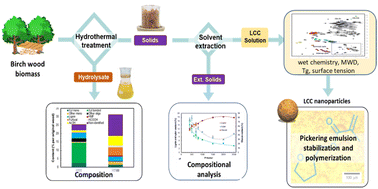
The current biorefineries are focused on the comprehensive fractionation of biomass components into separate lignin and carbohydrate fractions for the production of materials, platform chemicals and biofuel. However, it has become obvious that the combination of lignin and carbohydrates can have significant technical, environmental, and economic benefits as opposed to their separate use. Herein, we developed a green, simple, and flexible biorefinery concept for the integrated utilization of all major biomass components for high-value applications with the focus on functional lignin–carbohydrate hybrids (LCHs). The established process consisted of a modified hydrothermal treatment (HTT) of birch wood followed by solvent extraction of the resulting solids and is therefore named AquaSolv Omni (AqSO) biorefinery. The AqSO biorefinery produces three major streams: hydrolysate (hemicellulose-derived products), solvent-extracted lignin–carbohydrate complexes (LCCs) and cellulose-rich fibers. Specific process conditions were found to facilitate the production of LCCs of different types in high yields as a new valuable and industrially realistic process stream. The effect of the process severity and liquid to solid (L/S) ratio on the yields and compositions of the produced fractions as well as on the structure and properties of the extracted LCCs was investigated using state of the art NMR spectroscopy and molar mass distribution analysis among other methods. The high flexibility of the process allows for engineering of the resulting products in a wide range of chemical compositions, structures and physicochemical properties and therefore gives a good opportunity to optimize the products for specific high-value applications. The process can be easily combined with other biorefinery operations (e.g., enzymatic hydrolysis, pulping, bleaching) to be incorporated into existing value chains or create new ones and thus is suitable for different biorefinery scenarios. First examples of high-value applications of AqSO biorefinery LCHs are reported. LCC nanoparticles (LCCNPs) were produced for the first time directly from the solvent extract and their properties were investigated. LCCNPs could efficiently stabilize Pickering emulsions of tetrahydrofurfuryl methacrylate and allowed their free radical polymerization. In addition, AqSO LCHs showed promising results as wood adhesives. Overall, our results provide detailed information on the complex lignocellulosic fractions and bridge the gap from process engineering to sustainable product development.
Recommended Literature
- [1] Esterase-responsive polymeric prodrug-based tumor targeting nanoparticles for improved anti-tumor performance against colon cancer? Gang Pan,Yi-jie Bao,Jie Xu,Tao Liu,Cheng Liu,Yan-yan Qiu,Xiao-jing Shi,Hui Yu,Ting-ting Jia,Xia Yuan,Ze-ting Yuan,Yi-jun CaoRSC Adv., 2016,6, 42109-42119 10.1039/C6RA05236C
- [2] Emerging investigators Polym. Chem., 2015,6, 5501-5502 10.1039/C5PY90111A
- [3] Fast-Track to Research Data Management in Experimental Material Science-Setting the Ground for Research Group Level Materials Digitalization. LarsBanko,AlfredLudwig 10.1021/acscombsci.0c00057
- [4] Fe3O4 nanoparticle chains with N-doped carbon coating: magnetotactic bacteria assisted synthesis and high-rate lithium storage? Dan Yang,Yanping Zhou,Xianhong Rui,Jixin Zhu,Ziyang Lu,Eileen Fong,Qingyu YanRSC Adv., 2013,3, 14960-14962 10.1039/C3RA42116C
- [5] Evolution of cellulose into flexible conductive green electronics: a smart strategy to fabricate sustainable electrodes for supercapacitors Tengfei Yu,Yuehan Wu,Wei Li,Bin LiRSC Adv., 2014,4, 34134-34143 10.1039/C4RA07017H
- [6] Evidence for the intrinsic nature of band-gap states electrochemically observed on atomically flat TiO2(110) surfaces? Shintaro Takata,Yoshihiro MiuraPhys. Chem. Chem. Phys., 2014,16, 24784-24789 10.1039/C4CP03280B
- [7] EWOD-driven droplet microfluidic device integrated with optoelectronic tweezers as an automated platform for cellular isolation and analysis? Gaurav J. Shah,Eric P.-Y. Chiou,Ming C. Wu,Chang-Jin “CJ” KimLab Chip, 2009,9, 1732-1739 10.1039/B821508A
- [8] Dissolved oxygen sensor based on fluorescence quenching of oxygen-sensitive ruthenium complexes immobilized in sol–gel-derived porous silica coatings Analyst, 1996,121, 785-788 10.1039/AN9962100785
- [9] Emerging investigator series: kinetics of diopside reactivity for carbon mineralization in mafic–ultramafic rocks BrianaAguila,LandonHardee,H.ToddSchaef,SiavashZare,MohammadJavadAbdolhosseiniQomi,JarrodV.Crum,JadeE.HollimanJr.,ElenaTajueloRodriguez,LawrenceM.Anovitz,KevinM.Rosso,QuinR.S.Miller 10.1039/d3en00087g
- [10] Embedding cyclic nitrone in mesoporous silica particles for EPR spin trapping of superoxide and other radicals? Eric Besson,Stéphane Gastaldi,Emily Bloch,Selma Aslan,Hakim Karoui,Olivier Ouari,Micael HardyAnalyst, 2019,144, 4194-4203 10.1039/C9AN00468H

Journal Name:Green Chemistry
research_products
-

CAS no.: 89640-58-4


![N-(3-cyanothiolan-3-yl)-2-[(2,2,2-trifluoroethyl)sulfanyl]pyridine-4-carboxamide](https://ossimg.kuujia.com/scimg/1444500/1444113-98-7x500.png)

![1,2,3,4,5,6-Hexahydro-[2,3]bipyridinyl-6-ol](https://ossimg.kuujia.com/scimg/1271000/1270529-38-8x500.png)

![2,2-Difluoro-3-[methyl(2-methylbutyl)amino]propanoic acid](https://ossimg.kuujia.com/scimg/2138500/2138166-62-6x500.png)

![2-(1H-indol-3-yl)-N-{[6-(thiophen-2-yl)-[1,2,4]triazolo[4,3-b]pyridazin-3-yl]methyl}acetamide](https://ossimg.kuujia.com/scimg/2034500/2034271-14-0x500.png)