Pharmacophore-driven identification of human glutaminyl cyclase inhibitors from foods, plants and herbs unveils the bioactive property and potential of Azaleatin in the treatment of Alzheimer's disease?
Food & Function Pub Date: 2022-11-11 DOI: 10.1039/D2FO02507H
Abstract
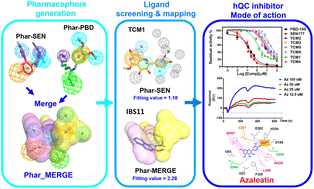
Alzheimer's disease (AD) is the leading cause of disabilities in old age and a rapidly growing condition in the elderly population. AD brings significant burden and has a devastating impact on public health, society and the global economy. Thus, developing new therapeutics to combat AD is imperative. Human glutaminyl cyclase (hQC), which catalyzes the formation of neurotoxic pyroglutamate (pE)-modified β-amyloid (Aβ) peptides, is linked to the amyloidogenic process that leads to the initiation of AD. Hence, hQC is an essential target for developing anti-AD therapeutics. Here, we systematically screened and identified hQC inhibitors from natural products by pharmacophore-driven inhibitor screening coupled with biochemical and biophysical examinations. We employed receptor–ligand pharmacophore generation to build pharmacophore models and Phar-MERGE and Phar-SEN for inhibitor screening through ligand-pharmacophore mapping. About 11 and 24 hits identified from the Natural Product and Traditional Chinese Medicine databases, respectively, showed diverse hQC inhibitory abilities. Importantly, the inhibitors TCM1 (Azaleatin; IC50 = 1.1 μM) and TCM2 (Quercetin; IC50 = 4.3 μM) found in foods and plants exhibited strong inhibitory potency against hQC. Furthermore, the binding affinity and molecular interactions were analyzed by surface plasmon resonance (SPR) and molecular modeling/simulations to explore the possible modes of action of Azaleatin and Quercetin. Our study successfully screened and characterized the foundational biochemical and biophysical properties of Azaleatin and Quercetin toward targeting hQC, unveiling their bioactive potential in the treatment of AD.
Recommended Literature
- [1] Emerging 2D hybrid nanomaterials: towards enhanced sensitive and selective conductometric gas sensors at room temperature Hanie Hashtroudi,Ian D. R. MackinnonJ. Mater. Chem. C, 2020,8, 13108-13126 10.1039/D0TC01968B
- [2] Excitation energies from ground-state density-functionals by means of generator coordinates A. B. F. da Silva,K. CapellePhys. Chem. Chem. Phys., 2009,11, 4564-4569 10.1039/B902529D
- [3] Excellent electrochemical performance of LiFe0.4Mn0.6PO4 microspheres produced using a double carbon coating process? Yong Ping Huang,Tao Tao,Zheng Chen,Wei Han,Ying Wu,Chunjiang Kuang,Shaoxiong Zhou,Ying ChenJ. Mater. Chem. A, 2014,2, 18831-18837 10.1039/C4TA03994G
- [4] Evolution of cellulose into flexible conductive green electronics: a smart strategy to fabricate sustainable electrodes for supercapacitors Tengfei Yu,Yuehan Wu,Wei Li,Bin LiRSC Adv., 2014,4, 34134-34143 10.1039/C4RA07017H
- [5] Evidence of field induced slow magnetic relaxation in cis-[Co(hfac)2(H2O)2] exhibiting tri-axial anisotropy with a negative axial component? Denis V. Korchagin,Elena A. Yureva,Alexander V. Akimov,Eugenii Ya. Misochko,Gennady V. Shilov,Artem D. Talantsev,Roman B. Morgunov,Alexander A. Shakin,Sergey M. Aldoshin,Boris S. TsukerblatDalton Trans., 2017,46, 7540-7548 10.1039/C7DT01236E
- [6] Enabling chloride salts for thermal energy storage: implications of salt purity? J. Matthew Kurley,Phillip W. Halstenberg,Abbey McAlister,Stephen Raiman,Richard T. MayesRSC Adv., 2019,9, 25602-25608 10.1039/C9RA03133B
- [7] Emerging enantiomeric resolution materials with homochiral nano-fabrications Ji-Ping WeiNanoscale, 2015,7, 11815-11832 10.1039/C5NR03048J
- [8] Evolutionary de novo design of phenothiazine derivatives for dye-sensitized solar cells? Vishwesh Venkatraman,Marco Foscato,Vidar R. Jensen,Bj?rn K?re AlsbergJ. Mater. Chem. A, 2015,3, 9851-9860 10.1039/C5TA00625B
- [9] Emergence of microfluidic wearable technologies Joo Chuan Yeo,KenryLab Chip, 2016,16, 4082-4090 10.1039/C6LC00926C
- [10] Evolution of dealloying induced strain in nanoporous gold crystals? Ross Harder,David C. Dunand,Ian McNultyNanoscale, 2017,9, 5686-5693 10.1039/C6NR09635B

Journal Name:Food & Function
research_products
-

CAS no.: 89640-58-4

![1,2,3,4,5,6-Hexahydro-[2,3]bipyridinyl-6-ol](https://ossimg.kuujia.com/scimg/1271000/1270529-38-8x500.png)


![N-(3-cyanothiolan-3-yl)-2-[(2,2,2-trifluoroethyl)sulfanyl]pyridine-4-carboxamide](https://ossimg.kuujia.com/scimg/1444500/1444113-98-7x500.png)

![2,2-Difluoro-3-[methyl(2-methylbutyl)amino]propanoic acid](https://ossimg.kuujia.com/scimg/2138500/2138166-62-6x500.png)

![2-(1H-indol-3-yl)-N-{[6-(thiophen-2-yl)-[1,2,4]triazolo[4,3-b]pyridazin-3-yl]methyl}acetamide](https://ossimg.kuujia.com/scimg/2034500/2034271-14-0x500.png)