A machine learning-integrated stepwise method to discover novel anti-obesity phytochemicals that antagonize the glucocorticoid receptor?
Food & Function Pub Date: 2023-01-30 DOI: 10.1039/D2FO03466B
Abstract
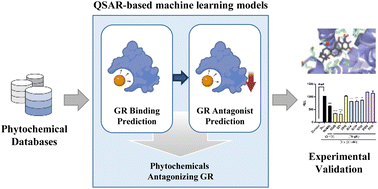
As a type of stress hormone, glucocorticoids (GCs) affect numerous physiological pathways by binding to the glucocorticoid receptor (GR) and regulating the transcription of various genes. However, when GCs are dysregulated, the resulting hypercortisolism may contribute to various metabolic disorders, including obesity. Thus, attempts have been made to discover potent GR antagonists that can reverse excess-GC-related metabolic diseases. Phytochemicals are a collection of valuable bioactive compounds that are known for their wide variety of chemotypes. Recently, various computational methods have been developed to obtain active phytochemicals that can modulate desired target proteins. In this study, we developed a workflow comprising two consecutive quantitative structure–activity relationship-based machine learning models to discover novel GR-antagonizing phytochemicals. These two models collectively identified 65 phytochemicals that bind to and antagonize GR. Of these, nine commercially available phytochemicals were validated for GR-antagonist and anti-obesity activities. In particular, we confirmed that demethylzeylasteral, a phytochemical of the Tripterygium wilfordii Radix, exhibits potent anti-obesity activity in vitro through GR antagonism.
Recommended Literature
- [1] Excitation energies from ground-state density-functionals by means of generator coordinates A. B. F. da Silva,K. CapellePhys. Chem. Chem. Phys., 2009,11, 4564-4569 10.1039/B902529D
- [2] Embedding cyclic nitrone in mesoporous silica particles for EPR spin trapping of superoxide and other radicals? Eric Besson,Stéphane Gastaldi,Emily Bloch,Selma Aslan,Hakim Karoui,Olivier Ouari,Micael HardyAnalyst, 2019,144, 4194-4203 10.1039/C9AN00468H
- [3] Enabling shape memory and healable effects in a conjugated polymer by incorporating siloxane via dynamic imine bond? Yaling Zhang,Chunhui Dai,Shiwei Zhou,Bin LiuChem. Commun., 2018,54, 10092-10095 10.1039/C8CC05410J
- [4] Evolutionary de novo design of phenothiazine derivatives for dye-sensitized solar cells? Vishwesh Venkatraman,Marco Foscato,Vidar R. Jensen,Bj?rn K?re AlsbergJ. Mater. Chem. A, 2015,3, 9851-9860 10.1039/C5TA00625B
- [5] Elusive 2-aminofuran Diels–Alder substrates for a straightforward synthesis of polysubstituted anilines? Ana G. Neo,Ana Bornadiego,Jesús Díaz,Stefano Marcaccini,Carlos F. MarcosOrg. Biomol. Chem., 2013,11, 6546-6555 10.1039/C3OB41411F
- [6] Emulsion technologies for multicellular tumour spheroid radiation assays? Kay S. McMillan,Anthony G. McCluskey,Annette Sorensen,Marie Boyd,Michele ZagnoniAnalyst, 2016,141, 100-110 10.1039/C5AN01382H
- [7] Fe/Fe3C@C nanoparticles encapsulated in N-doped graphene–CNTs framework as an efficient bifunctional oxygen electrocatalyst for robust rechargeable Zn–air batteries? Zhiyan Chen,Nan Wu,Yaobing Wang,Bing Wang,Yingde WangJ. Mater. Chem. A, 2018,6, 516-526 10.1039/C7TA08423D
- [8] Excellent lithium ion storage property of porous MnCo2O4 nanorods? Peiyuan Zeng,Xiaoxiao Wang,Ming Ye,Qiuyang Ma,Jianwen Li,Wanwan Wang,Baoyou Geng,Zhen FangRSC Adv., 2016,6, 23074-23084 10.1039/C5RA26176G
- [9] Embedding heteroatoms: an effective approach to create porphyrin-based functional materials Norihito Fukui,Keisuke Fujimoto,Hideki Yorimitsu,Atsuhiro OsukaDalton Trans., 2017,46, 13322-13341 10.1039/C7DT02815F
- [10] Fast synthesis of copper nanoclusters through the use of hydrogen peroxide additive and their application for the fluorescence detection of Hg2+ in water samples? Liao Xiaoqing,Li Ruiyi,Li Zaijun,Sun Xiulan,Wang Zhouping,Liu JunkangNew J. Chem., 2015,39, 5240-5248 10.1039/C5NJ00831J

Journal Name:Food & Function
research_products
-

CAS no.: 89640-58-4

![1,2,3,4,5,6-Hexahydro-[2,3]bipyridinyl-6-ol](https://ossimg.kuujia.com/scimg/1271000/1270529-38-8x500.png)


![N-(3-cyanothiolan-3-yl)-2-[(2,2,2-trifluoroethyl)sulfanyl]pyridine-4-carboxamide](https://ossimg.kuujia.com/scimg/1444500/1444113-98-7x500.png)

![2,2-Difluoro-3-[methyl(2-methylbutyl)amino]propanoic acid](https://ossimg.kuujia.com/scimg/2138500/2138166-62-6x500.png)

![2-(1H-indol-3-yl)-N-{[6-(thiophen-2-yl)-[1,2,4]triazolo[4,3-b]pyridazin-3-yl]methyl}acetamide](https://ossimg.kuujia.com/scimg/2034500/2034271-14-0x500.png)