Analysis of the mechanism of action of quercetin in the treatment of hyperlipidemia based on metabolomics and intestinal flora
Food & Function Pub Date: 2023-01-27 DOI: 10.1039/D2FO03509J
Abstract
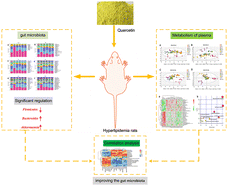
Hyperlipidemia (HLP) is one of the main factors leading to cardiovascular diseases. Quercetin (QUE) is a naturally occurring polyhydroxy flavonoid compound that has a wide range of pharmacological effects. However, the potential mechanism for treating HLP remains unclear. Thus, the study aimed to investigate the role of QUE in HLP development and its underlying mechanisms in HLP rats based on the analysis of gut microbiota and plasma metabolomics. Following the establishment of an HLP model in rats, QUE was orally administered. Plasma samples and fecal samples were collected from HLP rats for microbiome 16S rDNA sequencing and metabolic UPLC-Q-Exactive-MS analysis. The results suggested that QUE could regulate dyslipidemia and inhibit the levels of TC, TG, and LDL-c. Additionally, histopathological findings revealed that QUE could reduce lipid deposition, ameliorate hepatic injury and steatosis in HFD-induced rats, and have a protective effect on the liver. The analysis and identification of plasma metabolomics showed that the intervention effect of QUE on HLP rats was related to 60 differential metabolites and signal pathways such as lactosamine, 11b-hydroxyprogesterone, arachidonic acid, glycerophospholipid, sphingolipid, glycerolipid, and linoleic acid metabolism. Combined with fecal microbiological analysis, it was found that QUE could significantly change the composition of intestinal flora in HLP rats, increase beneficial bacteria, and reduce the composition of harmful bacteria, attenuating the Firmicutes/Bacteroidetes ratio. The results of correlation analysis showed that the relative abundance level of Firmicutes, Deironobacterium, Fusobacterium, Bacteroides, and Escherichia coli was closely related to the change of differential metabolites. In summary, combined with metabolomics and gut microbiota studies, it is found that QUE can reduce lipid levels and improve liver function. The potential mechanism may be the regulation of metabolism and intestinal flora that play a role in reducing lipid levels, to achieve the purpose of treatment of HLP.
Recommended Literature
- [1] Emerging investigator series: bacteriophages as nano engineering tools for quality monitoring and pathogen detection in water and wastewater Fereshteh BayatEnviron. Sci.: Nano, 2021,8, 367-389 10.1039/D0EN00962H
- [2] Fe3O4 nanosphere@microporous organic networks: enhanced anode performances in lithium ion batteries through carbonization? Byungho Lim,Jaewon Jin,Jin Yoo,Seung Yong Han,Kyeongyeol Kim,Sungah Kang,Nojin Park,Sang Moon Lee,Hae Jin Kim,Seung Uk SonChem. Commun., 2014,50, 7723-7726 10.1039/C4CC02068E
- [3] Dissolved oxygen sensor based on fluorescence quenching of oxygen-sensitive ruthenium complexes immobilized in sol–gel-derived porous silica coatings Analyst, 1996,121, 785-788 10.1039/AN9962100785
- [4] Etching of glass microchips with supercritical water? Pavel Karásek,Jakub Grym,Michal Roth,Josef Planeta,Franti?ek ForetLab Chip, 2015,15, 311-318 10.1039/C4LC00843J
- [5] Excitable dynamics in the bromate–sulfite–ferrocyanide reaction J. Zagora,M. Vosla?,L. Schreiberová,I. SchreiberPhys. Chem. Chem. Phys., 2002,4, 1284-1291 10.1039/B110048C
- [6] Esterase-responsive polymeric prodrug-based tumor targeting nanoparticles for improved anti-tumor performance against colon cancer? Gang Pan,Yi-jie Bao,Jie Xu,Tao Liu,Cheng Liu,Yan-yan Qiu,Xiao-jing Shi,Hui Yu,Ting-ting Jia,Xia Yuan,Ze-ting Yuan,Yi-jun CaoRSC Adv., 2016,6, 42109-42119 10.1039/C6RA05236C
- [7] Fast-Track to Research Data Management in Experimental Material Science-Setting the Ground for Research Group Level Materials Digitalization. LarsBanko,AlfredLudwig 10.1021/acscombsci.0c00057
- [8] Evidence for the intrinsic nature of band-gap states electrochemically observed on atomically flat TiO2(110) surfaces? Shintaro Takata,Yoshihiro MiuraPhys. Chem. Chem. Phys., 2014,16, 24784-24789 10.1039/C4CP03280B
- [9] Distinct roles of SNARE-mimicking lipopeptides during initial steps of membrane fusion? Alena Koukalová,?árka Pokorná,Aimee L. Boyle,Nestor Lopez Mora,Alexander Kros,Martin Hof,Radek ?achlNanoscale, 2018,10, 19064-19073 10.1039/C8NR05730C
- [10] Emerging investigators Polym. Chem., 2015,6, 5501-5502 10.1039/C5PY90111A
Journal Name:Food & Function
research_products
-

CAS no.: 89640-58-4


![N-(3-cyanothiolan-3-yl)-2-[(2,2,2-trifluoroethyl)sulfanyl]pyridine-4-carboxamide](https://ossimg.kuujia.com/scimg/1444500/1444113-98-7x500.png)

![1,2,3,4,5,6-Hexahydro-[2,3]bipyridinyl-6-ol](https://ossimg.kuujia.com/scimg/1271000/1270529-38-8x500.png)

![2,2-Difluoro-3-[methyl(2-methylbutyl)amino]propanoic acid](https://ossimg.kuujia.com/scimg/2138500/2138166-62-6x500.png)

![2-(1H-indol-3-yl)-N-{[6-(thiophen-2-yl)-[1,2,4]triazolo[4,3-b]pyridazin-3-yl]methyl}acetamide](https://ossimg.kuujia.com/scimg/2034500/2034271-14-0x500.png)