Functionalization of carbon nanotubes with bovine plasma biowaste by forming a protein corona enhances copper removal from water and ecotoxicity mitigation?
Environmental Science: Nano Pub Date: 2022-06-28 DOI: 10.1039/D2EN00145D
Abstract
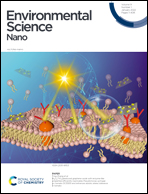
Water remediation is a current challenge in environmental science and technology. Functionalization is a pivotal step toward the application of carbon nanotubes for water remediation. Bovine plasma is an abundant agro-industrial biowaste that can be exploited as a low-cost source of biomolecules in green nanotechnologies. Here we show the functionalization of oxidized multiwalled carbon nanotubes with bovine plasma by forming a protein corona (BP@MWCNT) for copper removal from water linked to ecotoxicity mitigation for the first time. Cryogenic transmission electron microscopy (Cryo-TEM) showed that corona thickness is a function of nanotube diameter. The functionalization of nanotubes increased the dispersion stability (ca. 90%) and the removal of copper ions from water (ca. 400%) when compared to oxidized nanotubes. Importantly, BP@MWCNT did not show any acute toxicity (48 h) to Daphnia similis up to 100 mg L?1 and mitigated the copper toxicity (ca. 100%) to this aquatic model organism in co-exposure assays. Our results demonstrate the significance of the environmental dimensions of biomolecular coronas in mediating the nanobiointeractions and ecotoxicity of carbon nanotubes. In addition, considering life cycle assessment, BP@MWCNT was easily removed from water with aluminum sulphate treatment. Surface functionalization of carbon nanotubes with bovine plasma (corona formation) is therefore a novel strategy for the removal of pollutants from water; connecting agricultural wastes and nanomaterial functionalization towards eco-friendly and waste-to-wealth approaches in agri-environmental nanotechnology.

Recommended Literature
- [1] Evolution of cellulose into flexible conductive green electronics: a smart strategy to fabricate sustainable electrodes for supercapacitors Tengfei Yu,Yuehan Wu,Wei Li,Bin LiRSC Adv., 2014,4, 34134-34143 10.1039/C4RA07017H
- [2] Fe3O4/PEG-SO3H as a heterogeneous and magnetically-recyclable nanocatalyst for the oxidation of sulfides to sulfones or sulfoxides Saeideh Mirfakhraei,Malak Hekmati,Fereshteh Hosseini Eshbala,Hojat VeisiNew J. Chem., 2018,42, 1757-1761 10.1039/C7NJ02513K
- [3] ETFE-based anion-exchange membrane ionomer powders for alkaline membrane fuel cells: a first performance comparison of head-group chemistry? Lianqin Wang,Rachida Bance-Soualhi,Julia Ponce-González,Pilar Ocón,Edson A. Ticianelli,Daniel K. Whelligan,John R. VarcoeJ. Mater. Chem. A, 2018,6, 24330-24341 10.1039/C8TA08309F
- [4] Expanding nanoparticle multifunctionality: size-selected cargo release and multiple logic operations? Danlei XiangNanoscale, 2021,13, 5497-5506 10.1039/D1NR00642H
- [5] Enantiomeric two-fold interpenetrated 3D zinc(ii) coordination networks as a catalytic platform: significant difference between water within the cage and trace water in transesterification? Eunkyung Choi,Minjoo Ryu,Haeri Lee,Ok-Sang JungDalton Trans., 2017,46, 4595-4601 10.1039/C7DT00217C
- [6] Emerging investigator series: bacteriophages as nano engineering tools for quality monitoring and pathogen detection in water and wastewater Fereshteh BayatEnviron. Sci.: Nano, 2021,8, 367-389 10.1039/D0EN00962H
- [7] Fe3O4/Au/Fe3O4 nanoflowers exhibiting tunable saturation magnetization and enhanced bioconjugation Feng Shi,Kunping Yan,Mingli Peng,Xiao Cheng,Yanling Luo,Xuemei Chen,V. A. L. Roy,Zuankai WangNanoscale, 2012,4, 747-751 10.1039/C2NR11489E
- [8] Excellent energy storage performance in NaNbO3-based relaxor antiferroeic ceramics under a low electric field XuxinCheng,XiaomingChen,PengyuanFan 10.1007/s10832-022-00283-w
- [9] Distinctive size effects of Pt nanoparticles immobilized on Fe3O4@PPy used as an efficient recyclable catalyst for benzylic alcohol aerobic oxidation and hydrogenation reduction of nitroaromatics Yu Long,Bing Yuan,Jianrui Niu,Xin Tong,Jiantai MaNew J. Chem., 2015,39, 1179-1185 10.1039/C4NJ01869A
- [10] Distribution and ecological risk assessment of typical antibiotics in the surface waters of seven major rivers, China? Environ. Sci.: Processes Impacts, 2021,23, 1088-1100 10.1039/D1EM00079A
Journal Name:Environmental Science: Nano
research_products
-

CAS no.: 89640-58-4

![1,2,3,4,5,6-Hexahydro-[2,3]bipyridinyl-6-ol](https://ossimg.kuujia.com/scimg/1271000/1270529-38-8x500.png)


![N-(3-cyanothiolan-3-yl)-2-[(2,2,2-trifluoroethyl)sulfanyl]pyridine-4-carboxamide](https://ossimg.kuujia.com/scimg/1444500/1444113-98-7x500.png)

![2,2-Difluoro-3-[methyl(2-methylbutyl)amino]propanoic acid](https://ossimg.kuujia.com/scimg/2138500/2138166-62-6x500.png)

![2-(1H-indol-3-yl)-N-{[6-(thiophen-2-yl)-[1,2,4]triazolo[4,3-b]pyridazin-3-yl]methyl}acetamide](https://ossimg.kuujia.com/scimg/2034500/2034271-14-0x500.png)