Stubborn aerosol: why particulate mass concentrations do not drop during the wet season in Metro Manila, Philippines?
Environmental Science: Atmospheres Pub Date: 2022-09-02 DOI: 10.1039/D2EA00073C
Abstract
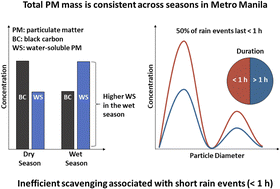
Wet scavenging is the most important sink for particulate matter (PM) and is expected to decrease PM concentrations in the wet season. However, Metro Manila, Philippines has highly similar PM mass across seasons despite large differences in seasonal rainfall. It is important to identify factors contributing to seasonally consistent PM mass as these may be present in similar developing megacities besides Metro Manila, leading to PM accumulation and posing significant health risks. We use size-resolved aerosol composition, aerosol optical depth, and meteorological data to reveal that the seasonally consistent PM mass in Metro Manila is due to (1) opposing seasonal cycles of black carbon and water-soluble PM, (2) inefficient scavenging by short rain events (<1 h), and (3) the high frequency (50%) of these short rain events. Water-soluble PM was most sensitive to scavenging within the 0.18–1.0 μm and 1.8–5.6 μm size ranges but more clearly for rain events lasting over an hour, pointing to the importance of rain duration for efficient scavenging. We demonstrate that the presence of rain does not imply wet scavenging is taking place efficiently and rain characteristics are critical to properly estimating wet scavenging. In a changing climate, our understanding of factors such as rain duration and aerosol accumulation will become more important for guiding air quality-related policymaking and ensuring sustainable growth in developing megacities.
Recommended Literature
- [1] Excellent mechanical performance and enhanced dielectric properties of OBC/SiO2 elastomeric nanocomposites: effect of dispersion of the SiO2 nanoparticles? Xing Zhao,Lu Bai,Rui-Ying Bao,Zheng-Ying Liu,Ming-Bo Yang,Wei YangRSC Adv., 2017,7, 46297-46305 10.1039/C7RA08074C
- [2] Evolutionary de novo design of phenothiazine derivatives for dye-sensitized solar cells? Vishwesh Venkatraman,Marco Foscato,Vidar R. Jensen,Bj?rn K?re AlsbergJ. Mater. Chem. A, 2015,3, 9851-9860 10.1039/C5TA00625B
- [3] Fast synthesis of copper nanoclusters through the use of hydrogen peroxide additive and their application for the fluorescence detection of Hg2+ in water samples? Liao Xiaoqing,Li Ruiyi,Li Zaijun,Sun Xiulan,Wang Zhouping,Liu JunkangNew J. Chem., 2015,39, 5240-5248 10.1039/C5NJ00831J
- [4] Evolution of calcium phosphate precipitation in hanging drop vapor diffusion by in situRaman microspectroscopy Gloria Belén Ramírez-Rodríguez,José Manuel Delgado-López,Jaime Gómez-MoralesCrystEngComm, 2013,15, 2206-2212 10.1039/C2CE26556G
- [5] EWOD-driven droplet microfluidic device integrated with optoelectronic tweezers as an automated platform for cellular isolation and analysis? Gaurav J. Shah,Eric P.-Y. Chiou,Ming C. Wu,Chang-Jin “CJ” KimLab Chip, 2009,9, 1732-1739 10.1039/B821508A
- [6] Examination of the hydrogen-bonding networks in small water clusters (n = 2–5, 13, 17) using absolutely localized molecular orbital energy decomposition analysis? Erika A. Cobar,Paul R. Horn,Robert G. Bergman,Martin Head-GordonPhys. Chem. Chem. Phys., 2012,14, 15328-15339 10.1039/C2CP42522J
- [7] Distinct impact of glycation towards the aggregation and toxicity of murine and human amyloid-β? Eunju Nam,Jiyeon Han,Sunhee Choi,Mi Hee LimChem. Commun., 2021,57, 7637-7640 10.1039/D1CC02695J
- [8] Evolving better nanoparticles: Genetic algorithms for optimising cluster geometries Dalton Trans., 2003, 4193-4207 10.1039/B305686D
- [9] Evolution of cellulose into flexible conductive green electronics: a smart strategy to fabricate sustainable electrodes for supercapacitors Tengfei Yu,Yuehan Wu,Wei Li,Bin LiRSC Adv., 2014,4, 34134-34143 10.1039/C4RA07017H
- [10] Evolution of hierarchical porous structures in supramolecular guest–host hydrogels? Christopher B. Rodell,Christopher B. Highley,Minna H. Chen,Neville N. Dusaj,Chao Wang,Lin Han,Jason A. BurdickSoft Matter, 2016,12, 7839-7847 10.1039/C6SM01395C

Journal Name:Environmental Science: Atmospheres
research_products
-

CAS no.: 89640-58-4

![1,2,3,4,5,6-Hexahydro-[2,3]bipyridinyl-6-ol](https://ossimg.kuujia.com/scimg/1271000/1270529-38-8x500.png)


![N-(3-cyanothiolan-3-yl)-2-[(2,2,2-trifluoroethyl)sulfanyl]pyridine-4-carboxamide](https://ossimg.kuujia.com/scimg/1444500/1444113-98-7x500.png)

![2,2-Difluoro-3-[methyl(2-methylbutyl)amino]propanoic acid](https://ossimg.kuujia.com/scimg/2138500/2138166-62-6x500.png)

![2-(1H-indol-3-yl)-N-{[6-(thiophen-2-yl)-[1,2,4]triazolo[4,3-b]pyridazin-3-yl]methyl}acetamide](https://ossimg.kuujia.com/scimg/2034500/2034271-14-0x500.png)