Iron(ii)-α-keto acid complexes of tridentate ligands on gold nanoparticles: the effect of ligand geometry and immobilization on their dioxygen-dependent reactivity?
Dalton Transactions Pub Date: 2022-12-07 DOI: 10.1039/D2DT02433K
Abstract
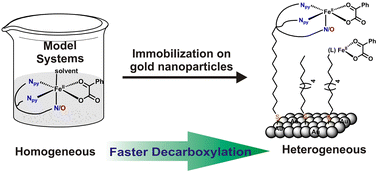
Two mononuclear nonheme iron(II)-benzoylformate (BF) complexes [(6Me2-Me-BPA)Fe(BF)](ClO4) (1a) and [(6Me3-TPMM)Fe(BF)](ClO4) (1b) of tridentate nitrogen donor ligands, bis((6-methylpyridin-2-yl)methyl)(N-methyl)amine (6Me2-Me-BPA) and tris(2-(6-methyl)pyridyl)methoxymethane (6Me3-TPMM), were isolated and characterized. The structural characterization of iron(II)-chloro complexes indicates that the ligand 6Me2-Me-BPA binds to the iron(II) centre in a meridional fashion, whereas 6Me3-TPMM behaves as a facial ligand. Both the ligands were functionalized with terminal thiol for immobilization on gold nanoparticles (AuNPs), and the corresponding iron(II) complexes [(6Me2-BPASH)Fe(BF)(ClO4)]@C8Au (2a) and [(6Me3-TPMSH)Fe(BF)(ClO4)]@C8Au (2b) were prepared to probe the effect of immobilization on their ability to perform bioinspired oxidation reactions. All the complexes react with dioxygen to display the oxidative decarboxylation of the coordinated benzoylformate, but the complexes supported by 6Me3-TPMM and its thiol-appended ligand display faster reactivity compared to their analogues with the 6Me2-Me-BPA-derived ligands. In each case, an electrophilic iron–oxygen oxidant was intercepted as the active oxidant generated from dioxygen. The immobilized complexes (2a and 2b) display enhanced O2-dependent reactivity in oxygen-atom transfer reactions (OAT) and hydrogen-atom transfer (HAT) reactions compared to their homogeneous congeners (1a and 1b). Furthermore, the immobilized complex 2b displays catalytic OAT reactions. This study supports that the ligand geometry and immobilization on AuNPs influence the dioxygen-dependent reactivity of the complexes.
Recommended Literature
- [1] Alternative synthesis of the anti-baldness compound RU58841? RSC Adv., 2014,4, 14143-14148 10.1039/C4RA00332B
- [2] An amorphous carbon nitride/NiO/CoN-based composite: a highly efficient nonprecious electrode for supercapacitors and the oxygen evolution reaction? Huifang Yang,Haoran Guo,Peidong Fan,Xinpan Li,Wenlu Ren,Rui SongNanoscale, 2020,12, 7024-7034 10.1039/D0NR00001A
- [3] An analysis of the WTC fires using CIB correlations and simple modeling JGQuintiere 10.1177/0734904121989670
- [4] An apparatus for testing water by measurement of its electrical conductivity Analyst, 1912,37, 538-543 10.1039/AN9123700538
- [5] An artificial enzyme cascade amplification strategy for highly sensitive and specific detection of breast cancer-derived exosomes? Huiying Xu,Lu Zheng,Yu Zhou,Bang-Ce YeAnalyst, 2021,146, 5542-5549 10.1039/D1AN01071A
- [6] An asymmetric supercapacitor based on controllable WO3 nanorod bundle and alfalfa-derived porous carbon? Kanjun Sun,Fengting Hua,Shuzhen Cui,Yanrong Zhu,Hui Peng,Guofu MaRSC Adv., 2021,11, 37631-37642 10.1039/D1RA04788D
- [7] Acetyl protected thiol methacrylic polymers as effective ligands to keep quantum dots in luminescent standby mode? Marta Liras,Isabel Quijada-Garrido,Marta Palacios-Cuesta,Sonia Mu?oz-Durieux,Olga GarcíaPolym. Chem., 2014,5, 433-442 10.1039/C3PY00987D
- [8] Alt-proteins: A promising future 10.1002/fsat.3701_10.x
- [9] An amorphous Cu–In–S nanoparticle-based precursor ink with improved atom economy for CuInSe2 solar cells with 10.85% efficiency? Green Chem., 2017,19, 1268-1277 10.1039/C6GC03280J
- [10] Acetyl group orientation modulates the electronic ground-state asymmetry of the special pair in purple bacterial reaction centers P. K. Wawrzyniak,M. T. P. Beerepoot,H. J. M. de Groot,F. BudaPhys. Chem. Chem. Phys., 2011,13, 10270-10279 10.1039/C1CP20213H

Journal Name:Dalton Transactions
research_products
-

CAS no.: 89640-58-4


![N-(3-cyanothiolan-3-yl)-2-[(2,2,2-trifluoroethyl)sulfanyl]pyridine-4-carboxamide](https://ossimg.kuujia.com/scimg/1444500/1444113-98-7x500.png)

![1,2,3,4,5,6-Hexahydro-[2,3]bipyridinyl-6-ol](https://ossimg.kuujia.com/scimg/1271000/1270529-38-8x500.png)

![2,2-Difluoro-3-[methyl(2-methylbutyl)amino]propanoic acid](https://ossimg.kuujia.com/scimg/2138500/2138166-62-6x500.png)

![2-(1H-indol-3-yl)-N-{[6-(thiophen-2-yl)-[1,2,4]triazolo[4,3-b]pyridazin-3-yl]methyl}acetamide](https://ossimg.kuujia.com/scimg/2034500/2034271-14-0x500.png)