The metabolomic analysis of five Mentha species: cytotoxicity, anti-Helicobacter assessment, and the development of polymeric micelles for enhancing the anti-Helicobacter activity
RSC Advances Pub Date: 2021-02-12 DOI: 10.1039/D0RA09334C
Abstract
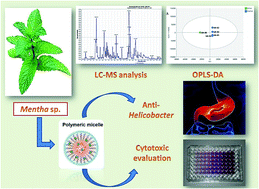
Mentha species are medicinally used worldwide and remain attractive for research due to the diversity of their phytoconstituents and large therapeutic indices for various ailments. This study used the metabolomics examination of five Mentha species (M. suaveolens, M. sylvestris, M. piperita, M. longifolia, and M. viridis) to justify their cytotoxicity and their anti-Helicobacter effects. The activities of species were correlated with their phytochemical profiles by orthogonal partial least square discriminant analysis (OPLS-DA). Tentatively characterized phytoconstituents using liquid chromatography high-resolution electrospray ionization mass spectrometry (LC-HR-ESI-MS) included 49 compounds: 14 flavonoids, 10 caffeic acid esters, 7 phenolic acids, and other constituents. M. piperita showed the highest cytotoxicity to HepG2 (human hepatoma), MCF-7 (human breast adenocarcinoma), and CACO2 (human colon adenocarcinoma) cells using 3-(4,5-dimethylthiazol-2-yl)-2,5-diphenyltetrazolium bromide (MTT) assays. OPLS-DA and dereplication studies predicted that the cytotoxic activity was related to benzyl glucopyranoside-sulfate, a lignin glycoside. Furthermore, M. viridis was effective in suppressing the growth of Helicobacter pylori at a concentration of 50 mg mL?1. OPLS-DA predicted that this activity was related to a dihydroxytrimethoxyflavone. M. viridis extract was formulated with Pluronic? F127 to develop polymeric micelles as a nanocarrier that enhanced the anti-Helicobacter activity of the extract and provided minimum inhibitory concentrations and minimum bactericidal concentrations of 6.5 and 50 mg mL?1, respectively. This activity was also correlated to tentatively identified constituents, including rosmarinic acid, catechins, carvone, and piperitone oxide.
Recommended Literature
- [1] Emulsion soft templating of carbide-derived carbon nanospheres with controllable porosity for capacitive electrochemical energy storage? M. Zeiger,N. J?ckel,P. Strubel,L. Borchardt,R. Reinhold,W. Nickel,J. Eckert,V. Presser,S. KaskelJ. Mater. Chem. A, 2015,3, 17983-17990 10.1039/C5TA03730A
- [2] Emulsion technologies for multicellular tumour spheroid radiation assays? Kay S. McMillan,Anthony G. McCluskey,Annette Sorensen,Marie Boyd,Michele ZagnoniAnalyst, 2016,141, 100-110 10.1039/C5AN01382H
- [3] Dissociation of large gaseous serine clusters produces abundant protonated serine octamer Jacob S. Jordan,Evan R. WilliamsAnalyst, 2021,146, 2617-2625 10.1039/D1AN00273B
- [4] Evolution of dealloying induced strain in nanoporous gold crystals? Ross Harder,David C. Dunand,Ian McNultyNanoscale, 2017,9, 5686-5693 10.1039/C6NR09635B
- [5] Excitation energies from ground-state density-functionals by means of generator coordinates A. B. F. da Silva,K. CapellePhys. Chem. Chem. Phys., 2009,11, 4564-4569 10.1039/B902529D
- [6] Examination of ammonia–poly(pyrrole) interactions by piezoelectric and conductivity measurements Analyst, 1991,116, 1125-1130 10.1039/AN9911601125
- [7] Fast-Track to Research Data Management in Experimental Material Science-Setting the Ground for Research Group Level Materials Digitalization. LarsBanko,AlfredLudwig 10.1021/acscombsci.0c00057
- [8] Embedding cyclic nitrone in mesoporous silica particles for EPR spin trapping of superoxide and other radicals? Eric Besson,Stéphane Gastaldi,Emily Bloch,Selma Aslan,Hakim Karoui,Olivier Ouari,Micael HardyAnalyst, 2019,144, 4194-4203 10.1039/C9AN00468H
- [9] Evidence that the availability of an allylic hydrogen governs the regioselectivity of the Wacker oxidation Matthew J. Gaunt,Jinquan Yu,Jonathan B. SpencerChem. Commun., 2001, 1844-1845 10.1039/B103066N
- [10] Establishing plasmon contribution to chemical reactions: alkoxyamines as a thermal probe? Olga Guselnikova,Gérard Audran,Jean-Patrick Joly,Andrii Trelin,Evgeny V. Tretyakov,Vaclav Svorcik,Oleksiy Lyutakov,Sylvain R. A. MarqueChem. Sci., 2021,12, 4154-4161 10.1039/D0SC06470J

Journal Name:RSC Advances
research_products
-

CAS no.: 89640-58-4


![N-(3-cyanothiolan-3-yl)-2-[(2,2,2-trifluoroethyl)sulfanyl]pyridine-4-carboxamide](https://ossimg.kuujia.com/scimg/1444500/1444113-98-7x500.png)

![1,2,3,4,5,6-Hexahydro-[2,3]bipyridinyl-6-ol](https://ossimg.kuujia.com/scimg/1271000/1270529-38-8x500.png)

![2,2-Difluoro-3-[methyl(2-methylbutyl)amino]propanoic acid](https://ossimg.kuujia.com/scimg/2138500/2138166-62-6x500.png)

![2-(1H-indol-3-yl)-N-{[6-(thiophen-2-yl)-[1,2,4]triazolo[4,3-b]pyridazin-3-yl]methyl}acetamide](https://ossimg.kuujia.com/scimg/2034500/2034271-14-0x500.png)