Synthesis, self-assembly, and catalytic activity of histidine-based structured lipopeptides for hydrolysis reactions in water?
RSC Advances Pub Date: 2015-04-13 DOI: 10.1039/C5RA02853A
Abstract
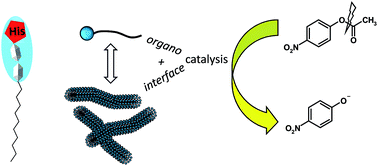
A new series of lipopeptides was designed to study their organocatalytic properties towards ester hydrolysis and the role of their self-assembled structures in catalysis. Synthesis of the catalysts was achieved by grafting fatty chains on tripeptides either at the C-terminal position or at the N-terminal extremity, affording amphiphilic character and self-assembling properties. Insertion of a histidine in the peptide sequence was chosen to bring about organocatalytic activity. Self-organization was evidenced first by the determination of critical aggregation concentrations and then by characterizing the aggregates formed by performing scattering techniques and microscopy. Variation of the structures (peptide sequence, hydrophobic character) led to the formation of various aggregates, from globular objects to fibers. All derivatives containing histidine presented a catalytic activity for the hydrolysis reaction of p-nitrophenyl acetate in aqueous solution. The influence of the self-organization on the catalysis was evidenced by showing different behaviors observed between the monomers and aggregates.
Recommended Literature
- [1] Acetylcholinesterase amperometric detection system based on a cobalt(II) tetraphenylporphyrin-modified electrode Analyst, 1996,121, 1123-1126 10.1039/AN9962101123
- [2] An atomistic mechanism for the degradation of perovskite solar cells by trapped charge? Eunhak Lim,Jiyoung Heo,Seong Keun KimNanoscale, 2019,11, 11369-11378 10.1039/C9NR02193K
- [3] An approach to C–N activation: coupling of arenesulfonyl hydrazides and arenesulfonyl chlorides with tert-amines via a metal-, oxidant- and halogen-free anodic oxidation?? M. Sheykhan,S. Khani,S. Shaabanzadeh,M. JoafshanGreen Chem., 2017,19, 5940-5948 10.1039/C7GC03141F
- [4] An astrophysically-relevant mechanism for amino acid enantiomer enrichment Stephen P. Fletcher,Richard B. C. Jagt,Ben L. FeringaChem. Commun., 2007, 2578-2580 10.1039/B702882B
- [5] An algal process treatment combined with the Fenton reaction for high concentrations of amoxicillin and cefradine Haitao Li,Yu Pan,Zhizhi Wang,Shan Chen,Ruixin Guo,Jianqiu ChenRSC Adv., 2015,5, 100775-100782 10.1039/C5RA21508K
- [6] An artificial photosynthetic system for photoaccumulation of two electrons on a fused dipyridophenazine (dppz)–pyridoquinolinone ligand? Philipp Traber,Stephan Kupfer,Stefanie Gr?fe,Isabelle Baussanne,Martine Demeunynck,Jean-Marie Mouesca,Serge Gambarelli,Vincent Artero,Murielle Chavarot-KerlidouChem. Sci., 2018,9, 4152-4159 10.1039/C7SC04348A
- [7] An all-solid-state imprinted polymer-based potentiometric sensor for determination of bisphenol S? Rongning Liang,Tanji Yin,Ruiqing Yao,Wei QinRSC Adv., 2016,6, 73308-73312 10.1039/C6RA14461F
- [8] An integrated droplet-digital microfluidic system for on-demand droplet creation, mixing, incubation, and sorting? Lab Chip, 2019,19, 524-535 10.1039/C8LC01170B
- [9] An automatic determination of thoria in thoria-urania mixtures Analyst, 1966,91, 208-210 10.1039/AN9669100208
- [10] An autonomous self-optimizing flow machine for the synthesis of pyridine–oxazoline (PyOX) ligands? Eric Wimmer,Daniel Cortés-Borda,Solène Brochard,Elvina Barré,Charlotte Truchet,Fran?ois-Xavier FelpinReact. Chem. Eng., 2019,4, 1608-1615 10.1039/C9RE00096H

Journal Name:RSC Advances
research_products
-

CAS no.: 89640-58-4


![N-(3-cyanothiolan-3-yl)-2-[(2,2,2-trifluoroethyl)sulfanyl]pyridine-4-carboxamide](https://ossimg.kuujia.com/scimg/1444500/1444113-98-7x500.png)

![1,2,3,4,5,6-Hexahydro-[2,3]bipyridinyl-6-ol](https://ossimg.kuujia.com/scimg/1271000/1270529-38-8x500.png)

![2,2-Difluoro-3-[methyl(2-methylbutyl)amino]propanoic acid](https://ossimg.kuujia.com/scimg/2138500/2138166-62-6x500.png)

![2-(1H-indol-3-yl)-N-{[6-(thiophen-2-yl)-[1,2,4]triazolo[4,3-b]pyridazin-3-yl]methyl}acetamide](https://ossimg.kuujia.com/scimg/2034500/2034271-14-0x500.png)