An intrinsic white-light-emitting hyperbranched polyimide: synthesis, structure–property and its application as a “turn-off” sensor for iron(iii) ions?
Journal of Materials Chemistry C Pub Date: 2019-10-28 DOI: 10.1039/C9TC04102H
Abstract
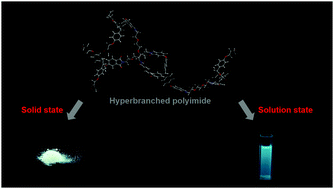
An intrinsic white-light-emitting semi-aliphatic hyperbranched polyimide with epoxide terminal groups (EHBPI) has been reported for the first time. The UV/vis absorption spectra and density functional theory calculations showed that the lowest electronic transition of the semi-aliphatic hyperbranched polyimide is hybridized local and charge transfer transition, whereas the lowest electronic transition of aromatic hyperbranched polyimides is charge transfer transition. Due to the hybridized local and charge transfer transition, semi-aliphatic EHBPIs emit visible fluorescence after excitation. The solution fluorescence results suggest that (1) fluorescence depends on the backbone structure and the terminal group; (2) solvent polarity, concentration, degree of aggregation, and temperature also affect emission behaviors; (3) both iron and copper ions quench the solution fluorescence, with Fe3+ being the most effective. The decreasing trend of the quantum yield with increasing concentration and/or addition of water as well as the higher solution-state quantum yield compared with that in the solid state indicate the ACQ nature of the fluorescence. Moreover, EHBPI3, which has the most flexible spacer, emits bluish green fluorescence in solution and emits white fluorescence in the solid state. The free-standing film prepared by blending EHBPI3 with poly(vinyl alcohol) also emits white fluorescence with a quantum yield of 0.05. The solid-state white fluorescence in a simple single-component hyperbranched polymer could offer unique benefits for certain applications.
Recommended Literature
- [1] Emerging investigator series: kinetics of diopside reactivity for carbon mineralization in mafic–ultramafic rocks BrianaAguila,LandonHardee,H.ToddSchaef,SiavashZare,MohammadJavadAbdolhosseiniQomi,JarrodV.Crum,JadeE.HollimanJr.,ElenaTajueloRodriguez,LawrenceM.Anovitz,KevinM.Rosso,QuinR.S.Miller 10.1039/d3en00087g
- [2] Fate of nitrogen-15 in the subsequent growing season of greenhouse tomato plants (Lycopersicon esculentum Mill) as influenced by alternate partial root-zone irrigation Maomao Hou,Fenglin Zhong,Qiu Jin,Enjiang Liu,Jie Feng,Tengyun Wang,Yue GaoRSC Adv., 2017,7, 34392-34400 10.1039/C7RA05271E
- [3] Emerging investigator series: heterogeneous reactions of sulfur dioxide on mineral dust nanoparticles: from single component to mixed components? Tao Wang,Yangyang Liu,Yue Deng,Hongbo Fu,Jianmin ChenEnviron. Sci.: Nano, 2018,5, 1821-1833 10.1039/C8EN00376A
- [4] Fast-Track to Research Data Management in Experimental Material Science-Setting the Ground for Research Group Level Materials Digitalization. LarsBanko,AlfredLudwig 10.1021/acscombsci.0c00057
- [5] Establishing empirical design rules of nucleic acid templates for the synthesis of silver nanoclusters with tunable photoluminescence and functionalities towards targeted bioimaging applications? Jason Y. C. Lim,Yong Yu,Guorui Jin,Kai Li,Yi Lu,Jianping XieNanoscale Adv., 2020,2, 3921-3932 10.1039/D0NA00381F
- [6] Excited state dynamics of symmetric and asymmetric Cr3(dpa)4Cl2 measured using femtosecond transient absorption spectroscopy? Chao-Han Cheng,Wen-Zhen Wang,Shie-Ming Peng,I-Chia ChenPhys. Chem. Chem. Phys., 2017,19, 25471-25477 10.1039/C7CP03968A
- [7] Emerging investigator series: bacteriophages as nano engineering tools for quality monitoring and pathogen detection in water and wastewater Fereshteh BayatEnviron. Sci.: Nano, 2021,8, 367-389 10.1039/D0EN00962H
- [8] Establishment and implications of a characterization method for magnetic nanoparticle using cell tracking velocimetry and magnetic susceptibility modified solutions Huading Zhang,Lee R. Moore,Maciej Zborowski,P. Stephen Williams,Shlomo Margel,Jeffrey J. ChalmersAnalyst, 2005,130, 514-527 10.1039/B412723D
- [9] Excitable dynamics in the bromate–sulfite–ferrocyanide reaction J. Zagora,M. Vosla?,L. Schreiberová,I. SchreiberPhys. Chem. Chem. Phys., 2002,4, 1284-1291 10.1039/B110048C
- [10] Examination of deposit in commercial diluted phosphoric acid Analyst, 1880,5, 146-147 10.1039/AN8800500146

Journal Name:Journal of Materials Chemistry C
research_products
-

CAS no.: 89640-58-4


![N-(3-cyanothiolan-3-yl)-2-[(2,2,2-trifluoroethyl)sulfanyl]pyridine-4-carboxamide](https://ossimg.kuujia.com/scimg/1444500/1444113-98-7x500.png)

![1,2,3,4,5,6-Hexahydro-[2,3]bipyridinyl-6-ol](https://ossimg.kuujia.com/scimg/1271000/1270529-38-8x500.png)

![2,2-Difluoro-3-[methyl(2-methylbutyl)amino]propanoic acid](https://ossimg.kuujia.com/scimg/2138500/2138166-62-6x500.png)

![2-(1H-indol-3-yl)-N-{[6-(thiophen-2-yl)-[1,2,4]triazolo[4,3-b]pyridazin-3-yl]methyl}acetamide](https://ossimg.kuujia.com/scimg/2034500/2034271-14-0x500.png)