Sonneratia apetala seed oil attenuates potassium oxonate/hypoxanthine-induced hyperuricemia and renal injury in mice?
Food & Function Pub Date: 2021-07-24 DOI: 10.1039/D1FO01830B
Abstract
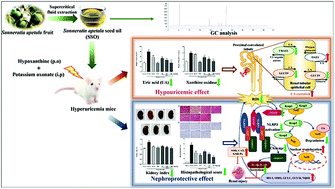
Sonneratia apetala seeds are considered as prospective nutraceuticals with a high content of unsaturated fatty acids (UFAs) which are mainly distributed in the oil. It is well-known that UFAs could exhibit urate-lowering potency and protect against renal injury, indicating that S. apetala seed oil (SSO) may possess hypouricemic and nephroprotective effects. Consequently, the present work attempted to probe into the effects and mechanisms of SSO on potassium oxonate/hypoxanthine-induced hyperuricemia and associated renal injury. The results indicated that SSO treatment prominently inhibited the increase of serum uric acid (UA), creatinine (CRE), and urea nitrogen (BUN) levels and hepatic xanthine oxidase (XOD) activity in hyperuricemia mice. Kidney indexes and histopathological lesions were also remarkably ameliorated. Additionally, SSO treatment improved the renal anti-oxidant status in hyperuricemia mice by significantly reversing the increase in ROS and MDA levels as well as the decline in SOD, CAT and GSH-Px activities. SSO dramatically downregulated the expression and secretion of pro-inflammatory factors involving MCP-1, IL-1β, IL-6, IL-18 and TNF-α elicited by hyperuricemia. Furthermore, after SSO treatment, increased protein expressions of GLUT9, URAT1 and OAT1 in the hyperuricemia mice were obviously reversed. SSO treatment enormously restored Nrf2 activation and subsequent translation of related anti-oxidative enzymes in the kidneys. TXNIP/NLRP3 inflammasome activation was also obviously suppressed by SSO. In conclusion, SSO exerted favorable hypouricemic effects owing to its dual functions of downregulating the XOD activity and modulating the expressions of renal urate transport-associated proteins, and it also could alleviate hyperuricemia-induced renal injury by restoring the Keap1-Nrf2 pathway and blocking the TXNIP/NLRP3 inflammasome activation.
Recommended Literature
- [1] Exciplex emission from the mixed dimer of naphthalene and 2-cyanonaphthalene in a supersonic jet Aloke Das,K. K. Mahato,Chayan K. Nandi,Tapas Chakraborty,Shridhar R. Gadre,Nikhil A. GokhalePhys. Chem. Chem. Phys., 2002,4, 2162-2168 10.1039/B200124C
- [2] Excimer formation effects and trap-assisted charge recombination loss channels in organic solar cells of perylene diimide dimer acceptors? Min Kim,Jae-Joon Lee,Tengling Ye,Panagiotis E. Keivanidis,Kilwon ChoJ. Mater. Chem. C, 2020,8, 1686-1696 10.1039/C9TC04955J
- [3] Excellent mechanical performance and enhanced dielectric properties of OBC/SiO2 elastomeric nanocomposites: effect of dispersion of the SiO2 nanoparticles? Xing Zhao,Lu Bai,Rui-Ying Bao,Zheng-Ying Liu,Ming-Bo Yang,Wei YangRSC Adv., 2017,7, 46297-46305 10.1039/C7RA08074C
- [4] Evolution of hierarchical porous structures in supramolecular guest–host hydrogels? Christopher B. Rodell,Christopher B. Highley,Minna H. Chen,Neville N. Dusaj,Chao Wang,Lin Han,Jason A. BurdickSoft Matter, 2016,12, 7839-7847 10.1039/C6SM01395C
- [5] Evidence of CO2 molecule acting as an electron acceptor on a nanoporous metal–organic-framework MIL-53 or Cr3+(OH)(O2C–C6H4–CO2)? Alexandre Vimont,Arnaud Travert,Philippe Bazin,Jean-Claude Lavalley,Marco Daturi,Christian Serre,Gérard Férey,Sandrine Bourrelly,Philip L. LlewellynChem. Commun., 2007, 3291-3293 10.1039/B703468G
- [6] Evidence that the availability of an allylic hydrogen governs the regioselectivity of the Wacker oxidation Matthew J. Gaunt,Jinquan Yu,Jonathan B. SpencerChem. Commun., 2001, 1844-1845 10.1039/B103066N
- [7] Evolutionary de novo design of phenothiazine derivatives for dye-sensitized solar cells? Vishwesh Venkatraman,Marco Foscato,Vidar R. Jensen,Bj?rn K?re AlsbergJ. Mater. Chem. A, 2015,3, 9851-9860 10.1039/C5TA00625B
- [8] Emerging enantiomeric resolution materials with homochiral nano-fabrications Ji-Ping WeiNanoscale, 2015,7, 11815-11832 10.1039/C5NR03048J
- [9] Establishing empirical design rules of nucleic acid templates for the synthesis of silver nanoclusters with tunable photoluminescence and functionalities towards targeted bioimaging applications? Jason Y. C. Lim,Yong Yu,Guorui Jin,Kai Li,Yi Lu,Jianping XieNanoscale Adv., 2020,2, 3921-3932 10.1039/D0NA00381F
- [10] Fe3O4 nanosphere@microporous organic networks: enhanced anode performances in lithium ion batteries through carbonization? Byungho Lim,Jaewon Jin,Jin Yoo,Seung Yong Han,Kyeongyeol Kim,Sungah Kang,Nojin Park,Sang Moon Lee,Hae Jin Kim,Seung Uk SonChem. Commun., 2014,50, 7723-7726 10.1039/C4CC02068E
Journal Name:Food & Function
research_products
-

CAS no.: 89640-58-4

![1,2,3,4,5,6-Hexahydro-[2,3]bipyridinyl-6-ol](https://ossimg.kuujia.com/scimg/1271000/1270529-38-8x500.png)


![N-(3-cyanothiolan-3-yl)-2-[(2,2,2-trifluoroethyl)sulfanyl]pyridine-4-carboxamide](https://ossimg.kuujia.com/scimg/1444500/1444113-98-7x500.png)

![2,2-Difluoro-3-[methyl(2-methylbutyl)amino]propanoic acid](https://ossimg.kuujia.com/scimg/2138500/2138166-62-6x500.png)

![2-(1H-indol-3-yl)-N-{[6-(thiophen-2-yl)-[1,2,4]triazolo[4,3-b]pyridazin-3-yl]methyl}acetamide](https://ossimg.kuujia.com/scimg/2034500/2034271-14-0x500.png)