Matrix effects on hydrogen bonding and proton transfer in fluoropyridine – HCl complexes
Physical Chemistry Chemical Physics Pub Date: 2021-12-23 DOI: 10.1039/D1CP04110J
Abstract
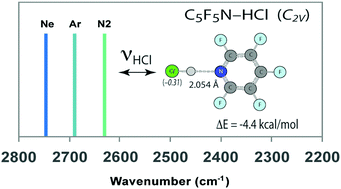
We report an extensive computational and spectroscopic study of several fluoropyridine–HCl complexes, and the parent, pyridine–HCl system. Matrix-IR spectra for pentafluoropyridine–HCl, 2,6-difluororpyridine–HCl, and 3,5-difluororpyridine–HCl in solid neon exhibit shifts for the H–Cl stretching band that parallel the effects of fluorination on hydrogen-bond strength. Analogous spectral shifts observed across various host environments (solid neon, argon, and nitrogen) for pentafluoropyridine–HCl and 2,6-difluororpyridine–HCl convey a systematically varying degree of matrix stabilization on the hydrogen bonds in these complexes. An extended quantum-chemical study of pyridine–HCl and eight fluorinated analogs, including 2-, 3-, and 4-fluoropyridine–HCl, 2,6- and 3,5-difluororpyridine–HCl, 2,4,6- and 3,4,5-trifluropyridine–HCl, as well as pentafluoropyridine–HCl, was also performed. Equilibrium structures and binding energies for the gas-phase complexes illustrate two clear trends in how fluorine substitution affects hydrogen bond strength; increasing fluorination weakens these interactions, yet substitution at the 2- and 6-positions has the most pronounced effect. Bonding analyses for a select subset of these systems reveal shifts in electron density that accompany hydrogen bonding, and most notably, the values of the electron density at the N–H bond critical points among the stronger systems in this subset significantly exceed those typical for moderately strong hydrogen-bonds. We also explored the effects of dielectric media on the structural and bonding properties of these systems. For pyridine–HCl, 3-fluoropyridine–HCl, and 3,5-difluororpyridine–HCl, a transition to proton transfer-type structures is observed at ε-values of 1.2, 1.5, and 2.0, respectively. This is signaled by key structural changes, as well as an increase in the negative charge on the chorine, and dramatic shifts in topological properties of the H–Cl and N–H bonds. In the case of pentafluoropyridine–HCl, and 2,6-difluororpyridine–HCl, we do not predict proton transfer in dielectric media up to ε = 20.0. However, there are clear indications that the media enhance hydrogen-bond strength, and moreover, these observations are completely consistent with the experimental IR spectra.
Recommended Literature
- [1] Evolved polymerases facilitate selection of fully 2′-OMe-modified aptamers? Zhixia Liu,Tingjian Chen,Floyd E. RomesbergChem. Sci., 2017,8, 8179-8182 10.1039/C7SC03747C
- [2] Examination of the hydrogen-bonding networks in small water clusters (n = 2–5, 13, 17) using absolutely localized molecular orbital energy decomposition analysis? Erika A. Cobar,Paul R. Horn,Robert G. Bergman,Martin Head-GordonPhys. Chem. Chem. Phys., 2012,14, 15328-15339 10.1039/C2CP42522J
- [3] Evolutionary de novo design of phenothiazine derivatives for dye-sensitized solar cells? Vishwesh Venkatraman,Marco Foscato,Vidar R. Jensen,Bj?rn K?re AlsbergJ. Mater. Chem. A, 2015,3, 9851-9860 10.1039/C5TA00625B
- [4] Evolution of calcium phosphate precipitation in hanging drop vapor diffusion by in situRaman microspectroscopy Gloria Belén Ramírez-Rodríguez,José Manuel Delgado-López,Jaime Gómez-MoralesCrystEngComm, 2013,15, 2206-2212 10.1039/C2CE26556G
- [5] Dissociative dynamics of O2 on Ag(110)? Ivor Lon?ari?Phys. Chem. Chem. Phys., 2015,17, 9436-9445 10.1039/C4CP05900J
- [6] Fast-Track to Research Data Management in Experimental Material Science-Setting the Ground for Research Group Level Materials Digitalization. LarsBanko,AlfredLudwig 10.1021/acscombsci.0c00057
- [7] Emerging investigator series: bacteriophages as nano engineering tools for quality monitoring and pathogen detection in water and wastewater Fereshteh BayatEnviron. Sci.: Nano, 2021,8, 367-389 10.1039/D0EN00962H
- [8] Excellent energy storage performance in NaNbO3-based relaxor antiferroeic ceramics under a low electric field XuxinCheng,XiaomingChen,PengyuanFan 10.1007/s10832-022-00283-w
- [9] Evidence for the intrinsic nature of band-gap states electrochemically observed on atomically flat TiO2(110) surfaces? Shintaro Takata,Yoshihiro MiuraPhys. Chem. Chem. Phys., 2014,16, 24784-24789 10.1039/C4CP03280B
- [10] Evolution of cellulose into flexible conductive green electronics: a smart strategy to fabricate sustainable electrodes for supercapacitors Tengfei Yu,Yuehan Wu,Wei Li,Bin LiRSC Adv., 2014,4, 34134-34143 10.1039/C4RA07017H

Journal Name:Physical Chemistry Chemical Physics
research_products
-

CAS no.: 89640-58-4


![N-(3-cyanothiolan-3-yl)-2-[(2,2,2-trifluoroethyl)sulfanyl]pyridine-4-carboxamide](https://ossimg.kuujia.com/scimg/1444500/1444113-98-7x500.png)

![1,2,3,4,5,6-Hexahydro-[2,3]bipyridinyl-6-ol](https://ossimg.kuujia.com/scimg/1271000/1270529-38-8x500.png)

![2,2-Difluoro-3-[methyl(2-methylbutyl)amino]propanoic acid](https://ossimg.kuujia.com/scimg/2138500/2138166-62-6x500.png)

![2-(1H-indol-3-yl)-N-{[6-(thiophen-2-yl)-[1,2,4]triazolo[4,3-b]pyridazin-3-yl]methyl}acetamide](https://ossimg.kuujia.com/scimg/2034500/2034271-14-0x500.png)