Impacts of surfactants on dissolution and sulfidation of silver nanowires in aquatic environments?
Environmental Science: Nano Pub Date: 2018-09-22 DOI: 10.1039/C8EN00898A
Abstract
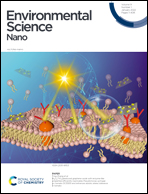
Due to their excellent properties, silver nanowires (AgNWs) have been applied increasingly in many optical and electronic products, and may be inevitably discharged in aquatic environments. Dissolution and sulfidation are two of the most important processes of AgNWs occurring in aquatic environments and may significantly affect their fate and toxicities. This study aimed to investigate the impacts of four types of surfactants on the dissolution and sulfidation of AgNWs. Anionic, zwitterionic, and nonionic surfactants, including sodium dodecylbenzenesulfonate, cetyl betaine, and glycerol monostearate, did not affect the dissolution and sulfidation of AgNWs. However, cationic surfactants (cetyltrimethylammonium bromide, cetyltrimethylammonium nitrate and benzyldimethyldodecylammonium nitrate) promoted the dissolution and sulfidation of AgNWs significantly. The cationic surfactants, especially cetyltrimethylammonium bromide, preferred to bind with the (111) planes of AgNWs, leading to the corrosion of the initial wire structure of AgNWs to shorter nanorods. The increased surface area of AgNWs resulted in faster dissolution. The dissolved Ag+ ions reacted with sulfide quickly, leading to faster sulfidation of AgNWs. In addition, the cationic surfactants interacted with AgNWs and decreased the electrostatic repulsion between the sulfide ions and the surface of AgNWs, thus promoting the direct oxysulfidation. As a consequence, the cationic surfactants facilitated the sulfidation of AgNWs to a greater extent than dissolution. The interaction of AgNWs and surfactants could significantly affect their bioavailability and ecotoxicities in aquatic environments.

Recommended Literature
- [1] Fe(iii)-mediated isomerization of α,α-diarylallylic alcohols to ketones via radical 1,2-aryl migration? Ziyang Deng,Changwei Chen,Sunliang CuiRSC Adv., 2016,6, 93753-93755 10.1039/C6RA20007A
- [2] Evidence of field induced slow magnetic relaxation in cis-[Co(hfac)2(H2O)2] exhibiting tri-axial anisotropy with a negative axial component? Denis V. Korchagin,Elena A. Yureva,Alexander V. Akimov,Eugenii Ya. Misochko,Gennady V. Shilov,Artem D. Talantsev,Roman B. Morgunov,Alexander A. Shakin,Sergey M. Aldoshin,Boris S. TsukerblatDalton Trans., 2017,46, 7540-7548 10.1039/C7DT01236E
- [3] Fe(ii)-Assisted one-pot synthesis of ultra-small core–shell Au–Pt nanoparticles as superior catalysts towards the HER and ORR? Yi Cao,Yujiao Xiahou,Lixiang Xing,Xiang Zhang,Hong Li,ChenShou Wu,Haibing XiaNanoscale, 2020,12, 20456-20466 10.1039/D0NR04995F
- [4] Fast synthesis of copper nanoclusters through the use of hydrogen peroxide additive and their application for the fluorescence detection of Hg2+ in water samples? Liao Xiaoqing,Li Ruiyi,Li Zaijun,Sun Xiulan,Wang Zhouping,Liu JunkangNew J. Chem., 2015,39, 5240-5248 10.1039/C5NJ00831J
- [5] Excitation energies from ground-state density-functionals by means of generator coordinates A. B. F. da Silva,K. CapellePhys. Chem. Chem. Phys., 2009,11, 4564-4569 10.1039/B902529D
- [6] Fe3O4 nanosphere@microporous organic networks: enhanced anode performances in lithium ion batteries through carbonization? Byungho Lim,Jaewon Jin,Jin Yoo,Seung Yong Han,Kyeongyeol Kim,Sungah Kang,Nojin Park,Sang Moon Lee,Hae Jin Kim,Seung Uk SonChem. Commun., 2014,50, 7723-7726 10.1039/C4CC02068E
- [7] Excess electrons in lithium–ethylamine solutions—density, electrical conductivity and EPR studies Phys. Chem. Chem. Phys., 1999,1, 3561-3565 10.1039/A900683D
- [8] Esterase-responsive polymeric prodrug-based tumor targeting nanoparticles for improved anti-tumor performance against colon cancer? Gang Pan,Yi-jie Bao,Jie Xu,Tao Liu,Cheng Liu,Yan-yan Qiu,Xiao-jing Shi,Hui Yu,Ting-ting Jia,Xia Yuan,Ze-ting Yuan,Yi-jun CaoRSC Adv., 2016,6, 42109-42119 10.1039/C6RA05236C
- [9] Examination of ammonia–poly(pyrrole) interactions by piezoelectric and conductivity measurements Analyst, 1991,116, 1125-1130 10.1039/AN9911601125
- [10] Establishment and implications of a characterization method for magnetic nanoparticle using cell tracking velocimetry and magnetic susceptibility modified solutions Huading Zhang,Lee R. Moore,Maciej Zborowski,P. Stephen Williams,Shlomo Margel,Jeffrey J. ChalmersAnalyst, 2005,130, 514-527 10.1039/B412723D
Journal Name:Environmental Science: Nano
research_products
-

CAS no.: 89640-58-4


![N-(3-cyanothiolan-3-yl)-2-[(2,2,2-trifluoroethyl)sulfanyl]pyridine-4-carboxamide](https://ossimg.kuujia.com/scimg/1444500/1444113-98-7x500.png)

![1,2,3,4,5,6-Hexahydro-[2,3]bipyridinyl-6-ol](https://ossimg.kuujia.com/scimg/1271000/1270529-38-8x500.png)

![2,2-Difluoro-3-[methyl(2-methylbutyl)amino]propanoic acid](https://ossimg.kuujia.com/scimg/2138500/2138166-62-6x500.png)

![2-(1H-indol-3-yl)-N-{[6-(thiophen-2-yl)-[1,2,4]triazolo[4,3-b]pyridazin-3-yl]methyl}acetamide](https://ossimg.kuujia.com/scimg/2034500/2034271-14-0x500.png)