Folate-modified bexarotene-loaded bovine serum albumin nanoparticles as a promising tumor-targeting delivery system?
Journal of Materials Chemistry B Pub Date: 2014-10-13 DOI: 10.1039/C4TB01102C
Abstract
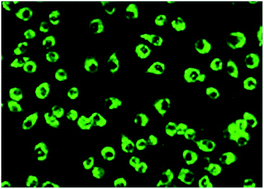
Bexarotene (BEX), a high-affinity agonist for retinoid X receptors (RXRs), shows apparent biological activities and distinct inhibitive efficacy in both cancer therapy and prevention. This study exploited a folate-decorated delivery of bexarotene-loaded bovine serum albumin nanoparticles, which could solubilize the poorly water-soluble drug and overcome the nonspecific targeting disadvantage. Bexarotene-loaded bovine serum albumin nanoparticles (BEX-BSANPs) were optimized by a desolvation technique, subsequently conjugated with folate by carbodiimide reaction. The resultant folate-modified bexarotene-loaded bovine serum albumin nanoparticles (FA-BEX-BSANPs) showed a spherical shape, with a diameter of 195.3 ± 5.6 nm, a zeta potential of ?33.64 ± 1.97 mV, and 71.28 ± 1.93 μg folate was coupled per mg BSA. Differential scanning calorimetry and X-ray diffraction analysis confirmed the amorphous state of bexarotene in the folate-conjugates. The in vitro drug release of bexarotene presented a controlled and sustained release pattern. The in vitro cytotoxicity, cell apoptosis and cellular uptake experiments of the nanoparticles were performed by MTT assay, propidium iodide staining, fluorescence microscopy and flow cytometric analysis on A549 and MCF-7 cancer cells. Both the BEX-BSANPs and FA-BEX-BSANPs induced an enhanced cancer cell apoptotic effect in contrast to BEX solution. The cells showed an excellent binding for folate-modified nanoparticles. Especially, the interference effect on the cellular internalization process by an excess folic acid was relatively dramatic for the FR-positive MCF-7 cells in comparison to the modest change seen in the FR-negative A549 cell lines, indicating that the uptake was mediated by the folate receptors. Together these data suggested that the folate-modified bexarotene-loaded delivery system, which demonstrated better biocompatibility and potential superiority, could be an appropriate cancer therapy in targeting tumors in the future.
Recommended Literature
- [1] Evolution in surface coverage of CH3NH3PbI3?XClXvia heat assisted solvent vapour treatment and their effects on photovoltaic performance of devices Dhirendra K. Chaudhary,Pramendra Kumar,Lokendra KumarRSC Adv., 2016,6, 94731-94738 10.1039/C6RA18729C
- [2] Enabling shape memory and healable effects in a conjugated polymer by incorporating siloxane via dynamic imine bond? Yaling Zhang,Chunhui Dai,Shiwei Zhou,Bin LiuChem. Commun., 2018,54, 10092-10095 10.1039/C8CC05410J
- [3] Excitation energies from ground-state density-functionals by means of generator coordinates A. B. F. da Silva,K. CapellePhys. Chem. Chem. Phys., 2009,11, 4564-4569 10.1039/B902529D
- [4] Evolutionary de novo design of phenothiazine derivatives for dye-sensitized solar cells? Vishwesh Venkatraman,Marco Foscato,Vidar R. Jensen,Bj?rn K?re AlsbergJ. Mater. Chem. A, 2015,3, 9851-9860 10.1039/C5TA00625B
- [5] Enabling stable MnO2 matrix for aqueous zinc-ion battery cathodes? Yiding Jiao,Liqun Kang,Jasper Berry-Gair,Kit McColl,Jianwei Li,Haobo Dong,Hao Jiang,Ryan Wang,Furio Corà,Dan J. L. Brett,Ivan P. ParkinJ. Mater. Chem. A, 2020,8, 22075-22082 10.1039/D0TA08638J
- [6] Fast synthesis of red Li3BaSrLn3(WO4)8:Eu3+ phosphors for white LEDs under near-UV excitation by a microwave-assisted solid state reaction method and photoluminescence studies Bo Wei,Zhenyu Liu,Chen Xie,Shu Yang,Wentao Tang,Aiwei Gu,Wing-Tak Wong,Ka-Leung WongJ. Mater. Chem. C, 2015,3, 12322-12327 10.1039/C5TC03165F
- [7] Emulsion technologies for multicellular tumour spheroid radiation assays? Kay S. McMillan,Anthony G. McCluskey,Annette Sorensen,Marie Boyd,Michele ZagnoniAnalyst, 2016,141, 100-110 10.1039/C5AN01382H
- [8] Evolution and characterization of a benzylguanine-binding RNA aptamer? J. Xu,T. J. Carrocci,A. A. HoskinsChem. Commun., 2016,52, 549-552 10.1039/C5CC07605F
- [9] Fe/S-Catalyzed synthesis of 2-benzoylbenzoxazoles and 2-quinolylbenzoxazoles via redox condensation of o-nitrophenols with acetophenones and methylquinolines? Thi Thu Tram Nguyen,Thanh Binh NguyenOrg. Biomol. Chem., 2021,19, 6015-6020 10.1039/D1OB00976A
- [10] Dissociation of large gaseous serine clusters produces abundant protonated serine octamer Jacob S. Jordan,Evan R. WilliamsAnalyst, 2021,146, 2617-2625 10.1039/D1AN00273B

Journal Name:Journal of Materials Chemistry B
research_products
-

CAS no.: 89640-58-4

![1,2,3,4,5,6-Hexahydro-[2,3]bipyridinyl-6-ol](https://ossimg.kuujia.com/scimg/1271000/1270529-38-8x500.png)


![N-(3-cyanothiolan-3-yl)-2-[(2,2,2-trifluoroethyl)sulfanyl]pyridine-4-carboxamide](https://ossimg.kuujia.com/scimg/1444500/1444113-98-7x500.png)

![2,2-Difluoro-3-[methyl(2-methylbutyl)amino]propanoic acid](https://ossimg.kuujia.com/scimg/2138500/2138166-62-6x500.png)

![2-(1H-indol-3-yl)-N-{[6-(thiophen-2-yl)-[1,2,4]triazolo[4,3-b]pyridazin-3-yl]methyl}acetamide](https://ossimg.kuujia.com/scimg/2034500/2034271-14-0x500.png)