Essential oil from the raw and vinegar-processed Rhizoma Curcumae ameliorate CCl4-induced liver fibrosis: integrating network pharmacology and molecular mechanism evaluation?
Food & Function Pub Date: 2021-03-17 DOI: 10.1039/D0FO03052J
Abstract
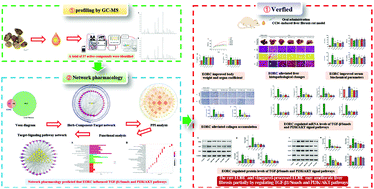
Liver fibrosis, caused by multiple chronic liver injuries, is a known contributor to cirrhosis and even liver cancer. As a Traditional Chinese Medicine (TCM), Rhizoma curcumae has been extensively used in the treatment of liver fibrosis with satisfying therapeutic effects; however, its mechanism is unclear. The essential oil is the main bioactive component. The purpose of this study was to investigate the chemical profile and the pharmacological mechanisms of the essential oil of Rhizoma curcumae (EORC) against liver fibrosis by combining network pharmacology and transcriptomic technologies. A total of 37 active compounds were identified using the GC/MS system and literature mining, and the corresponding putative targets were predicted. Then, network pharmacology method was applied to identify the 168 candidate targets of EORC-alleviated liver fibrosis. String database and Cytoscape software were used to build the herb-compound-target network and protein–protein interactions (PPIs) network. Functional and pathway enrichment analysis indicated that EORC significantly influenced TGF-β1/Smads and PI3K/AKT pathways. Experimentally, we verified that EORC attenuated the severity and pathological changes during liver fibrosis progression based on the CCl4-induced liver fibrosis rat model. Transcriptomic technologies demonstrated that EORC ameliorated liver fibrosis partially by regulating the TGF-β1/Smads and PI3K/AKT pathways. In addition, the effect of vinegar-processed EORC was more significant than that of the raw one. Therefore, EORC can alleviate the severity of liver fibrosis through mechanisms predicted by network pharmacology and provide a basis for the further understanding of the application of EORC in the treatment of liver fibrosis.
Recommended Literature
- [1] Emulsion soft templating of carbide-derived carbon nanospheres with controllable porosity for capacitive electrochemical energy storage? M. Zeiger,N. J?ckel,P. Strubel,L. Borchardt,R. Reinhold,W. Nickel,J. Eckert,V. Presser,S. KaskelJ. Mater. Chem. A, 2015,3, 17983-17990 10.1039/C5TA03730A
- [2] Excited state dynamics of symmetric and asymmetric Cr3(dpa)4Cl2 measured using femtosecond transient absorption spectroscopy? Chao-Han Cheng,Wen-Zhen Wang,Shie-Ming Peng,I-Chia ChenPhys. Chem. Chem. Phys., 2017,19, 25471-25477 10.1039/C7CP03968A
- [3] Exceptionally high temperature spin crossover in amide-functionalised 2,6-bis(pyrazol-1-yl)pyridine iron(ii) complex revealed by variable temperature Raman spectroscopy and single crystal X-ray diffraction? Max Attwood,Hiroki Akutsu,Lee Martin,Toby J. Blundell,Pierre Le Maguere,Scott S. TurnerDalton Trans., 2021,50, 11843-11851 10.1039/D1DT01743H
- [4] Distribution and ecological risk assessment of typical antibiotics in the surface waters of seven major rivers, China? Environ. Sci.: Processes Impacts, 2021,23, 1088-1100 10.1039/D1EM00079A
- [5] Fate of Sb(v) and Sb(iii) species along a gradient of pH and oxygen concentration in the Carnoulès mine waters (Southern France) Eléonore Resongles,Corinne Casiot,Fran?oise Elbaz-Poulichet,Rémi Freydier,Odile Bruneel,Christine Piot,Sophie Delpoux,Aurélie Volant,Angélique DesoeuvreEnviron. Sci.: Processes Impacts, 2013,15, 1536-1544 10.1039/C3EM00215B
- [6] Evolution of calcium phosphate precipitation in hanging drop vapor diffusion by in situRaman microspectroscopy Gloria Belén Ramírez-Rodríguez,José Manuel Delgado-López,Jaime Gómez-MoralesCrystEngComm, 2013,15, 2206-2212 10.1039/C2CE26556G
- [7] Fate of nitrogen-15 in the subsequent growing season of greenhouse tomato plants (Lycopersicon esculentum Mill) as influenced by alternate partial root-zone irrigation Maomao Hou,Fenglin Zhong,Qiu Jin,Enjiang Liu,Jie Feng,Tengyun Wang,Yue GaoRSC Adv., 2017,7, 34392-34400 10.1039/C7RA05271E
- [8] Evidence of CO2 molecule acting as an electron acceptor on a nanoporous metal–organic-framework MIL-53 or Cr3+(OH)(O2C–C6H4–CO2)? Alexandre Vimont,Arnaud Travert,Philippe Bazin,Jean-Claude Lavalley,Marco Daturi,Christian Serre,Gérard Férey,Sandrine Bourrelly,Philip L. LlewellynChem. Commun., 2007, 3291-3293 10.1039/B703468G
- [9] Excimer and exciplex formation in a pair of bright phosphorescent isomers constructed from Cu3(pyrazolate)3 and Cu3I3 coordination luminophores? Shun-Ze Zhan,Mian Li,Xiao-Ping Zhou,Dan Li,Seik Weng NgRSC Adv., 2011,1, 1457-1459 10.1039/C1RA00566A
- [10] Distribution characteristics of nitrogen and the related microbial community in the surface sediments of the Songhua River? Congyu Li,Wenfu Wang,Haiyan Wang,Guokai Yan,Weiyang Dong,Zhaosheng Chu,Huan Wang,Yang ChangRSC Adv., 2021,11, 26721-26731 10.1039/D1RA04903H

Journal Name:Food & Function
research_products
-

CAS no.: 89640-58-4


![N-(3-cyanothiolan-3-yl)-2-[(2,2,2-trifluoroethyl)sulfanyl]pyridine-4-carboxamide](https://ossimg.kuujia.com/scimg/1444500/1444113-98-7x500.png)

![1,2,3,4,5,6-Hexahydro-[2,3]bipyridinyl-6-ol](https://ossimg.kuujia.com/scimg/1271000/1270529-38-8x500.png)

![2,2-Difluoro-3-[methyl(2-methylbutyl)amino]propanoic acid](https://ossimg.kuujia.com/scimg/2138500/2138166-62-6x500.png)

![2-(1H-indol-3-yl)-N-{[6-(thiophen-2-yl)-[1,2,4]triazolo[4,3-b]pyridazin-3-yl]methyl}acetamide](https://ossimg.kuujia.com/scimg/2034500/2034271-14-0x500.png)