Efficient syntheses and anti-cancer activity of xenortides A–D including ent/epi-stereoisomers?
Organic & Biomolecular Chemistry Pub Date: 2018-07-05 DOI: 10.1039/C8OB00452H
Abstract
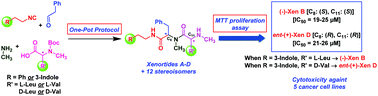
A one-pot, two-step, total synthesis of naturally occurring xenortides A, B, C and D, (Xens A–D) isolated from the bacterium Xenorhabdus nematophila, and an entire complementary set of stereoisomers, has been achieved. Compounds were synthesized utilizing an isocyanide-based Ugi 4-CR followed by facile N-Boc deprotection. The reaction sequence took advantage of the chiral pool of N-Boc protected amino acids (L-Leu/Val and D-Leu/Val) with aryl isocyanides, phenyl acetaldehyde and methylamine giving the desired Xens A–D (A and B >98% ee) and all subsequent stereoisomers in reasonable yields upon deprotection followed by separation of diastereomers. Also, detailed mechanistic insights for diastereoselectivity of (?)-Xen A, as a model in the Ugi 4-CR, has been described. Moreover, for the first time, this focused library was screened for cytotoxicity against a panel of epithelial cancer cell lines as well as normal cell lines with an MTT proliferation assay. The structure–activity relationship (SAR) study demonstrated that tryptamides Xen B and D were more active than phenylethylamides Xen A and C. Furthermore, (?)-Xen B (IC50 = 19–25 μM) and ent-(+)-Xen D (IC50 = 21–26 μM) gave the highest cytotoxicity and they were also found to be non-toxic toward normal cells. Importantly, the SAR results indicate that the stereochemistry at C8 and C11 in (?)-Xen B and ent-(+)-Xen D play a critical role in cytotoxic activity.
Recommended Literature
- [1] Excellent mechanical performance and enhanced dielectric properties of OBC/SiO2 elastomeric nanocomposites: effect of dispersion of the SiO2 nanoparticles? Xing Zhao,Lu Bai,Rui-Ying Bao,Zheng-Ying Liu,Ming-Bo Yang,Wei YangRSC Adv., 2017,7, 46297-46305 10.1039/C7RA08074C
- [2] Estimates of hydride ion stability in condensed systems: energy of formation and solvation in aqueous and polar-organic solvents Craig A. Kelly,David R. RosseinskyPhys. Chem. Chem. Phys., 2001,3, 2086-2090 10.1039/B010092G
- [3] Enabling stable MnO2 matrix for aqueous zinc-ion battery cathodes? Yiding Jiao,Liqun Kang,Jasper Berry-Gair,Kit McColl,Jianwei Li,Haobo Dong,Hao Jiang,Ryan Wang,Furio Corà,Dan J. L. Brett,Ivan P. ParkinJ. Mater. Chem. A, 2020,8, 22075-22082 10.1039/D0TA08638J
- [4] Exchanged ligands on the surface of a giant cluster: [(MoO3)176(H2O)63(CH3OH)17Hn](32 – n)– Chem. Commun., 1998, 1501-1502 10.1039/A801804I
- [5] Emulsion soft templating of carbide-derived carbon nanospheres with controllable porosity for capacitive electrochemical energy storage? M. Zeiger,N. J?ckel,P. Strubel,L. Borchardt,R. Reinhold,W. Nickel,J. Eckert,V. Presser,S. KaskelJ. Mater. Chem. A, 2015,3, 17983-17990 10.1039/C5TA03730A
- [6] Fe(iii)-mediated isomerization of α,α-diarylallylic alcohols to ketones via radical 1,2-aryl migration? Ziyang Deng,Changwei Chen,Sunliang CuiRSC Adv., 2016,6, 93753-93755 10.1039/C6RA20007A
- [7] Emerging 2D hybrid nanomaterials: towards enhanced sensitive and selective conductometric gas sensors at room temperature Hanie Hashtroudi,Ian D. R. MackinnonJ. Mater. Chem. C, 2020,8, 13108-13126 10.1039/D0TC01968B
- [8] Enabling chloride salts for thermal energy storage: implications of salt purity? J. Matthew Kurley,Phillip W. Halstenberg,Abbey McAlister,Stephen Raiman,Richard T. MayesRSC Adv., 2019,9, 25602-25608 10.1039/C9RA03133B
- [9] Excimer formation effects and trap-assisted charge recombination loss channels in organic solar cells of perylene diimide dimer acceptors? Min Kim,Jae-Joon Lee,Tengling Ye,Panagiotis E. Keivanidis,Kilwon ChoJ. Mater. Chem. C, 2020,8, 1686-1696 10.1039/C9TC04955J
- [10] Enabling high-throughput single-animal gene-expression studies with molecular and micro-scale technologies Jason WanLab Chip, 2020,20, 4528-4538 10.1039/D0LC00881H

Journal Name:Organic & Biomolecular Chemistry
research_products
-

CAS no.: 89640-58-4


![N-(3-cyanothiolan-3-yl)-2-[(2,2,2-trifluoroethyl)sulfanyl]pyridine-4-carboxamide](https://ossimg.kuujia.com/scimg/1444500/1444113-98-7x500.png)

![1,2,3,4,5,6-Hexahydro-[2,3]bipyridinyl-6-ol](https://ossimg.kuujia.com/scimg/1271000/1270529-38-8x500.png)

![2,2-Difluoro-3-[methyl(2-methylbutyl)amino]propanoic acid](https://ossimg.kuujia.com/scimg/2138500/2138166-62-6x500.png)

![2-(1H-indol-3-yl)-N-{[6-(thiophen-2-yl)-[1,2,4]triazolo[4,3-b]pyridazin-3-yl]methyl}acetamide](https://ossimg.kuujia.com/scimg/2034500/2034271-14-0x500.png)