Dynamics of proton, ion, molecule, and crystal lattice in functional molecular assemblies
Chemical Communications Pub Date: 2021-07-21 DOI: 10.1039/D1CC01586A
Abstract
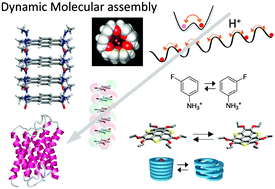
Dynamic molecular processes, such as short- or long-range proton (H+) and ion (M+) motions, and molecular rotations in electrical conducting and magnetic molecular assemblies enable the fabrication of electron–H+ (or M+) coupling systems, while crystal lattice dynamics and molecular conformation changes in hydrogen-bonded molecular crystals have been utilised in external stimuli responsive reversible gas-induced gate opening and molecular adsorption/desorption behavior. These dynamics of the polar structural units are responsible for the dielectric measurements. The H+ dynamics are formed from ferroelectrics and H+ conductors, while the dynamic M+ motions of Li+ and Na+ involve ionic conductors and coupling to the conduction electrons. In n-type organic semiconductors, the crystal lattices are modulated by replacing M+ cations, with cations such as Li+, Na+, K+, Rb+, and Cs+. The use of polar rotator or inversion structures such as alkyl amides, m-fluoroanilinium cations, and bowl-shaped trithiasumanene π-cores enables the formation of ferroelectric molecular assemblies. The host–guest molecular systems of ESIPT fluorescent chromic molecules showed interesting molecular sensing properties using various bases, where the dynamic transformation of the crystal lattice and the molecular conformational change were coupled to each other.
Recommended Literature
- [1] Emerging investigator series: kinetics of diopside reactivity for carbon mineralization in mafic–ultramafic rocks BrianaAguila,LandonHardee,H.ToddSchaef,SiavashZare,MohammadJavadAbdolhosseiniQomi,JarrodV.Crum,JadeE.HollimanJr.,ElenaTajueloRodriguez,LawrenceM.Anovitz,KevinM.Rosso,QuinR.S.Miller 10.1039/d3en00087g
- [2] Fate of Sb(v) and Sb(iii) species along a gradient of pH and oxygen concentration in the Carnoulès mine waters (Southern France) Eléonore Resongles,Corinne Casiot,Fran?oise Elbaz-Poulichet,Rémi Freydier,Odile Bruneel,Christine Piot,Sophie Delpoux,Aurélie Volant,Angélique DesoeuvreEnviron. Sci.: Processes Impacts, 2013,15, 1536-1544 10.1039/C3EM00215B
- [3] Excitable dynamics in the bromate–sulfite–ferrocyanide reaction J. Zagora,M. Vosla?,L. Schreiberová,I. SchreiberPhys. Chem. Chem. Phys., 2002,4, 1284-1291 10.1039/B110048C
- [4] Fast-Track to Research Data Management in Experimental Material Science-Setting the Ground for Research Group Level Materials Digitalization. LarsBanko,AlfredLudwig 10.1021/acscombsci.0c00057
- [5] Enantiomorphic symmetry breaking in crystallization of molten sodium chlorate? Martin R. Ward,Gary W. Copeland,Andrew J. AlexanderChem. Commun., 2010,46, 7634-7636 10.1039/C0CC02563A
- [6] Dissolved oxygen sensor based on fluorescence quenching of oxygen-sensitive ruthenium complexes immobilized in sol–gel-derived porous silica coatings Analyst, 1996,121, 785-788 10.1039/AN9962100785
- [7] Etching of glass microchips with supercritical water? Pavel Karásek,Jakub Grym,Michal Roth,Josef Planeta,Franti?ek ForetLab Chip, 2015,15, 311-318 10.1039/C4LC00843J
- [8] Emerging investigator series: bacteriophages as nano engineering tools for quality monitoring and pathogen detection in water and wastewater Fereshteh BayatEnviron. Sci.: Nano, 2021,8, 367-389 10.1039/D0EN00962H
- [9] Excellent peroxidase mimicking property of CuO/Pt nanocomposites and their application as an ascorbic acid sensor? Xinhuan Wang,Shuangfei Cai,Cui QiAnalyst, 2017,142, 2500-2506 10.1039/C7AN00589J
- [10] Esterase-responsive polymeric prodrug-based tumor targeting nanoparticles for improved anti-tumor performance against colon cancer? Gang Pan,Yi-jie Bao,Jie Xu,Tao Liu,Cheng Liu,Yan-yan Qiu,Xiao-jing Shi,Hui Yu,Ting-ting Jia,Xia Yuan,Ze-ting Yuan,Yi-jun CaoRSC Adv., 2016,6, 42109-42119 10.1039/C6RA05236C

Journal Name:Chemical Communications
research_products
-

CAS no.: 89640-58-4


![N-(3-cyanothiolan-3-yl)-2-[(2,2,2-trifluoroethyl)sulfanyl]pyridine-4-carboxamide](https://ossimg.kuujia.com/scimg/1444500/1444113-98-7x500.png)

![1,2,3,4,5,6-Hexahydro-[2,3]bipyridinyl-6-ol](https://ossimg.kuujia.com/scimg/1271000/1270529-38-8x500.png)

![2,2-Difluoro-3-[methyl(2-methylbutyl)amino]propanoic acid](https://ossimg.kuujia.com/scimg/2138500/2138166-62-6x500.png)

![2-(1H-indol-3-yl)-N-{[6-(thiophen-2-yl)-[1,2,4]triazolo[4,3-b]pyridazin-3-yl]methyl}acetamide](https://ossimg.kuujia.com/scimg/2034500/2034271-14-0x500.png)