Tuning the work function of polyaniline via camphorsulfonic acid: an X-ray photoelectron spectroscopy investigation
RSC Advances Pub Date: 2014-11-19 DOI: 10.1039/C4RA11832D
Abstract
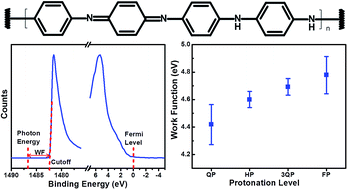
In this work, we present the first demonstration of tuning the work function of polyaniline by controlling the concentration level of camphorsulfonic acid as a protonic acid dopant and m-cresol as a solvent. Optical, thermal, structural, and electronic properties, along with surface topography and elemental analysis of protonated polyaniline, were studied in detail to investigate the effect of camphorsulfonic acid on the work function of polyaniline. The results showed that an increase in camphorsulfonic acid content induces a gradual transformation in the polyaniline structure from an emeraldine base to an emeraldine salt phase, which is associated with an increase in electrical conductivity and an improvement in crystallinity. X-ray photoelectron spectroscopy was used to evaluate the work function and to determine the elemental composition of the surface and several atomic layers beneath the surface. The results showed that increasing the camphorsulfonic acid content from quarter protonated to fully protonated leads to an increase in the work function of polyaniline from 4.42 ± 0.14 eV to 4.78 ± 0.13 eV.
Recommended Literature
- [1] Fatty acid positional distribution in colostrum and mature milk of women living in Inner Mongolia, North Jiangsu and Guangxi of China? Long Deng,Qian Zou,Biao Liu,Wenhui Ye,Chengfei Zhuo,Li Chen,Ze-Yuan Deng,Ya-Wei Fan,Jing LiFood Funct., 2018,9, 4234-4245 10.1039/C8FO00787J
- [2] Examination of the hydrogen-bonding networks in small water clusters (n = 2–5, 13, 17) using absolutely localized molecular orbital energy decomposition analysis? Erika A. Cobar,Paul R. Horn,Robert G. Bergman,Martin Head-GordonPhys. Chem. Chem. Phys., 2012,14, 15328-15339 10.1039/C2CP42522J
- [3] Emulsion technologies for multicellular tumour spheroid radiation assays? Kay S. McMillan,Anthony G. McCluskey,Annette Sorensen,Marie Boyd,Michele ZagnoniAnalyst, 2016,141, 100-110 10.1039/C5AN01382H
- [4] Emerging investigator series: first-principles and thermodynamics comparison of compositionally-tuned delafossites: cation release from the (001) surface of complex metal oxides? Joseph W. Bennett,Diamond T. Jones,Blake G. Hudson,Joshua Melendez-Rivera,Robert J. Hamers,Sara E. MasonEnviron. Sci.: Nano, 2020,7, 1642-1651 10.1039/C9EN01304K
- [5] Evolutionary de novo design of phenothiazine derivatives for dye-sensitized solar cells? Vishwesh Venkatraman,Marco Foscato,Vidar R. Jensen,Bj?rn K?re AlsbergJ. Mater. Chem. A, 2015,3, 9851-9860 10.1039/C5TA00625B
- [6] Excimer–monomer switch: a reaction-based approach for selective detection of fluoride? Qiao Song,Angela Bamesberger,Lingyun Yang,Haley Houtwed,Haishi CaoAnalyst, 2014,139, 3588-3592 10.1039/C4AN00522H
- [7] Establishing the accuracy of position-specific carbon isotope analysis of propane by GC-pyrolysis-GC-IRMS ChangjieLiu,PengLiu,XiaofengWang,XiaoqiangLi,JuskeHorita 10.1002/rcm.9494
- [8] Evidence that the availability of an allylic hydrogen governs the regioselectivity of the Wacker oxidation Matthew J. Gaunt,Jinquan Yu,Jonathan B. SpencerChem. Commun., 2001, 1844-1845 10.1039/B103066N
- [9] Fe/S-Catalyzed synthesis of 2-benzoylbenzoxazoles and 2-quinolylbenzoxazoles via redox condensation of o-nitrophenols with acetophenones and methylquinolines? Thi Thu Tram Nguyen,Thanh Binh NguyenOrg. Biomol. Chem., 2021,19, 6015-6020 10.1039/D1OB00976A
- [10] Esterase-responsive polymeric prodrug-based tumor targeting nanoparticles for improved anti-tumor performance against colon cancer? Gang Pan,Yi-jie Bao,Jie Xu,Tao Liu,Cheng Liu,Yan-yan Qiu,Xiao-jing Shi,Hui Yu,Ting-ting Jia,Xia Yuan,Ze-ting Yuan,Yi-jun CaoRSC Adv., 2016,6, 42109-42119 10.1039/C6RA05236C

Journal Name:RSC Advances
research_products
-

CAS no.: 89640-58-4


![N-(3-cyanothiolan-3-yl)-2-[(2,2,2-trifluoroethyl)sulfanyl]pyridine-4-carboxamide](https://ossimg.kuujia.com/scimg/1444500/1444113-98-7x500.png)

![1,2,3,4,5,6-Hexahydro-[2,3]bipyridinyl-6-ol](https://ossimg.kuujia.com/scimg/1271000/1270529-38-8x500.png)

![2,2-Difluoro-3-[methyl(2-methylbutyl)amino]propanoic acid](https://ossimg.kuujia.com/scimg/2138500/2138166-62-6x500.png)

![2-(1H-indol-3-yl)-N-{[6-(thiophen-2-yl)-[1,2,4]triazolo[4,3-b]pyridazin-3-yl]methyl}acetamide](https://ossimg.kuujia.com/scimg/2034500/2034271-14-0x500.png)