Z-isomerization of retinoids through combination of monochromatic photoisomerization and metal catalysis?
Organic & Biomolecular Chemistry Pub Date: 2019-08-14 DOI: 10.1039/C9OB01645G
Abstract
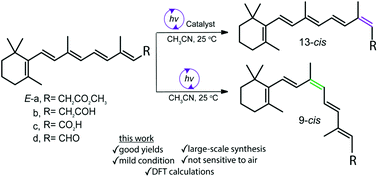
Catalytic Z-isomerization of retinoids to their thermodynamically less stable Z-isomer remains a challenge. In this report, we present a photochemical approach for the catalytic Z-isomerization of retinoids using monochromatic wavelength UV irradiation treatment. We have developed a straightforward approach for the synthesis of Z-retinoids in high yield, overcoming common obstacles normally associated with their synthesis. Calculations based on density functional theory (DFT) have allowed us to correlate the experimentally observed Z-isomer distribution of retinoids with the energies of chemically important intermediates, which include ground- and excited-state potential energy surfaces. We also demonstrate the application of the current method by synthesizing gram-scale quantities of 9-cis-retinyl acetate 9Z-a. Operational simplicity and gram-scale ability make this chemistry a very practical solution to the problem of Z-isomer retinoid synthesis.
Recommended Literature
- [1] An assay for the enzyme N-acetyl-β-d-glucosaminidase (NAGase) based on electrochemical detection using screen-printed carbon electrodes (SPCEs) R. M. Pemberton,J. P. Hart,T. T. MottramAnalyst, 2001,126, 1866-1871 10.1039/B104874K
- [2] An apparatus for determining small amounts of alchohol in sour milk and urine Analyst, 1964,89, 272-275 10.1039/AN9648900272
- [3] Aggregation of biologically important peptides and proteins: inhibition or acceleration depending on protein and metal ion concentrations Benjamin Gabriel Poulson,Kacper Szczepski,Joanna Izabela Lachowicz,Lukasz Jaremko,Abdul-Hamid Emwas,Mariusz JaremkoRSC Adv., 2020,10, 215-227 10.1039/C9RA09350H
- [4] An intermolecular C–H oxidizing strategy to access highly fused carbazole skeletons from simple naphthylamines? Christian K. Rank,Alexander W. Jones,Tatjana Wall,Patrick Di Martino-Fumo,Sarah Schr?ck,Markus Gerhards,Frederic W. PatureauChem. Commun., 2019,55, 13749-13752 10.1039/C9CC05240B
- [5] An automatic determination of thoria in thoria-urania mixtures Analyst, 1966,91, 208-210 10.1039/AN9669100208
- [6] Aggregation-induced emission enhancement in halochalcones? Patricia A. A. M. Vaz,Jo?o Rocha,Artur M. S. SilvaNew J. Chem., 2016,40, 8198-8201 10.1039/C6NJ01387B
- [7] An aptamer-based keypad lock system? Yaqing Liu,Jiangtao Ren,Jing Li,Jiyang Liu,Erkang WangChem. Commun., 2012,48, 802-804 10.1039/C1CC15979H
- [8] An artificial photosynthetic system for photoaccumulation of two electrons on a fused dipyridophenazine (dppz)–pyridoquinolinone ligand? Philipp Traber,Stephan Kupfer,Stefanie Gr?fe,Isabelle Baussanne,Martine Demeunynck,Jean-Marie Mouesca,Serge Gambarelli,Vincent Artero,Murielle Chavarot-KerlidouChem. Sci., 2018,9, 4152-4159 10.1039/C7SC04348A
- [9] Acentric and chiral heterometallic inorganic–organic hybrid frameworks mediated by alkali or alkaline earth ions: synthesis and NLO properties Huabin Zhang,Shaowu DuCrystEngComm, 2014,16, 4059-4068 10.1039/C3CE42419G
- [10] An approach to biodegradable star polymeric architectures using disulfide coupling? Jingquan Liu,Huiyun Liu,Zhongfan Jia,Volga Bulmus,Thomas P. DavisChem. Commun., 2008, 6582-6584 10.1039/B817037A

Journal Name:Organic & Biomolecular Chemistry
research_products
-

CAS no.: 89640-58-4


![N-(3-cyanothiolan-3-yl)-2-[(2,2,2-trifluoroethyl)sulfanyl]pyridine-4-carboxamide](https://ossimg.kuujia.com/scimg/1444500/1444113-98-7x500.png)

![1,2,3,4,5,6-Hexahydro-[2,3]bipyridinyl-6-ol](https://ossimg.kuujia.com/scimg/1271000/1270529-38-8x500.png)

![2,2-Difluoro-3-[methyl(2-methylbutyl)amino]propanoic acid](https://ossimg.kuujia.com/scimg/2138500/2138166-62-6x500.png)

![2-(1H-indol-3-yl)-N-{[6-(thiophen-2-yl)-[1,2,4]triazolo[4,3-b]pyridazin-3-yl]methyl}acetamide](https://ossimg.kuujia.com/scimg/2034500/2034271-14-0x500.png)