Zn-MOFs containing flexible α,ω-alkane (or alkene)-dicarboxylates with 1,2-bis(4-pyridyl)ethylene: comparison with Zn-MOFs containing 1,2-bis(4-pyridyl)ethane ligands?
CrystEngComm Pub Date: 2016-11-18 DOI: 10.1039/C6CE02122K
Abstract
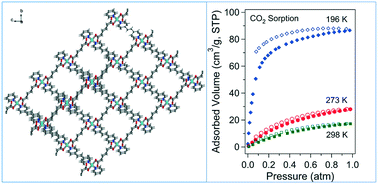
Flexible ditopic α,ω-alkane (or alkene)-dicarboxylate bridging ligands provided the following six Zn-MOFs with a 1,2-bis(4-pyridyl)ethylene (bpe) pillar (malonate (1-bpe), succinate (2-bpe), fumarate (3-bpe), glutarate (4-bpe), adipate (5-bpe), and muconate (6-bpe)). Newly-prepared 5-bpe and 6-bpe were structurally characterized. Both 3-bpe and 6-bpe formed three-dimensional (3-D), diamond-like frameworks with a 4-connected uninodal net and a Schl?fli symbol of 66. By contrast, 5-bpe formed a 3-D framework of a 6-connected uninodal net with a Schl?fli symbol of 412·63. 2-bpe formed a 2-D framework with a 4-connected uninodal net with a Schl?fli symbol of 44·62. 3-bpe and 6-bpe showed potential void spaces after solvent removal. Gas sorption analysis with N2, H2, and CO2 at a suitable temperature indicated that 6-bpe was an adsorbent with selectivity for CO2 adsorption at 196 K over N2 and H2. The CO2 uptake at 196 K was 86.68 cm3 g?1 (3.87 mmol g?1). 3-bpe did not exhibit appreciable uptake levels for N2, H2, and CO2, which was possibly due to the relatively rigid nonporous activated form of the framework after solvent removal. Both 3-bpe and 6-bpe exhibited a good encapsulating ability for molecular iodine in cyclohexane. The crystal structure of I2-containing 6-bpe_I2 was elucidated. A comparison with Zn-MOFs containing 1,2-bis(4-pyridyl)ethane ligands is discussed.
Recommended Literature
- [1] Evolution of important glucosinolates in three common Brassica vegetables during their processing into vegetable powder and in vitro gastric digestion Nan Fu,Naphaporn Chiewchan,Xiao Dong ChenFood Funct., 2020,11, 211-220 10.1039/C9FO00811J
- [2] Evolution of cellulose into flexible conductive green electronics: a smart strategy to fabricate sustainable electrodes for supercapacitors Tengfei Yu,Yuehan Wu,Wei Li,Bin LiRSC Adv., 2014,4, 34134-34143 10.1039/C4RA07017H
- [3] Emulsifier-free, organotellurium-mediated living radical emulsion polymerization (emulsion TERP) of styrene: poly(dimethylaminoethyl methacrylate) macro-TERP agent? Yukiya KitayamaPolym. Chem., 2014,5, 2784-2792 10.1039/C3PY01539D
- [4] Establishment and implications of a characterization method for magnetic nanoparticle using cell tracking velocimetry and magnetic susceptibility modified solutions Huading Zhang,Lee R. Moore,Maciej Zborowski,P. Stephen Williams,Shlomo Margel,Jeffrey J. ChalmersAnalyst, 2005,130, 514-527 10.1039/B412723D
- [5] Ester-directed orthogonal dual C–H activation and ortho aryl C–H alkenylation via distal weak coordination? Manickam Bakthadoss,Tadiparthi Thirupathi Reddy,Vishal Agarwal,Duddu S. SharadaChem. Commun., 2022,58, 1406-1409 10.1039/D1CC06097J
- [6] Evolution of calcium phosphate precipitation in hanging drop vapor diffusion by in situRaman microspectroscopy Gloria Belén Ramírez-Rodríguez,José Manuel Delgado-López,Jaime Gómez-MoralesCrystEngComm, 2013,15, 2206-2212 10.1039/C2CE26556G
- [7] Establishing plasmon contribution to chemical reactions: alkoxyamines as a thermal probe? Olga Guselnikova,Gérard Audran,Jean-Patrick Joly,Andrii Trelin,Evgeny V. Tretyakov,Vaclav Svorcik,Oleksiy Lyutakov,Sylvain R. A. MarqueChem. Sci., 2021,12, 4154-4161 10.1039/D0SC06470J
- [8] Evidence for the intrinsic nature of band-gap states electrochemically observed on atomically flat TiO2(110) surfaces? Shintaro Takata,Yoshihiro MiuraPhys. Chem. Chem. Phys., 2014,16, 24784-24789 10.1039/C4CP03280B
- [9] Excellent humidity sensor based on ultrathin HKUST-1 nanosheets? Qiaoe Wang,Meiling Lian,Xiaowen Zhu,Xu ChenRSC Adv., 2021,11, 192-197 10.1039/D0RA08354B
- [10] Empowering microfluidics by micro-3D printing and solution-based mineral coating? Hongxia Li,Aikifa Raza,Qiaoyu Ge,Jin-You Lu,TieJun ZhangSoft Matter, 2020,16, 6841-6849 10.1039/D0SM00958J

Journal Name:CrystEngComm
research_products
-

CAS no.: 89640-58-4

![1,2,3,4,5,6-Hexahydro-[2,3]bipyridinyl-6-ol](https://ossimg.kuujia.com/scimg/1271000/1270529-38-8x500.png)


![N-(3-cyanothiolan-3-yl)-2-[(2,2,2-trifluoroethyl)sulfanyl]pyridine-4-carboxamide](https://ossimg.kuujia.com/scimg/1444500/1444113-98-7x500.png)

![2,2-Difluoro-3-[methyl(2-methylbutyl)amino]propanoic acid](https://ossimg.kuujia.com/scimg/2138500/2138166-62-6x500.png)

![2-(1H-indol-3-yl)-N-{[6-(thiophen-2-yl)-[1,2,4]triazolo[4,3-b]pyridazin-3-yl]methyl}acetamide](https://ossimg.kuujia.com/scimg/2034500/2034271-14-0x500.png)