Unimolecular reaction energies for polycyclic aromatic hydrocarbon ions?
Physical Chemistry Chemical Physics Pub Date: 2018-02-09 DOI: 10.1039/C7CP07369K
Abstract
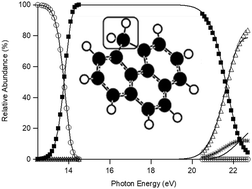
Imaging photoelectron photoion coincidence spectroscopy was employed to explore the unimolecular dissociation of the ionized polycyclic aromatic hydrocarbons (PAHs) acenaphthylene, fluorene, cyclopenta[d,e,f]phenanthrene, pyrene, perylene, fluoranthene, dibenzo[a,e]pyrene, dibenzo[a,l]pyrene, coronene and corannulene. The primary reaction is always hydrogen atom loss, with the smaller species also exhibiting loss of C2H2 to varying extents. Combined with previous work on smaller PAH ions, trends in the reaction energies (E0) for loss of H from sp2-C and sp3-C centres, along with hydrocarbon molecule loss were found as a function of the number of carbon atoms in the ionized PAHs ranging in size from naphthalene to coronene. In the case of molecules which possessed at least one sp3-C centre, the activation energy for the loss of an H atom from this site was 2.34 eV, with the exception of cyclopenta[d,e,f]phenanthrene (CPP) ions, for which the E0 was 3.44 ± 0.86 eV due to steric constraints. The hydrogen loss from PAH cations and from their H-loss fragments exhibits two trends, depending on the number of unpaired electrons. For the loss of the first hydrogen atom, the energy is consistently ca. 4.40 eV, while the threshold to lose the second hydrogen atom is much lower at ca. 3.16 eV. The only exception was for the dibenzo[a,l]pyrene cation, which has a unique structure due to steric constraints, resulting in a low H loss reaction energy of 2.85 eV. If C2H2 is lost directly from the precursor cation, the energy required for this dissociation is 4.16 eV. No other fragmentation channels were observed over a large enough sample set for trends to be extrapolated, though data on CH3 and C4H2 loss obtained in previous studies is included for completeness. The dissociation reactions were also studied by collision induced dissociation after ionization by atmospheric pressure chemical ionization. When modeled with a simple temperature-based theory for the post-collision internal energy distribution, there was reasonable agreement between the two sets of data.
Recommended Literature
- [1] Evolving better nanoparticles: Genetic algorithms for optimising cluster geometries Dalton Trans., 2003, 4193-4207 10.1039/B305686D
- [2] Excitation energies from ground-state density-functionals by means of generator coordinates A. B. F. da Silva,K. CapellePhys. Chem. Chem. Phys., 2009,11, 4564-4569 10.1039/B902529D
- [3] Exchanged ligands on the surface of a giant cluster: [(MoO3)176(H2O)63(CH3OH)17Hn](32 – n)– Chem. Commun., 1998, 1501-1502 10.1039/A801804I
- [4] Dissolution of cork biopolymers in biocompatible ionic liquids Helga Garcia,Rui Ferreira,Marija Petkovic,Jamie L. Ferguson,Maria C. Leit?o,H. Q. Nimal Gunaratne,Luís Paulo N. RebeloGreen Chem., 2010,12, 367-369 10.1039/B922553F
- [5] Evolution of hierarchical porous structures in supramolecular guest–host hydrogels? Christopher B. Rodell,Christopher B. Highley,Minna H. Chen,Neville N. Dusaj,Chao Wang,Lin Han,Jason A. BurdickSoft Matter, 2016,12, 7839-7847 10.1039/C6SM01395C
- [6] Exceptionally high temperature spin crossover in amide-functionalised 2,6-bis(pyrazol-1-yl)pyridine iron(ii) complex revealed by variable temperature Raman spectroscopy and single crystal X-ray diffraction? Max Attwood,Hiroki Akutsu,Lee Martin,Toby J. Blundell,Pierre Le Maguere,Scott S. TurnerDalton Trans., 2021,50, 11843-11851 10.1039/D1DT01743H
- [7] Embedding cyclic nitrone in mesoporous silica particles for EPR spin trapping of superoxide and other radicals? Eric Besson,Stéphane Gastaldi,Emily Bloch,Selma Aslan,Hakim Karoui,Olivier Ouari,Micael HardyAnalyst, 2019,144, 4194-4203 10.1039/C9AN00468H
- [8] Evolution of dealloying induced strain in nanoporous gold crystals? Ross Harder,David C. Dunand,Ian McNultyNanoscale, 2017,9, 5686-5693 10.1039/C6NR09635B
- [9] Fe3O4 nanoclusters highly dispersed on a porous graphene support as an additive for improving the hydrogen storage properties of LiBH4? Guang Xu,Wei Zhang,Ying Zhang,Xiaoxia Zhao,Ping Wen,Di MaRSC Adv., 2018,8, 19353-19361 10.1039/C8RA02762E
- [10] Evidence that the availability of an allylic hydrogen governs the regioselectivity of the Wacker oxidation Matthew J. Gaunt,Jinquan Yu,Jonathan B. SpencerChem. Commun., 2001, 1844-1845 10.1039/B103066N

Journal Name:Physical Chemistry Chemical Physics
research_products
-

CAS no.: 89640-58-4


![N-(3-cyanothiolan-3-yl)-2-[(2,2,2-trifluoroethyl)sulfanyl]pyridine-4-carboxamide](https://ossimg.kuujia.com/scimg/1444500/1444113-98-7x500.png)

![1,2,3,4,5,6-Hexahydro-[2,3]bipyridinyl-6-ol](https://ossimg.kuujia.com/scimg/1271000/1270529-38-8x500.png)

![2,2-Difluoro-3-[methyl(2-methylbutyl)amino]propanoic acid](https://ossimg.kuujia.com/scimg/2138500/2138166-62-6x500.png)

![2-(1H-indol-3-yl)-N-{[6-(thiophen-2-yl)-[1,2,4]triazolo[4,3-b]pyridazin-3-yl]methyl}acetamide](https://ossimg.kuujia.com/scimg/2034500/2034271-14-0x500.png)