Systematic investigation of hydrogen-bond propensities for informing co-crystal design and assembly?
CrystEngComm Pub Date: 2019-10-02 DOI: 10.1039/C9CE01196J
Abstract
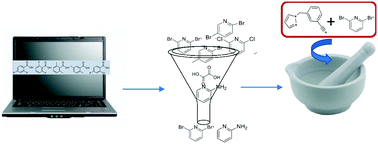
Co-crystallizations can be utilized for generating new solid forms of a target substance in order to alter or enhance some specific bulk physical property. Generally, selection of the co-former (the necessary partner for the target molecule) is based on existing structural information about molecular recognition events involving complementary functional groups, and extensive experimental screening methods. In this study, we utilize structure-informatics in an attempt to predict if two different molecules will form a co-crystal or not. Our study is based on hydrogen-bond propensity (HBP), and the key premise of our approach rests on whether target–co-former interactions are more likely to take place than either target–target or co-former–co-former hydrogen bonds. We examined six different target molecules in combination with 25 possible co-formers each and used the HBP protocol for predicting if a co-crystal would form or not. The predictions were then compared with results from an experimental co-crystal screen of the 150 different combinations. The correct outcome was successfully predicted 92–95% of the time which shows that for this series of small molecules, HBP is a very reliable indicator for determining if a co-crystal will form between a target molecule and a particular co-former.
Recommended Literature
- [1] Embedding cyclic nitrone in mesoporous silica particles for EPR spin trapping of superoxide and other radicals? Eric Besson,Stéphane Gastaldi,Emily Bloch,Selma Aslan,Hakim Karoui,Olivier Ouari,Micael HardyAnalyst, 2019,144, 4194-4203 10.1039/C9AN00468H
- [2] Emerging enantiomeric resolution materials with homochiral nano-fabrications Ji-Ping WeiNanoscale, 2015,7, 11815-11832 10.1039/C5NR03048J
- [3] Excellent energy storage performance in NaNbO3-based relaxor antiferroeic ceramics under a low electric field XuxinCheng,XiaomingChen,PengyuanFan 10.1007/s10832-022-00283-w
- [4] Empowering microfluidics by micro-3D printing and solution-based mineral coating? Hongxia Li,Aikifa Raza,Qiaoyu Ge,Jin-You Lu,TieJun ZhangSoft Matter, 2020,16, 6841-6849 10.1039/D0SM00958J
- [5] Emerging 2D hybrid nanomaterials: towards enhanced sensitive and selective conductometric gas sensors at room temperature Hanie Hashtroudi,Ian D. R. MackinnonJ. Mater. Chem. C, 2020,8, 13108-13126 10.1039/D0TC01968B
- [6] Emerging investigator series: bacteriophages as nano engineering tools for quality monitoring and pathogen detection in water and wastewater Fereshteh BayatEnviron. Sci.: Nano, 2021,8, 367-389 10.1039/D0EN00962H
- [7] Emerging investigator series: kinetics of diopside reactivity for carbon mineralization in mafic–ultramafic rocks BrianaAguila,LandonHardee,H.ToddSchaef,SiavashZare,MohammadJavadAbdolhosseiniQomi,JarrodV.Crum,JadeE.HollimanJr.,ElenaTajueloRodriguez,LawrenceM.Anovitz,KevinM.Rosso,QuinR.S.Miller 10.1039/d3en00087g
- [8] Excellent mechanical performance and enhanced dielectric properties of OBC/SiO2 elastomeric nanocomposites: effect of dispersion of the SiO2 nanoparticles? Xing Zhao,Lu Bai,Rui-Ying Bao,Zheng-Ying Liu,Ming-Bo Yang,Wei YangRSC Adv., 2017,7, 46297-46305 10.1039/C7RA08074C
- [9] Evidence of rutile-to-anatase photo-induced electron transfer in mixed-phase TiO2 by solid-state NMR spectroscopy? Weili Dai,Guangjun Wu,Michael HungerChem. Commun., 2015,51, 13779-13782 10.1039/C5CC04971G
- [10] Dissociative electron attachment to HGaF4 Lewis–Br?nsted superacid Marcin Czapla,Jack SimonsPhys. Chem. Chem. Phys., 2018,20, 21739-21745 10.1039/C8CP04007A

Journal Name:CrystEngComm
research_products
-

CAS no.: 89640-58-4


![N-(3-cyanothiolan-3-yl)-2-[(2,2,2-trifluoroethyl)sulfanyl]pyridine-4-carboxamide](https://ossimg.kuujia.com/scimg/1444500/1444113-98-7x500.png)

![1,2,3,4,5,6-Hexahydro-[2,3]bipyridinyl-6-ol](https://ossimg.kuujia.com/scimg/1271000/1270529-38-8x500.png)

![2,2-Difluoro-3-[methyl(2-methylbutyl)amino]propanoic acid](https://ossimg.kuujia.com/scimg/2138500/2138166-62-6x500.png)

![2-(1H-indol-3-yl)-N-{[6-(thiophen-2-yl)-[1,2,4]triazolo[4,3-b]pyridazin-3-yl]methyl}acetamide](https://ossimg.kuujia.com/scimg/2034500/2034271-14-0x500.png)