A theoretical investigation on the atmospheric degradation of the radical: reactions with NO, NO2, and NO3?
Environmental Science: Processes & Impacts Pub Date: 2020-05-29 DOI: 10.1039/D0EM00112K
Abstract
The  radical is the key intermediate in the atmospheric oxidation of benzaldehyde, and its further chemistry contributes to local air pollution. The reaction mechanisms of the
  radical with NO, NO2,
  and NO3 were studied by quantum chemistry calculations at the CCSD(T)/CBS//M06-2X/def2-TZVP level of theory. The explicit potential energy curves were provided in order to reveal the atmospheric fate of the
  radical comprehensively. The main products of the reaction of
  with NO are predicted to be
  , CO2 and NO2. The reaction of
  with NO2 is reversible, and its main product would be C6H5C(O)O2NO2 which was predicted to be more stable than PAN (peroxyacetyl nitrate) at room temperature. The decomposition of C6H5C(O)O2NO2 at different ambient temperatures would be a potential long-range transport source of NOx in the atmosphere. The predominant products of the reaction
 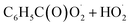 are predicted to be C6H5C(O)O2H, C6H5C(O)OH, O2 and O3, while HO˙ is of minor importance. So, the reaction of
  with
with  would be an important source of ozone and carboxylic acids in the local atmosphere, and has less contribution to the regeneration of HO˙ radicals. The reaction of
  with NO3 should mainly produce
  , CO2, O2 and NO2, which might play an important role in atmospheric chemistry of peroxy radicals at night, but has less contribution to the night-time conversion of
  (
( and RO˙) to
  (
( and HO˙) in the local atmosphere. The results above are in good accordance with the reported experimental observations.

Recommended Literature
- [1] Dissociative electron attachment to HGaF4 Lewis–Br?nsted superacid Marcin Czapla,Jack SimonsPhys. Chem. Chem. Phys., 2018,20, 21739-21745 10.1039/C8CP04007A
- [2] Fc microparticles can modulate the physical extent and magnitude of complement activity? David White,Sean R. StowellBiomater. Sci., 2017,5, 463-474 10.1039/C6BM00608F
- [3] Emergence of cationic polyamine dendrimersomes: design, stimuli sensitivity and potential biomedical applications Partha Laskar,Christine DufèsNanoscale Adv., 2021,3, 6007-6026 10.1039/D1NA00536G
- [4] Fe(iii)-mediated isomerization of α,α-diarylallylic alcohols to ketones via radical 1,2-aryl migration? Ziyang Deng,Changwei Chen,Sunliang CuiRSC Adv., 2016,6, 93753-93755 10.1039/C6RA20007A
- [5] Fe3O4 nanoclusters highly dispersed on a porous graphene support as an additive for improving the hydrogen storage properties of LiBH4? Guang Xu,Wei Zhang,Ying Zhang,Xiaoxia Zhao,Ping Wen,Di MaRSC Adv., 2018,8, 19353-19361 10.1039/C8RA02762E
- [6] Evolution of important glucosinolates in three common Brassica vegetables during their processing into vegetable powder and in vitro gastric digestion Nan Fu,Naphaporn Chiewchan,Xiao Dong ChenFood Funct., 2020,11, 211-220 10.1039/C9FO00811J
- [7] Emergence of microfluidic wearable technologies Joo Chuan Yeo,KenryLab Chip, 2016,16, 4082-4090 10.1039/C6LC00926C
- [8] Evolution of shape, size, and areal density of a single plane of Si nanocrystals embedded in SiO2 matrix studied by atom probe tomography Bin Han,Yasuo Shimizu,Gabriele Seguini,Celia Castro,Gérard Ben Assayag,Koji Inoue,Yasuyoshi Nagai,Sylvie Schamm-Chardon,Michele PeregoRSC Adv., 2016,6, 3617-3622 10.1039/C5RA26710B
- [9] Evidence of field induced slow magnetic relaxation in cis-[Co(hfac)2(H2O)2] exhibiting tri-axial anisotropy with a negative axial component? Denis V. Korchagin,Elena A. Yureva,Alexander V. Akimov,Eugenii Ya. Misochko,Gennady V. Shilov,Artem D. Talantsev,Roman B. Morgunov,Alexander A. Shakin,Sergey M. Aldoshin,Boris S. TsukerblatDalton Trans., 2017,46, 7540-7548 10.1039/C7DT01236E
- [10] Fate of nitrogen-15 in the subsequent growing season of greenhouse tomato plants (Lycopersicon esculentum Mill) as influenced by alternate partial root-zone irrigation Maomao Hou,Fenglin Zhong,Qiu Jin,Enjiang Liu,Jie Feng,Tengyun Wang,Yue GaoRSC Adv., 2017,7, 34392-34400 10.1039/C7RA05271E
Journal Name:Environmental Science: Processes & Impacts
research_products
-

CAS no.: 89640-58-4

![1,2,3,4,5,6-Hexahydro-[2,3]bipyridinyl-6-ol](https://ossimg.kuujia.com/scimg/1271000/1270529-38-8x500.png)


![N-(3-cyanothiolan-3-yl)-2-[(2,2,2-trifluoroethyl)sulfanyl]pyridine-4-carboxamide](https://ossimg.kuujia.com/scimg/1444500/1444113-98-7x500.png)

![2,2-Difluoro-3-[methyl(2-methylbutyl)amino]propanoic acid](https://ossimg.kuujia.com/scimg/2138500/2138166-62-6x500.png)

![2-(1H-indol-3-yl)-N-{[6-(thiophen-2-yl)-[1,2,4]triazolo[4,3-b]pyridazin-3-yl]methyl}acetamide](https://ossimg.kuujia.com/scimg/2034500/2034271-14-0x500.png)