Transition-metal mediated carbon–sulfur bond activation and transformations: an update
Chemical Society Reviews Pub Date: 2020-05-27 DOI: 10.1039/C9CS00837C
Abstract
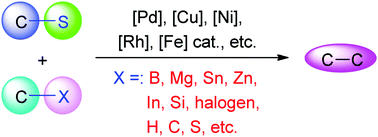
Carbon–sulfur bond cross-coupling has become more and more attractive as an alternative protocol to establish carbon–carbon and carbon–heteroatom bonds. Diverse transformations through transition-metal-catalyzed C–S bond activation and cleavage have recently been developed. This review summarizes the advances in transition-metal-catalyzed cross-coupling via carbon–sulfur bond activation and cleavage since late 2012 as an update of the critical review on the same topic published in early 2013 (Chem. Soc. Rev., 2013, 42, 599–621), which is presented by the categories of organosulfur compounds, that is, thioesters, thioethers including heteroaryl, aryl, vinyl, alkyl, and alkynyl sulfides, ketene dithioacetals, sulfoxides including DMSO, sulfones, sulfonyl chlorides, sulfinates, thiocyanates, sulfonium salts, sulfonyl hydrazides, sulfonates, thiophene-based compounds, and C![[double bond, length as m-dash]](https://www.rsc.org/images/entities/char_e001.gif) S functionality-bearing compounds such as thioureas, thioamides, and carbon disulfide, as well as the mechanistic insights. An overview of C–S bond cleavage reactions with stoichiometric transition-metal reagents is briefly given. Theoretical studies on the reactivity of carbon–sulfur bonds by DFT calculations are also discussed.
S functionality-bearing compounds such as thioureas, thioamides, and carbon disulfide, as well as the mechanistic insights. An overview of C–S bond cleavage reactions with stoichiometric transition-metal reagents is briefly given. Theoretical studies on the reactivity of carbon–sulfur bonds by DFT calculations are also discussed.
Recommended Literature
- [1] Fatty acid positional distribution in colostrum and mature milk of women living in Inner Mongolia, North Jiangsu and Guangxi of China? Long Deng,Qian Zou,Biao Liu,Wenhui Ye,Chengfei Zhuo,Li Chen,Ze-Yuan Deng,Ya-Wei Fan,Jing LiFood Funct., 2018,9, 4234-4245 10.1039/C8FO00787J
- [2] Establishing plasmon contribution to chemical reactions: alkoxyamines as a thermal probe? Olga Guselnikova,Gérard Audran,Jean-Patrick Joly,Andrii Trelin,Evgeny V. Tretyakov,Vaclav Svorcik,Oleksiy Lyutakov,Sylvain R. A. MarqueChem. Sci., 2021,12, 4154-4161 10.1039/D0SC06470J
- [3] Examination of the hydrogen-bonding networks in small water clusters (n = 2–5, 13, 17) using absolutely localized molecular orbital energy decomposition analysis? Erika A. Cobar,Paul R. Horn,Robert G. Bergman,Martin Head-GordonPhys. Chem. Chem. Phys., 2012,14, 15328-15339 10.1039/C2CP42522J
- [4] Enabling high-throughput single-animal gene-expression studies with molecular and micro-scale technologies Jason WanLab Chip, 2020,20, 4528-4538 10.1039/D0LC00881H
- [5] Excited state dynamics of symmetric and asymmetric Cr3(dpa)4Cl2 measured using femtosecond transient absorption spectroscopy? Chao-Han Cheng,Wen-Zhen Wang,Shie-Ming Peng,I-Chia ChenPhys. Chem. Chem. Phys., 2017,19, 25471-25477 10.1039/C7CP03968A
- [6] Emerging 2D hybrid nanomaterials: towards enhanced sensitive and selective conductometric gas sensors at room temperature Hanie Hashtroudi,Ian D. R. MackinnonJ. Mater. Chem. C, 2020,8, 13108-13126 10.1039/D0TC01968B
- [7] Excellent humidity sensor based on ultrathin HKUST-1 nanosheets? Qiaoe Wang,Meiling Lian,Xiaowen Zhu,Xu ChenRSC Adv., 2021,11, 192-197 10.1039/D0RA08354B
- [8] Fe3O4 nanosphere@microporous organic networks: enhanced anode performances in lithium ion batteries through carbonization? Byungho Lim,Jaewon Jin,Jin Yoo,Seung Yong Han,Kyeongyeol Kim,Sungah Kang,Nojin Park,Sang Moon Lee,Hae Jin Kim,Seung Uk SonChem. Commun., 2014,50, 7723-7726 10.1039/C4CC02068E
- [9] Exceptional activity of sub-nm Pt clusters on CdS for photocatalytic hydrogen production: a combined experimental and first-principles study? Qiyuan Wu,Shangmin Xiong,Peichuan Shen,Shen Zhao,Alexander OrlovCatal. Sci. Technol., 2015,5, 2059-2064 10.1039/C4CY01563K
- [10] Establishing new scaling relations on two-dimensional MXenes for CO2 electroreduction? Albertus D. Handoko,Khoong Hong Khoo,Teck Leong Tan,Hongmei Jin,Zhi Wei SehJ. Mater. Chem. A, 2018,6, 21885-21890 10.1039/C8TA06567E

Journal Name:Chemical Society Reviews
research_products
-

CAS no.: 89640-58-4


![N-(3-cyanothiolan-3-yl)-2-[(2,2,2-trifluoroethyl)sulfanyl]pyridine-4-carboxamide](https://ossimg.kuujia.com/scimg/1444500/1444113-98-7x500.png)

![1,2,3,4,5,6-Hexahydro-[2,3]bipyridinyl-6-ol](https://ossimg.kuujia.com/scimg/1271000/1270529-38-8x500.png)

![2,2-Difluoro-3-[methyl(2-methylbutyl)amino]propanoic acid](https://ossimg.kuujia.com/scimg/2138500/2138166-62-6x500.png)

![2-(1H-indol-3-yl)-N-{[6-(thiophen-2-yl)-[1,2,4]triazolo[4,3-b]pyridazin-3-yl]methyl}acetamide](https://ossimg.kuujia.com/scimg/2034500/2034271-14-0x500.png)