Screening and quantification of 304 pesticides and related organic pollutants in surface water using dispersive liquid–liquid microextraction coupled with gas chromatography-mass spectrometry?
Analytical Methods Pub Date: 2014-01-08 DOI: 10.1039/C3AY42238K
Abstract
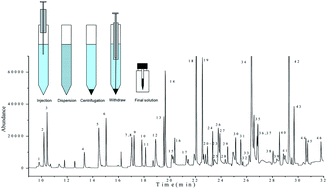
Dispersive liquid–liquid microextraction (DLLME) coupled with gas chromatography-mass spectrometry (GC-MS) was used to quantify and semi-quantify 304 pesticides and related organic pollutants in surface water. Extraction parameters including types and volumes of extraction solvent, disperser solvent, and the amount of salt addition were optimized to obtain highest recoveries and lowest detection limits. A mixture of 35 μL carbon tetrachloride (extraction solvent) and 1 mL acetone (disperser solvent) was added into 5 mL of water sample. After agitation and centrifugation, 20 μL of the sedimented phase was mixed with 1 μL of the internal standard solution, and 1 μL of the final solution was injected into GC-MS for separation and quantification. The enrichment factors ranging from 42- to 299-fold were obtained for all compounds. The limits of detection ranged from 0.001 to 1.125 μg L?1, and the limits of quantification ranged from 0.003 to 3.75 μg L?1. Of all 304 compounds, 90 compounds showed recoveries from 60% to 120% and RSDs lower than 20%. The proposed method is very low cost, rapid and convenient, and could be an effective method for the monitoring of multiple pesticides in surface water.
Recommended Literature
- [1] Acetyl group orientation modulates the electronic ground-state asymmetry of the special pair in purple bacterial reaction centers P. K. Wawrzyniak,M. T. P. Beerepoot,H. J. M. de Groot,F. BudaPhys. Chem. Chem. Phys., 2011,13, 10270-10279 10.1039/C1CP20213H
- [2] An amorphous Cu–In–S nanoparticle-based precursor ink with improved atom economy for CuInSe2 solar cells with 10.85% efficiency? Green Chem., 2017,19, 1268-1277 10.1039/C6GC03280J
- [3] An amplified fluorescence detection of T4 polynucleotide kinase activity based on coupled exonuclease III reaction and a graphene oxide platform? Ni-Na Sun,Fengli Qu,Xiaobing Zhang,Shufang Zhang,Jinmao YouAnalyst, 2015,140, 1827-1831 10.1039/C4AN01953A
- [4] An astrophysically-relevant mechanism for amino acid enantiomer enrichment Stephen P. Fletcher,Richard B. C. Jagt,Ben L. FeringaChem. Commun., 2007, 2578-2580 10.1039/B702882B
- [5] An artificial CO-releasing metalloprotein built by histidine-selective metallation? Inês S. Albuquerque,Hélia F. Jeremias,Miguel Chaves-Ferreira,Dijana Matak-Vinkovic,Omar Boutureira,Carlos C. Rom?oChem. Commun., 2015,51, 3993-3996 10.1039/C4CC10204E
- [6] An atomistic mechanism for the degradation of perovskite solar cells by trapped charge? Eunhak Lim,Jiyoung Heo,Seong Keun KimNanoscale, 2019,11, 11369-11378 10.1039/C9NR02193K
- [7] An antimonate pyrochlore (H1.23Sr0.45SbO3.48) for photocatalytic oxidation of benzene: effective oxygen usage and excellent activity? Jing Chen,Yu Shao,Danzhen LiJ. Mater. Chem. A, 2017,5, 937-941 10.1039/C6TA08652G
- [8] An anti-leakage liquid metal thermal interface material Kaiyuan Huang,Wangkang Qiu,Meilian Ou,Xiaorui Liu,Zenan Liao,Sheng ChuRSC Adv., 2020,10, 18824-18829 10.1039/D0RA02351E
- [9] An assessment of strategies for the development of solid-state adsorbents for vehicular hydrogen storage Mark D. Allendorf,Alauddin Ahmed,Tom Autrey,Jeffrey Camp,Eun Seon Cho,Maciej Haranczyk,Abhi Karkamkar,Di-Jia Liu,Katie R. Meihaus,Iffat H. Nayyar,Roman Nazarov,Donald J. Siegel,Vitalie Stavila,Jeffrey J. Urban,Srimukh Prasad Veccham,Brandon C. WoodEnergy Environ. Sci., 2018,11, 2784-2812 10.1039/C8EE01085D
- [10] An artificial photosynthesis system comprising a covalent triazine framework as an electron relay facilitator for photochemical carbon dioxide reduction? Siquan Zhang,Shengyao Wang,Liping Guo,Hao Chen,Bien Tan,Shangbin JinJ. Mater. Chem. C, 2020,8, 192-200 10.1039/C9TC05297F

Journal Name:Analytical Methods
research_products
-

CAS no.: 89640-58-4


![N-(3-cyanothiolan-3-yl)-2-[(2,2,2-trifluoroethyl)sulfanyl]pyridine-4-carboxamide](https://ossimg.kuujia.com/scimg/1444500/1444113-98-7x500.png)

![1,2,3,4,5,6-Hexahydro-[2,3]bipyridinyl-6-ol](https://ossimg.kuujia.com/scimg/1271000/1270529-38-8x500.png)

![2,2-Difluoro-3-[methyl(2-methylbutyl)amino]propanoic acid](https://ossimg.kuujia.com/scimg/2138500/2138166-62-6x500.png)

![2-(1H-indol-3-yl)-N-{[6-(thiophen-2-yl)-[1,2,4]triazolo[4,3-b]pyridazin-3-yl]methyl}acetamide](https://ossimg.kuujia.com/scimg/2034500/2034271-14-0x500.png)